
Top Stories of 2025: A KPBS News Special
Special | 27m 30sVideo has Closed Captions
"Top Stories 2025: A KPBS News Special" is a look back at the news that shaped our region.
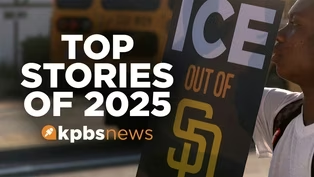
A look back at the news that shaped our region. This was a busy year for the KPBS newsroom. There were whistleblowers and in-depth investigations. Rising cost of living and a widening city budget gap. 2025 also marked President Trump's return to the White House, ushering in federal funding cuts, immigration raids and protests here in San Diego. Hear from the reporters who covered all the stories.
Problems playing video? | Closed Captioning Feedback
Problems playing video? | Closed Captioning Feedback
KPBS Specials is a local public television program presented by KPBS
Top Stories of 2025: A KPBS News Special
Special | 27m 30sVideo has Closed Captions
A look back at the news that shaped our region. This was a busy year for the KPBS newsroom. There were whistleblowers and in-depth investigations. Rising cost of living and a widening city budget gap. 2025 also marked President Trump's return to the White House, ushering in federal funding cuts, immigration raids and protests here in San Diego. Hear from the reporters who covered all the stories.
Problems playing video? | Closed Captioning Feedback
How to Watch KPBS Specials
KPBS Specials is available to stream on pbs.org and the free PBS App, available on iPhone, Apple TV, Android TV, Android smartphones, Amazon Fire TV, Amazon Fire Tablet, Roku, Samsung Smart TV, and Vizio.
♪♪♪ ♪♪♪ Maya Trabulsi: Hi, I'm Maya Trabulsi, anchor for KPBS Evening Edition.
On television, radio, and digital platforms, this was a busy year for the KPBS newsroom.
Much of it was shaped by the return of a president, his policies, and the protests that followed.
And that is where we start our look back on the top stories of 2025.
Donald Trump: I, Donald John Trump, do solemnly swear-- male: That I will faithfully execute-- Amita Sharma: Well, it has been an absolute whirlwind.
male: First, we have a list of pardons and commutations relating to events that occurred on January 6, 2021.
Amita: And I think we knew from the gate, from the first few days of the Trump administration, part two.
Donald: You don't have the cards right now.
With us, you start having cards, but-- Amita: That we were never going to be able to keep up with it, but what we could do is pull at the most important threads, and we did that.
male: Researchers told KPBS's Amita Sharma their work is now at risk if it contains language deemed problematic by the White House, including the word women.
Rebecca Fielding-Miller: If I can't say the word women, I can't tell you that an abortion ban is going to hurt women, or I can't document the way an abortion ban is hurting women.
I guess a word that's not on here is men, and I guess a word that I don't see on here is white, so I guess we'll see what's going on with white men and what they need.
Maya: Meanwhile, UCSD researchers have already been told to scrub their websites of diversity, equity, and inclusion language and the blows to federally funded scientific research at the university keep coming.
It just lost a $35 million USAID global research grant on reproductive health and nutrition, and other federal grants are in jeopardy.
Amita: It really impeded the ability of the scientists in our community to describe what they were researching accurately.
♪ We're so glad to see you here, Noah's here today.
♪♪ Maya: Twice a week, a group of three to six year olds and their parents gather in a small classroom in Spring Valley.
It's called the Parent Empowerment Program or PEP.
The goal is to give families the tools they need to overcome behaviors like tantrums, aggression, and separation anxiety.
Katie Anastas: This is a federal grant that came out of a bipartisan effort to fund more mental health support in schools after the school shooting in Uvalde, Texas.
Maya: The Department of Education awarded the La Mesa-Spring Valley School District more than $12 million over the course of five years.
In May, the Trump administration told school districts it would stop funding the grant program two years early.
Deann Ragsdale: And to have nobody come and even look at the work that we were doing, to talk about what we were doing, or to see what we were doing and how it's changing lives and have that just be stripped from us, it was shocking, it was sad, it made me angry.
Katie A.: When the district was told that this funding was cut, one of the reasons that the Trump administration cited was what they consider hiring quotas.
And I asked the district about that, "You know, is there anything in your application that you think could have been interpreted as a hiring quota?"
And they said we put in our application that we are making an effort to hire Spanish-speaking counselors and mental health support staff."
This whole program is one on one discussions between a counselor and a parent.
And if someone is a Spanish speaker and needs to go through that process in Spanish, it makes sense that the district here in San Diego would be looking to hire Spanish speakers.
So, that was a big shock for the district, too, was that that was the reason that this funding was pulled.
Alex Tardy: I just finished 32 years in federal government National Weather Service.
This is the first time where I was restricted where I could go, what I could say, who I could meet with.
Amita: What kind of explanation were you given for those limitations?
Some of it was where travel was banned, basically, as simple as that, no explanation.
He was--he put a real human face on the loss to the federal government of expertise while Elon Musk was going in and making cuts under DOGE, you know, millions of federal employees have lost their jobs.
Alex Tardy didn't lose his job, he decided to quit.
all: The people, united.
We'll never be divided.
Ric Epps: There's an inequity in the system that requires a response and you're trying to, you know, to take action in some way, shape, or form.
Frances Yasmeen Motiwalla: It's a moment where I think people are freaking out and rightfully so because in America we've never seen this kind of radical shift.
all: Donald Trump has got to go.
Hey, hey, go home.
Jacob Aere: An estimated 60,000 people of all ages and backgrounds peacefully joined together in downtown San Diego Saturday.
Matthew Bowler: I think that the shift is that people are protesting across the country, not just in San Diego.
And the protests across the country are also much larger.
And so, we feel like we're a part of something bigger and it's interesting because I did that story about sort of the history of protests in San Diego.
And, you know, there is that, you know, that protest corner and that 5th and E in downtown.
And that was a major focal point and actually led to a Supreme Court decision because they banned protesting in downtown.
So, San Diego actually has a long and kind of deep history with protests in particular.
Jake Gotta: I gotta say the first time I was just like surprised and really impressed by how many people there were out there.
It just dominates the conversation like culturally and socially and there's nothing else that is as interesting, I guess, and that's, you know, one way to put it as what's going on at the national level and what's going on with our political situation right now.
Maya: A statewide proposition asks voters one question, should the state temporarily redraw its congressional districts to favor Democrats?
Jake: We were hearing about here in San Diego just like lines out the door at polling places for people who wanted to register to vote on the same day so that they can actually vote.
Gavin Newsom: After poking the bear, this bear roared.
Jake: They did a really good job of making it clear that, you know, this is about the nationwide redistricting battle.
This is about the country, this is about our democracy, this is about the 2026 midterm elections.
Gavin: We can de facto end Donald Trump's presidency as we know it.
It is all on the line, a bright line in 2026.
Jake: If the Democratic voters in California are gonna have a chance to be part of this national conversation, it means stuff like this, it means doing what they can here in the state to actually affect everything else in the country.
Amita: The majority of the population still believes that something should be done for climate change, that still does believe that there is room for gun reform, and still does believe that those who are less fortunate than us should have access to government benefits.
Maybe we're all responsible in the media for creating this binary world, but I don't think it's--it truly exists.
I think that there are far more of us that are in agreement with one another than disagree.
Maya: Whistleblowers, wildfires, breaking news, and in-depth investigations all are part of KPBS's approach to covering public safety.
Here are our reporters on some of the stories they'll remember from 2025.
Scott Rodd: That was a big breaking story.
Like the newsroom, all of us activated.
Maya: We begin tonight with breaking news after a small jet crashed in a San Diego neighborhood.
We have live team coverage of this tragedy tonight.
Scott R.: As an investigative reporter, it's on us to try to dig a little bit deeper to see, well, what can we figure out about what might have been behind the crash.
We're not sure exactly what the cause was of the crash.
The investigation from the FAA, it's going to take a long time to come out, but we want to try to dig and see what we can find, you know, in the days and weeks after an event like that to try to just get a fuller understanding.
Maya: New details are coming to light about what happened.
Katie A.: It felt like a movie.
It felt like it was just like nothing I'd ever seen.
It was a lot to take in when we all first got there.
Even though this made national news, this felt like such a San Diego story because it affected our military community.
Tom Schrader: The community support in and of itself in a positive way is like makes you wanna break down in tears just because of how much everybody's come together and then just all the help.
It's been tremendous.
Scott R.: Everyone in the newsroom brings some sort of expertise.
Some folks have a lot of experience with breaking news, some people cover transportation, some people have connections with the city.
In a story like that, all of that expertise is valuable.
Together as a newsroom, responding to a big event like that collectively, we were able to put out a lot of important information to help the community understand what was going on.
Alexander Nguyen: We've seen this devastation.
male: Three major fires are still burning in the Pacific Palisades, in Pasadena, and in Selma.
Alexander: Homes destroyed, neighborhoods destroyed.
male: This year we knew with zero rain that one big wind storm and we were toast and last night it happened.
Alexander: San Diegans understand what it's like to live through this, so I think that's part of the reason why when this huge fires break out, especially to our north--to our neighbors, people just come out and help because they understand.
The Pasadena Humane Society has seen hundreds of animals come in as a result of their families losing their homes to the fires.
You know, lately because of climate change, we've been seeing fires break out year round now and Cal Fires has said to me, you know, numerous times that it's no longer fire season, it's just fire year round.
Scott R.: When a wildfire breaks out, information is gold.
male: If I've seen anything have the single greatest impact on engaging the public, this is the tool that's done it.
Scott R.: The adoption of this app just in--for San Diego County alone, there are over half a million subscribers.
This kid who's in his early 20s, working from his apartment, most people probably wouldn't realize that, like, he is providing such essential information.
Profiling him, seeing him do his work and kind of stay cool and collected under pressure, it was fascinating.
Katie Hyson: I hear time and time again that it's just wanting to prevent it from happening to someone else.
Allyson Ford: I'm speaking out today, not just for myself, but for everybody who has been failed by the system.
Katie H.: And it helps when someone files a lawsuit because that makes us able to report it out on the news.
If the department doesn't sustain the complaint or act on it, it disappears from public view.
So, these lawsuits are really important to the public knowing what's happening inside of our police department.
female: Three and a half years of, "Please just tell me what happened."
Katie H.: To settle the legal claim, the county agreed to develop better training for jail staff and pay the Schuck family $16 million.
Their lawyers say that's the most the county has ever paid to avoid taking a wrongful death claim to court.
Katie H.: When there's a big payout, I'm paying attention because the Families who have survived these people who have died in San Diego jails, they believe that nothing's going to change until it costs more not to change than it costs to change.
Maya: San Diego's highest paid city employees are cops who work a tremendous amount of overtime, and that is according to a recent investigation from KPBS.
Scott R.: First came to us as a tip actually.
Someone who had been looking through city records and said, "Hey, this is pretty interesting, you guys should look into it."
And with any tip like that, we always want to verify, so we dug into city records and we found that, yeah, he was right.
The highest paid city employee was a city police officer-- actually, the top several highest paid employees were police officers.
From that tip, we were able to build out a pretty full story and look at what are the risks involved when officers work that much overtime.
And financially speaking, how much money is the city spending on overtime?
Jacob: Records show that the San Diego Police Department shared data from its automated license plate reader program with federal law enforcement agencies more than 60 times last year.
Gustavo Solis: After 9/11, the culture has always been share information.
It's been share, share, share, coordinate, coordinate, coordinate, and now all of a sudden there's this cultural shift.
Michelle Woodson: They should be held to a higher scrutiny, and particularly when using technology that is storing and sharing all of our private data.
Jacob: And California Attorney General Rob Bonta seems to agree.
In April, his office sent SDPD a letter saying the department likely violated state law.
Gustavo: That has disrupted that trust and now people are questioning whether or not we should share information with those agencies, whether or not those agencies can be trusted.
And I think the conversation around the growth of police surveillance has shifted from something abstract to something that we can point to in the immigration context.
So, for all those reasons I think that's why this is a really, really interesting space for coverage right now.
Maya: The rising cost of living in San Diego remained a big theme this year, and those quality of life issues go beyond a budget sheet at City Hall.
Here are some stories that generated intense debates and mobilized community activism in 2025.
Andrew Bowen: The city was forced to turn over all of the stones that, you know, find every penny of revenue that they could.
Scott Lewis: We could be headed for the biggest budget standoff in 20 years in the city of San Diego.
It all has to do with cuts the mayor is proposing to parks, libraries, public restrooms, and more.
Andrew: It wasn't a huge surprise to me.
And the fact that it all sort of came to a head this year was somewhat predictable because we've seen such high inflation and it just reached a breaking point.
Todd Gloria: I cannot in good conscience allow a budget built on shaky assumptions to move forward.
Andrew: Where the city leadership couldn't keep on papering over these budget deficits with one-time resources, they really had to confront it head on, and they still are in fact.
Andrew: Those premium parking spots will get more expensive during Padres games.
The city will start charging for parking in Balboa Park.
The city and zoo have been negotiating over paid parking for months.
Andrew: You might go out to eat at a restaurant and spend more than $100 on the bill, but if you have to pay $5 for parking, that's really, really going to get you mad.
I can recall once the mayor, Todd Gloria, saying in an interview that he would rather talk about taxes than parking because people care more deeply about parking than they do about taxes.
And I think that's true.
People have a really emotional response to these changes.
Sean Elo-Rivera: That's not a free market, that's not innovation, it is digital collusion and it needs to be stopped.
Andrew: It was such a rich story and got so many people activated and interested.
It touches on so many things that people are feeling very deeply.
Rising rents, artificial intelligence, and, you know, corporate interests and machines being the ones that are actually determining how much you pay in rent.
Katie H.: About 50 neighbors have begun to organize.
They created a petition this month that has over 500 signatures.
They said they would consider legal action.
Rebecca Batista: This has turned us into activists and it's been really beautiful bringing our community together for something that we all believe in.
We know how special Encanto is.
Katie H.: I have been really struck by how these neighborhoods have organized.
I think they're gaining momentum in a way that's going to be really interesting to keep an eye on as future issues come up.
I think they've gained some steam and really some power.
female: At the end of the meeting, she announced middle school grades would stay.
Fabiola Bagula: Please know we're not touching Bethune.
girl: I feel great and I'm so happy that we get to have the middle schoolers stay.
Katie A.: Just the eruption of applause in the room when Superintendent Bagula announced that middle school would stay was a really great moment.
Jacob: The translated agendas will be required next summer.
Fernanda Vega: I would say that's power.
Now community has the power to be involved.
Not only the power to be involved, but also to demand for more.
Kori Suzuki: You're gonna have a voice in the process.
You're gonna be able to hear and to see for yourself what's happening and what's going on.
Maya: Our final segment focuses on the issue that shook our cross-border region.
ICE raids symbolize the debate over how America is balancing law enforcement with human rights.
Here is a look at how it played out in San Diego and Imperial Counties in 2025.
Gustavo: Anyone on social media has--whether you follow these accounts or you don't, the odds are you've been bombarded with images of the ICE raids.
male: He's gonna go here.
female: No, and then he won't come back.
How dare you!
Gustavo: It's impossible to ignore these images, these videos, and I think the public now, you know, we're recording this in November.
I think that the public has a general--a really good understanding of what these arrests look like.
Tania Thorne: On June 18, the Robles Ortega family woke up at 6 a.m.
to shattered windows and loud noises.
Kevin Robles: They threw, I mean, two flash grenades in here.
They flew the drone in here, broke windows, and they were not saying who they were.
I mean, we didn't know who it actually was that's-- We were thinking it was ICE.
Well we were correct.
Gustavo: I don't think they know what happens afterwards.
That's what a lot of my reporting has been trying to capture now.
What happens after the viral video?
What happens after the arrest?
Gustavo: What if I told you that the federal government has a database and it shows you exactly who is being held in immigration detention and you can look it up?
Gustavo: What are the conditions that they're being detained in?
What legal and questionably illegal tactics is the administration using to deport these people?
Who are these people?
Gustavo: Here's data from the Otay Mesa detention center right here in San Diego.
I can see exactly how many men and women classified as criminal and noncriminal are being detained here.
As you can see, it's people who are classified as non-criminals.
Gustavo: I think all those questions aren't fully answered in those viral videos, and I think what I hope to do with my reporting is show people what happens afterwards.
Erendira Ramirez: You can approach people at any other time and yet you're choosing to do it as they're picking up their kids, as they're dropping off their children, and that's unacceptable.
Kori: It could be really traumatizing to see--for someone who is really young to see a parent, even if it's not theirs, getting arrested.
Kori: DHS said ICE agents arrested Yu because your visa to be in the US expired nearly eight years ago.
The Agency confirmed reports that Yu's children were in the car when they arrested her.
Kori: To me, what really stood out were the condemnation that came from local officials.
Kori: Chula Vista City council member Michael Inzunza says the agents crossed the line by arresting Yu as students were arriving at school.
Michael Inzunza: There's no reason for us to go the extra step and dramatically and intentionally arrest people whose only crime is being undocumented.
Kori: Immediately after the arrest, the school itself put out a statement reaffirming that the school would take steps to prevent them from accessing the campus.
And we've seen this from a number of schools around the county, not just in South Bay.
What all of this sort of shows to me is that there is still kind of--that the rules around what federal immigration authorities will and will not do have been really changing very rapidly.
Katie H.: Our Lady of Guadalupe Parish calls itself an immigrant church.
In January, the Trump administration took back a long standing policy that churches, schools, and hospitals were generally off limits to immigration raids and arrests.
Scott Santarosa: That just sent, I would say, fear, tremors throughout the community.
Katie H.: I really look for ways that it's impacting the community even beyond the immigrants themselves.
These are ripple effects that affect everyone in San Diego, especially being such a big immigrant community and an immigrant city.
And so, I'm really looking at how is the community responding, how is this affecting all of us.
One scripture that the priest at that church quotes a lot is about Jesus telling us to be welcoming to the foreigner among us and Jesus himself being a refugee.
Scott S.: God doesn't really ask questions about whether we have documents, or where we were born, or whether the president of the United States, or a priest.
Katie H.: I think for this church they are an immigrant church.
It's not just part of their identity, but for them, it's also part of their calling of how they're responsible to act in the community.
Kori: ICE was holding Xie at the Imperial County Regional detention facility in Calexico.
Xie died after having a seizure at the detention center, according to ICE.
Immigrant rights groups say Xie's death fits into a pattern of dwindling oversight and increasingly harsh conditions at the Imperial County Detention Center and others across the country.
Kori: ICE and the company that runs the facility itself, the private prison company Management and Training Corporation, don't share a whole lot of information.
And that's become increasingly the case this year according to immigrant rights advocates that I've spoken to who've said that they've been able to visit detainees since 2022 inside the facility, but that earlier this year starting in August they've been denied access to speak with people who are being held there.
Maya: The first confirmed immigration raid in San Diego County since President Donald Trump took office.
Federal agents raided an industrial paint business in El Cajon suspected of hiring workers without legal status.
Relatives of people detained told KPBS reporter Gustavo Solis that they are just hard working people and not criminals.
Evelyn Leyba: [speaking in Spanish] Gustavo: That's Evelyn Leyba speaking about her brother-in-law Byron Martinez.
[speaking in Spanish] Gustavo: It felt like, at least here in San Diego, it felt like Trump's deportation campaign really came to San Diego in the springtime with the raid at the industrial paint shop right outside of El Cajon.
That was the biggest work-side raid in San Diego in recent history.
It was a short drive from the newsroom.
I was in the newsroom working on something else, dropped everything and just went over there and started talking to family, coworkers, anyone I could find to find out what was going on.
I was able to follow a couple of families in there and one of them specifically, Jorge, was just really-- like I still think about that family often and we still text periodically, but Jorge has been here since high school, married his high school sweetheart, worked in this business for years, and was caught in this immigration raid, detained in ICE.
He was held at the Otay Mesa detention center for a long time.
His wife, who is a US citizen, really struggled financially while the husband was away, right?
The primary earner.
They had four US citizen children.
One of them, it was their birthday around the time their dad got detained and she was obsessed with this question, "Is daddy gonna be here for my birthday?
Is daddy gonna be here for my birthday?
Are we gonna be able to celebrate my birthday?"
This poor mom couldn't give her an answer.
She didn't know.
It's been a difficult year for me covering this stuff, it's been really heavy and you are exposed to reading and hearing a lot of horrible stories, but one bit of hope and source for inspiration is seeing how people are responding to this all kinds of different ways.
There are people who are seeing these images or either firsthand or on social media.
They don't like what they're seeing and they wanna do something about it and they're finding their own way of pushing back.
Union del Barrio, they organize ride alongs, morning patrols around schools and different immigrant communities.
There are a mutual aid networks who are supporting undocumented folks with groceries, there are volunteers going to the detention center, volunteers going to immigration court to just witness any arrests that happen at immigration court, and I think you see it all over the country.
There are kind of just small pockets of resistance against what the administration is doing and everyone finding their own unique role.
Maya: You can find all of our reporting shows and other content on KPBS Plus.
It's our new streaming platform that we launched just this year.
I'm Maya Trabulsi.
Thank you for watching this KPBS news special.
♪♪♪ ♪♪♪ ♪♪♪ ♪♪♪
Video has Closed Captions
Preview: Special | 30s | "Top Stories 2025: A KPBS News Special" is a look back at the news that shaped our region. (30s)
Providing Support for PBS.org
Learn Moreabout PBS online sponsorship













Support for PBS provided by:
KPBS Specials is a local public television program presented by KPBS