
Passing It Down
Season 2 Episode 7 | 20m 12sVideo has Closed Captions
A tiny Wendish town persists in Texas. The legacy behind the iconic dish—the puffy taco.
A tiny Wendish settlement in Central Texas keeps traditions alive, and a taco editor digs into the family legacy behind an iconic regional dish.
Problems playing video? | Closed Captioning Feedback
Problems playing video? | Closed Captioning Feedback
Production Support Provided By: Riptide Waters LLC; Texas Parks & Wildlife Foundation; Texas Rural Funders, H-E-B”
Passing It Down
Season 2 Episode 7 | 20m 12sVideo has Closed Captions
A tiny Wendish settlement in Central Texas keeps traditions alive, and a taco editor digs into the family legacy behind an iconic regional dish.
Problems playing video? | Closed Captioning Feedback
Where to Watch Texas Monthly Presents: The Story
Texas Monthly Presents: The Story is available to stream on pbs.org and the PBS app.
Providing Support for PBS.org
Learn Moreabout PBS online sponsorship- How do you feel about this legacy?
- (sighs) Honored.
(Maria laughs) - [Weldon] In the Wendish community, there's a lot of stories, I'm afraid, that were lost.
- There were a few tears, mine included.
- I was surprised to see my family in this book.
- This is at the center of who they are.
- And you gotta find the good in everything and try to preserve it.
(gentle music) (air whooshing) (people chattering) (spirited orchestral music) (page rustling) (pages rustling) (ball thuds) (water splashing) (keyboard clacking) (pensive music) - Even though my parents were Wendish, we really didn't talk about Wendishness.
We didn't really know what Wendish was, but now we do.
Wendish people came from this area of Eastern Germany called Lusatia.
My mother's ancestors came from this community that was entirely Wendish.
So they came to this country to avoid wars, to avoid a king, and practice our religion the way we want to.
So the Wends traveled to Texas in 1854 aboard the Ben Nevis.
They wanted to stay together and form a community.
The Wendish moved to the valley.
They moved to East Texas.
They moved to West Texas.
They moved everywhere.
And now what we're trying to do is bring these families together at Wendish Fest.
(Weldon speaking in foreign language) It's a big family reunion.
(people chattering) When you get close to Serbin, things aren't done like they're done in the rest of the world.
Welcome to Wendish Fest.
My name is Weldon Mersiovsky.
I'm a Wendish braska.
I live in Walburg, Texas.
I'm happy to be here.
(lively music) - Oh.
(laughs) - I think the Wendish Fest is important to people in the Wendish community because it brings us together at one place at one time.
- Whoo.
- Everybody says the fun is only once.
When you're dead, you're done.
That's right.
(companion laughs) - God bless America and the Wendish family.
- Yeah!
(people chattering) (engine rumbling) - [Weldon] I know some people who are 100% Wendish who say they're German.
Well, they are German in a way because their ancestors came from Germany, but they have this Wendishness.
They're a part of this big family.
- My great-great-grandfather was Wendish.
My great-grandfather was Wendish.
My grandfather was Wendish.
My daddy was Wendish.
And my wife tells me I'm hardheaded.
I said, "No, I'm Wendish.
That's just the way we are."
- Ah!
Good job!
Good job!
(onlooker clapping) (bell ringing) (crowd cheering) - I learned I was Wendish my senior year at UT San Antonio.
I come across a section called Wendish.
I see my grandparents' church on the wall that I've been to plenty of times.
I called my mom, said, "This is the church, right?
This is it?
Because we're Wendish."
- It made me recall my granny teaching us a word or two in Wendish.
But when she said that, we had no idea what she was talking about.
- Yeah, come on.
(companion laughs) You can do it.
- Come on, do just little.
- Do it, do it.
(Lorine laughs) You sing it.
(both singing in foreign language) (both continue singing in foreign language) - We were something that I didn't know about because we were told we were German our whole life.
My grandparents both spoke German.
My great-grandma, I knew she also spoke German.
I didn't know she knew the Sorbian language.
- Yeah, and I often wondered some of the words my granny taught us.
Were they Wendish now or were they German?
- She was 96 years old when she died.
Yeah, Wends live forever because of the food that they eat.
(all laughing) It's my theory.
(laughs) - That's how grandma used to do stuff, grandpa.
They would want us to keep this heritage alive.
(upbeat music) (people chattering) - We like to say that the Wends came to Texas for three reasons, to maintain their faith, to keep up their language, and keep the culture.
Well, we kept the faith, we basically lost the language, and we're still working on the culture.
(church bells ringing) It's a incredible feeling to go into a church of your ancestors to experience the service.
(pastor singing in foreign language) (congregation singing in foreign language) (congregation continues singing in foreign language) - [Congregation] Amen.
- [Weldon] My mom was baptized there, married there.
I was baptized there.
It's the oldest Missouri Synod Lutheran church in Texas.
It's one of the seven painted churches of Texas.
(pastor speaking in foreign language) - [Weldon] It's a cultural experience for some people who've never had that before.
(pastor speaking in foreign language) - You can walk through the cemetery and see the tombstones of your ancestors.
You can go to the museum.
(birds chirping) (gentle music) Well, this is the book that I had translated.
It's all the Sorbian songs that were collected in the 1850s.
Reason I'm translating these books is for people to understand the conditions and circumstances that existed in Germany during the 1850s, '60s, and '70s that motivated people to come to this country.
There's a lot of stories, I'm afraid, that were lost.
My objective is to make these stories come alive.
(lighthearted music) So I'm a genealogist.
That's a fancy word for family scientist.
(switch clicking) I put together families.
"This is a day the Wendish brothers in Bremen embark for America.
With all my heart, I say good night to all of you.
I commend all of you to the Lord here in this German land.
I am now leaving you.
I am leaving the country in the name of Christ.
I was asked by the Army to identify my immigrant ancestors and I didn't know who they were, so I started researching it and I got good at it.
♪ Mm, hmm ♪ I found that half of my ancestors were 100% Wendish and the other half were 50% Wendish.
This is one of the earliest photos of me as a child with my dad on a piece of machinery that he operated for the county.
You got all of these church records that exist way before civil records existed.
I translate things or get things translated from Wendish and German into English so people will have an opportunity to know why they're here.
Most of the time, I find out that we're related or we know people in common, and I got another friend.
There were a few speaking Wendish people still in the 20th century, but they had nobody to speak to, so it died out.
But it's so strange that my ancestors spoke this language that was completely different from anything that I'd ever heard.
(Weldon speaking in foreign language) So you've got a Wendish community speaking Wendish, but you got the majority of people coming to Texas were German, so they had to resort to speaking German themselves.
The only Wendish that you'll hear in the United States is at Wendish Fest.
What I'm trying to do now with regard to the Wendish language is just keep a few words alive.
(both speaking in foreign language) - Yeah.
- That's good morning.
(attendee speaking in foreign language) - Yeah.
- Yeah.
- Yeah.
(attendee chuckles) If you could speak a few words of Wendish to somebody, you open up a whole new level of friendship and understanding.
And one of these days, it's gonna be gone.
- Yeah, I found out, actually, Weldon said he's my cousin in 47 different ways.
He's related to everyone.
He just really opened my eyes about just genealogy work 'cause I was kinda doing my own genealogy work.
(birds chirping) Yeah, this is the first book (page rustling) I've ever been in.
And I mean, I don't think I've been in a book since, but I didn't even know my face was in here.
I don't think half my cousins are in here, but I was surprised to see my family in this book.
- Yeah.
Baums, Bohac, Pohle, Krause, and Schmidt.
You didn't know that you're related to all of them.
- Exactly, and I didn't know we were related either.
- Yeah, yeah.
- Yeah.
- We have an ancestor in common.
Your grandma and I are third cousins.
Your mom and I are third cousins once removed, not the same generation.
- Uh-huh, yeah.
- Now you and I are third cousins twice removed.
So we could say we're third cousins.
- [Amy] Yeah, we can say that.
- We can say that.
- (chuckles) Yeah, right.
(Weldon laughs) - What I love about this book, though, is you see these pictures and I only knew them as old people.
- Mm.
- Then you see them as young people and you say- - Yeah.
- [Weldon] "Oh, my God."
(both laughing) - I also like the old photos, like my great-grandparents' wedding photos.
I actually wore a black wedding dress- - Oh.
- So that one day, we'll have my great-grandkids wondering, what was she doing and why?
(chuckles) And then, hopefully, being interested in their culture.
- There's something from everybody in you- - Yeah.
- In those people there 'cause you got the same genes that they had.
And you can see who you got your nose from, you see who you got your ears from, you see who you got your hair from, your build, your physique.
(gentle music) (liquid sizzling) Okay, it's time to check the noodles.
Ooh, look at that.
Don't they look good?
There you go.
- Okay.
Do we have to pray over them?
- Yeah, let's pray.
- Okay.
(Weldon chuckles) - [Both] Come, Lord Jesus, be our guest and let these gifts to us be blessed.
And may there be a goodly share on every table everywhere.
Oh, give thanks unto the Lord for he is good and his mercy endures forever.
Amen.
- It's just a incredible experience to help people and to connect everybody together.
It's like there's a one Wendish family.
It's a tribe, if you wanna think about it that way.
- Go on.
- [Coordinator] Right, here we go.
Smile.
- I'm asked to lead the Birds Wedding and introduce the children from the first grade and kindergarten and sing their song and do their little dance.
- [Children] And we celebrate our past.
- We never celebrated Birds Wedding when I was a kid.
That's just been a recent thing in trying to revive some Wendishness.
It's a great way of introducing the children to a cultural aspect of the Wendish lives and maybe it will generate some enthusiasm for them as they get older.
Sometimes I'm asked how I feel about being Wendish.
I guess I feel sad in a way that the language has died out, but- - Come on, come on, big one.
- [Weldon] Things change (crowd cheering) and you gotta find the good in everything that's happening and try to preserve it and try to look on the positive things of life and not be concerned about the negative things.
(saw whooshing) Being Wendish has gotta be fun and enjoyable.
And I try to have fun doing this and helping people understand their culture and enjoy doing it.
(birds chirping) (air whooshing) (pages rustling) - Texas is big.
That's an understatement, of course.
(mellow music) It's big in its history, it's big in its cultures, and it's big because there are people preserving the history, the heritage, the food.
(liquid burbling) The puffy taco is one of the most essential dishes of Tex-Mex.
Very few people, relatively speaking, know about the puffy taco.
It's our little Tex-Mex secret.
This is a taco of contradictions.
It is crunchy, flaky on the outside, chewy on the inside.
I fell in love.
But how did this come to be?
Who invented the puffy taco?
My name's Jose Ralat, the "Texas Monthly" taco editor, and I wrote "A Delicate History."
(trays clanging) (staff faintly speaking) A puffy taco is made from raw corn masa, shaped into a tortilla, so it's pressed, and then it's deep-fried.
(oil burbling) As it begins to inflate, you crimp it.
Becomes this U-shaped cloud.
It's fantastic to watch.
It's magical.
I wanted to see where this taco led me and it led me right back to San Antonio.
All roads lead to San Antonio.
(cars whooshing) Even though origin stories are messy and hard to follow, I like a challenge.
(playful music) Everyone wants to claim that their grandmother invented it, and that's probably true, but we know that it began to show up on menus, two places, Henry's and Ray's.
My search led me to the Lopezes.
So what do you have there?
- It's a hand copy, a handwritten copy, I should say, of basically my dad's own words of how and what.
How it transpired, how what is.
So there's my proof.
- [Jose] Currently, the owners are the children of the Lopez brothers, Henry, Ray, and Arturo.
- My great-grandmother was making tostadas.
The little tool she was using fell between the masa and made a puffy taco.
My uncle saw it and ran with that and started serving them here at Ray's Drive Inn in 1956.
- [Jose] Ray, Art, and Henry opened up their own places.
Ray's and Henry's are in San Antonio.
Arturo Puffy Taco, that opened in 1977.
That's in Orange County, California.
Ray's is a drive-in.
It's in its name.
And it continues to operate as a drive-in.
You can pull up and flash your lights, then a waitress comes out.
It's also a museum of all things Lopezes.
Photos, taxidermied animals, old signs.
It is a time capsule.
There's a truck in the middle of a dining room.
Henry's is a clean, quick, counter-service taqueria.
I sat down with Imelda Lopez Sanchez, Henry's daughter.
- My father actually had seen the word, puff, and started talking to Arturo about these, our tacos puff up, you know?
Yes, they're crispy and they're flaky and they're great, but they puff up.
- [Jose] Art Lopez trademarked the name.
- And when Uncle Henry, the baby, asked my dad if he could use the Puffy Taco name here in San Antonio, my dad agreed.
- Yeah.
- And the name took to where it belongs, here in San Antonio.
- Biting into a puffy taco, it's not just biting into something delicious.
This is at the center of who they are.
(oil sizzling) When Maria told me how much the puffy taco meant to her family, there were a few tears, mine included.
(pensive music) It's what got the family basically out of what looked like poverty.
Maria's grandmother had a dry goods store out of their kitchen facing the street so that people could buy flour, eggs, whatever they needed, and they hustled.
How do you feel about this legacy?
How do you feel about being tied to this food?
- (sighs) Honored.
I just loved hearing you say that 'cause I was just (Jose laughs) like (speaking in foreign language).
I mean, it's beautiful.
It is.
I think that's why I come here because it is that history.
And I'm not gonna go all puffy on anybody, (chuckles) trying to firm up who is what and how it started 'cause I feel like I know the truth.
So if you have your version and someone else has their version, okay, well, this is mine.
And to me, this is the truth.
So for the West Side and what that represents in this part of San Antonio where the Tex meets the Mex, that's my family.
There's a part of that.
That's huge.
(utensil thudding) (staff chattering) - You basically have a scrapbook, photo book, on the wall over there.
It's got your parents, your brothers, yourself, and even your children?
- Yes, it also has my grandmother- - [Jose] Oh, really?
- At her store.
It has my father working at Ray's.
- There is definitely a painting in here that I feel watches over me, and it's of my dad, and it's precious to me.
I don't feel like I'm running the... I'm just running it for him.
I feel like he's still in charge.
It's just like gives me the nudges.
I meditate a lot, so I listen.
(laughs) And yeah, that's why I'm here, I guess.
- We express ourselves through food.
When you enter someone's house, you say "Ya comiste?".
"Did you eat?"
It's never a question.
That endearment was what I came away with.
The puffy taco, when it's made for you and presented to you, you are being offered the results of hard work, labor, and love.
- If you're gonna take it to go, okay.
- (chuckles) Okay, don't.
(Maria laughs) (Jose laughs) - Okay.
Just know that the best way to eat a puffy is as soon as we give it to ya.
- Thank you.
- There you go.
- Food is great.
It's delicious most of the time.
(customers chattering) But without the stories, without the documentation, whether it's a scratch note or a photograph, it doesn't mean as much.
- [Weldon] It's a way of communicating with people, of transferring some values.
It's a way of just keeping something alive.
- If we forget our heritage, we forget a huge part of who we are, because the more we know about our stories, and that includes tacos, the more we can be us, our most honest selves.
Video has Closed Captions
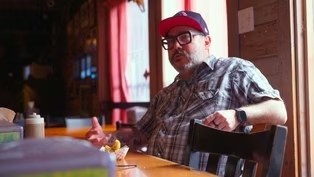
Preview: S2 Ep7 | 30s | A tiny Wendish town persists in Texas. The legacy behind the iconic dish—the puffy taco. (30s)
Providing Support for PBS.org
Learn Moreabout PBS online sponsorship










Support for PBS provided by:
Production Support Provided By: Riptide Waters LLC; Texas Parks & Wildlife Foundation; Texas Rural Funders, H-E-B”