Making of the Music: A Chicano Love Story
Clip | 10mVideo has Closed Captions
Go behind the scenes as Mission Bay High School’s students and staff compose an original score.
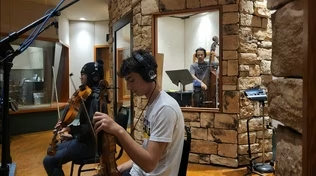
Take a behind the scenes look at how Mission Bay High School’s students and staff composed an original score for Linda & Carlos: A Chicano Love Story. Shot by student Elias Nuspl.
Problems playing video? | Closed Captioning Feedback
Problems playing video? | Closed Captioning Feedback
Making of the Music: A Chicano Love Story
Clip | 10mVideo has Closed Captions
Take a behind the scenes look at how Mission Bay High School’s students and staff composed an original score for Linda & Carlos: A Chicano Love Story. Shot by student Elias Nuspl.
Problems playing video? | Closed Captioning Feedback
How to Watch
is available to stream on pbs.org and the free PBS App, available on iPhone, Apple TV, Android TV, Android smartphones, Amazon Fire TV, Amazon Fire Tablet, Roku, Samsung Smart TV, and Vizio.
(upbeat jazz music) - My name is Eric Wesling, I served as the artistic director for this documentary music project.
For the last two years, I was working as the music assistant at Mission Bay High School, and I was very honored when Linda and Carlos wanted us to put together the original music score for this documentary.
(upbeat jazz music) When selecting students for different sections of the documentary, I kind of took into consideration their musical strengths and their interests, for example, the La Verdad section, the producer wanted a percussion-heavy kind of piece, so I knew our student Henry is a wonderful percussionist and is very into Afro-Cuban music and Latin music, so I knew he'd be a great fit for that, and so, we had individual Zoom meetings over the summer to work out how he was gonna go about working on this section, and... - Yeah, so I was thinking about having a sole just percussion feature, no melodic instruments for this part to really drive the music, and I've been learning about this style from Cuba called rumba guaguancó that has this part called the guagua, which in Cuban slang means, like, "bus," because it's really driving it, and so, the guagua part goes like... (loud tapping) Right?
And then, it has this other part kinda going over on top of it called the clave, which is, like, the key to the music, so while that's going like... (Henry mimicking rhythm) And then, it also has, like, three different drums that are kind of improvising with each other and, like, conversing while all that's going on, one's called the salidor, that's the low one, and then, it has the tres dor bass, which is the medium one, and then, the high-pitched one is called the quinto, and it kind... If you put it all in one, it kinda sounds like, one, two, a-one, two, three, four... (loud tapping) But that... I mean, it's kinda bad on just a table, but yeah... - No, I get the picture, though, yeah.
- But then, I have a recording right here all... Where it's all together so you can kind of hear what it sounds like.
(upbeat percussive music) And that's the clave.
(upbeat percussive music) (upbeat percussive music continues) Yeah, and so, you can kinda hear how the drums are conversing with each other, and it's a very momentous and kind of driving style and I think that would be fitting for this scene because it's a pivotal moment in the documentary, so I don't know.
- No, I think that'd be really cool, yeah, that'd be awesome.
You know, getting through the trial and error of what could work, what could not work, and it was a really fun experience for not only Henry, but for me too as the director.
- La Verdad, the Chicano newspaper, that is a great... (indistinct) The story.
(upbeat percussive music) You know, here are these individuals who didn't have any journalistic skills whatsoever.
(upbeat percussive music) We weren't writers, you know, we were just reporting what... You know, what was happening, you know, in education, in labor.
(upbeat percussive music) The paper also was an avenue for the artists to have their artwork in the paper.
(upbeat percussive music) - Another example of the Chicano Park scene, our student Brady, who's a wonderful trumpet player.
- Hi, my name's Brady Newell, I'm an 18-year-old, I graduated from Mission Bay High School this spring, I'm a brass player.
Composing for this was really unique because I have done some small amount of composing and arranging on my own prior, but nothing that's based around a film like this, so that was a whole new set of skills to learn and navigate around, and I actually watched a lot of things during the whole composition process to get inspired as, "Oh, how do composers make this scene more emotional?"
Or, "How do they make this more entertaining or more intense?"
It was an interesting learning experience for me learning how to compose with the intent to inflict a certain emotion based off what a certain scene was asking for, so it was really interesting to see how the other composers... We all had a shared Google Drive where we had to upload all of our work, and we could see who was on what section that was... That music needed to be written for, and I really liked to see what other people were writing for the sections that they were assigned to, what kind of emotions that they are writing for and how they brought that out in their music, and it was all cool people, all good friends of mine that went to school, and it was just another good experience to work with them in that context.
- A lot of our students were fairly new to composing in general, some of them had experience in our composition club.
I think, you know, we kind of touched on this a lot already, keeping things simple, keeping it light, just supporting the video and the images, yeah, I think you guys get that.
But it's very rare for students at this age to have such an amazing opportunity like composing an original documentary score, and so, this was such a huge learning process for all of us involved, and I think the students gained so much knowledge and experience from this project, and, you know, it's really difficult to compose for a documentary 'cause there's so many factors that you have to take into consideration, not only making sure the music fits with what's happening in the scenes, but also having the knowledge and the skills necessary to put together the music, and bring it to a live band and have it recorded live, so this was such an amazing opportunity for the students to not only work on their composing skills, but have that experience to be able to bring their works into real life and into a project that serves a greater goal, and, you know, our main priority was illustrating the message that Linda and Carlos were trying to portray through music, and trying to elevate their story and their message as much as we could.
Working in the studio was a really fun experience for both me and the students, as a musician myself, I've had experience recording guitar in recording studios for other musicians and other people that needed session work, but this was my first time playing more of a director role in that situation.
So yeah, that's a wrap for that one, so we're good on strings now, so you guys are done playing, so next will be Q28.
(relaxed jazz music) (relaxed jazz music continues) Yeah.
It was really fun putting everything together and watching it all happen.
I also did participate recording guitar for the documentary as well, but my main priority was making sure everything went smoothly and making sure everything everyone had what they needed.
What I meant was at bar 37, Ian, just do that, you guys still do the harmonies together at 25, but when it gets to the part where there's just the one... There's no harmonies there at 37, Ian, just do that part by yourself, but you guys still do the harmonies together, does that make sense?
- [Person] Yeah.
- You know, there was a little bit of nerves at first just because we had written all this music, and now, you know, we're bringing it to life, and sometimes, there's a little bit of uncertainty about how, you know, all this written music will work out once we play it together as a band, but to prepare for that, we had some rehearsals the week prior at school just so we had a good idea of how everything was gonna go down so that when we hit the studio, we just get together, play the song, record it down, and listen to it later, and overall, we had a really smooth experience, Studio West was great at accommodating us, we had a great engineer working with us to make sure everything went to plan, and yeah, it was a wonderful experience recording all the music, we did three days at Studio West, three six-hour sessions, so it was a lot of time and it was a lot of effort, but it was such a memorable experience for me and the students.
Let's just do another take doing that and I think we should be good.
Are we ready?
All right.
(upbeat percussive music)
 Now Playing
Making of the Music: A Chicano Love Story
Video has Closed Captions
Clip | 10m | Go behind the scenes as Mission Bay High School’s students and staff compose an original score. (10m)
Video has Closed Captions
Preview: Special | 30s | Coming 2/26 - the story of the remarkable journey of Chicano movement figures Linda and Carlos. (30s)
Providing Support for PBS.org
Learn Moreabout PBS online sponsorship













Support for PBS provided by: