
Spice Road | What Happens When Indian Spices Meet Mexican Classics? | S2 E4
Special | 6m 25sVideo has Closed Captions
Try scrumptious Indian-Mexican dishes as South Asian flavors become more popular in America.
Back in California, Rupak Ginn meets up with actor Omi Vaidya (3 Idiots) at Pasadena’s Saucy Chick eatery to try scrumptious Indian-Mexican dishes as the two discuss their experience of fusion food and how South Asian flavors are becoming more popular in America.
Problems playing video? | Closed Captioning Feedback
Problems playing video? | Closed Captioning Feedback
Spice Road | What Happens When Indian Spices Meet Mexican Classics? | S2 E4
Special | 6m 25sVideo has Closed Captions
Back in California, Rupak Ginn meets up with actor Omi Vaidya (3 Idiots) at Pasadena’s Saucy Chick eatery to try scrumptious Indian-Mexican dishes as the two discuss their experience of fusion food and how South Asian flavors are becoming more popular in America.
Problems playing video? | Closed Captioning Feedback
Where to Watch Independent Lens
Independent Lens is available to stream on pbs.org and the PBS app.

Aesthetics and Unraveling the AI Hype
Ghost in the Machine seeks to unravel the AI hype to find the untold origins of “artificial intelligence.”Providing Support for PBS.org
Learn Moreabout PBS online sponsorshipMore from This Collection
Films exploring the people, culture, and traditions of food.
Spice Road | What Indians REALLY Eat for Breakfast | S2 E7
Video has Closed Captions
Forget toast and cereal—this is how India does breakfast. (4m 37s)
Spice Road | Can She Identify Indian Bread Blindfolded? | S2 E6
Video has Closed Captions
Can you tell naan from chapati from puri… without seeing them? (4m 56s)
Spice Road | Which Butter Chicken Wins? | S2 E5
Video has Closed Captions
Which store-bought butter chicken is actually the best? (4m 19s)
Spice Road | This Bangladeshi Pizza Joint Was Ranked One of the Best in America | S2 E3
Video has Closed Captions
One of the best pizzas in America, according to The New York Times. (15m 12s)
Spice Road | You’ve Never Had Indian Food Like This| S2 E2
Video has Closed Captions
Kerala cuisine might be India’s best-kept secret—and most Americans have never tried it. (16m 49s)
Spice Road | Inside Chicago's First Michelin-Starred Indian Restaurant | S2 E1
Video has Closed Captions
What does it take for an Indian restaurant to earn a Michelin star—for the first time in Chicago? (16m 44s)
The Grocery List Show | Latino Grocery Store in Brooklyn | Ep 5
Video has Closed Captions
A food blogger cooks up his family's garnachas recipe after a jaunt to a Latin American grocery. (12m 21s)
The Grocery List Show | Family-Run Italian Market in New Jersey | Ep 4
Video has Closed Captions
A family-run grocery in New Jersey brings people from all over for delectable treats from Italy. (10m 31s)
The Grocery List Show | A Little Caribbean Market in Brooklyn | Ep 3
Video has Closed Captions
At a Caribbean grocery in Brooklyn, the "island vibe" infuses the spirit of the neighborhood. (10m 31s)
The Grocery List Show | Halal Grocery in Brooklyn | Ep 2
Video has Closed Captions
The family behind a Middle Eastern Brooklyn grocery makes a hearty mansaf meal. (12m 7s)
The Grocery List Show | Seafood City in Chicago | Ep 1
Video has Closed Captions
Filipino food galore at Seafood City in Chicago is followed by the making of a crab torta feast. (12m 39s)
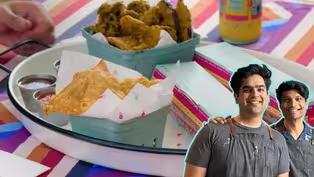
LA Street Food, South Asian Style | Spice Road, Episode 4
Video has Closed Captions
Rupak Ginna goes home to LA for Desi street delicacies and grocery store comfort food. (16m 31s)
Providing Support for PBS.org
Learn Moreabout PBS online sponsorship- Indian food and Mexican food.
Two spice infused cuisines that have gained widespread popularity in America.
What happens when you combine them?
I am here at Saucy Chick Indi-Mex Eatery to explore one of the greatest cuisine collabs in history, Indian and Mexican food.
Let's go.
This is "Spice Road."
(upbeat music) This menu is insane.
Indian Mexican cuisine.
What was the inspiration for that?
- My wife being Indian, me being Mexican, we really wanted to share the foods that we grew up eating with and having that opportunity to kind of put things together that are already a fusion or just really independently that eat well together.
- [Rupak] Let me share a little Indi-Mex history.
This cuisine is actually much older than you think.
Over 100 years ago, a number of Punjabi Sikh and Muslim men immigrated to the US West Coast from India in search of work as farmers and loggers.
But after the Immigration Act of 1917 was passed, it became exceedingly difficult for Indian women to immigrate to the US.
So, hundreds of these single Indian men in the US married Mexican women, (organ music - "Bridal Chorus") as the West Coast already had a fairly large Mexican population.
From this, a mini Mexican Indian American community emerged along with a unique new style of cooking that gave rise to a small number of restaurants featuring this cuisine.
Marcel and Rhea are part of this proud tradition as owners of Saucy Chick, which has been featured in "The LA Times," "New York Times," "Eater," and "LA Magazine."
- When we think about our cultures, yes, there's commonness in ingredients, but I think what's also even more common and I think what the world needs today is just warmth and hospitality.
♪ I don't think anyone thinks of an Indian or Mexican wedding or party and think they're gonna be underfed or under loved.
- Being able to give that and share that to people that are gonna experience it for the first time and them falling in love with it, that actually gives us a lot of energy to kind of push forward in some of the trying times and the challenges that come with it.
- The beautiful thing about immigration is a convergence of culture and I think that we, to some degree, represent that.
I think LA is very unique in that it's a gorgeous tapestry of different cultures intertwining to create this beautiful piece of art.
- [Rupak] Of course, for this special meal, I had to call my buddy and fellow foodie, Omi Vaidya, to join me.
- Is it Mexican or Indian?
- It's both, baby!
- Both!
Let's go.
- [Rupak] Omi is a talented actor, writer, comedian, and director who shot to fame in India for his role in the iconic film, "Three Idiots."
Though non-Desi audiences may be more familiar with him for his work on "The Office."
- We've got quite a spread tonight.
(Rupak laughs) So we do two different kind of chickens.
Jeera chicken, which is inspired by my dad's Indian curry.
Pibil, which is inspired by the Yucatan.
Popped Indian mustard seed potatoes, which is a take on my mom's shak.
My take on chaat, we call it Chaat-Chos.
We've got our chicken tinga masala tostada, GG sauce, a creamy chutney or salsa.
We've got the tamarind and then my favorite is our macha chili oil.
- I'm very excited about this.
- This is a seriously smoked chicken.
Smoked chicken.
What was your first experience of Mexican food?
Do you remember that?
- Sadly, I bet it was Taco Bell.
We have chapatis, they have tortillas, right?
These things are very similar.
How does it compare to Taco Bell?
Let's find out.
(Rupak laughs) This was a Jeera chicken.
- Jeera chicken.
Okay.
- And this is more of a- - Pibil.
Jeera, or cumin seed, comes from a flowering plant in the parsley family and it's coincidentally featured in both South Asian and Mexican cuisine despite both cultures being oceans apart.
In South Asia, cumin is usually blended with spices like coriander, turmeric, garlic, and onion, but here, it takes center stage, showcasing its warm, earthy depth.
The dish featuring Pibil traces back to the ancient Maya of the Yucatan, for whom Pibil meant buried.
Meat was traditionally marinated in citrus, wrapped in banana leaves, and slow cooked in pit ovens.
At Saucy Chick, Jeera meets Pibil, and centuries old traditions born worlds apart now converge on one plate.
- Really good.
- Oh yeah.
Let's eat some sauce.
Shall we dip?
- Let's try.
- Dip it out.
Mm.
Mine is a cooling.
It's a nice cool, it's like raita.
Mine's like a raita.
Oh my gosh.
I would never have dipped chicken into raita.
- Macha chili oil.
It's like fruity.
It just got spicy.
Whoa.
- Dude!
- Yes.
- I told you.
It's a little after burn, huh?
A little after kick.
- No, it's a punch.
It's a punch.
- Did your family do any kind of fusion Indian food growing up?
- I grew up in Joshua Tree, which is like rural California.
They didn't have many Indian spices back in the '80s.
They couldn't just go to an Indian market, but they didn't have all of the spices that they need.
So I'm pretty sure that it was fusion and it was different.
(Rupak laughs) You know?
I think there's a lot of India that may not be as bold and exciting, but the flavor profile is something that's unique.
I think that these sorts of foods will start to come up.
- [Rupak] And it evolves too like what we have here with fusion food, right?
- I love Indian pickles.
- Achar, man!
- Achar.
- Achar, that flavor on chicken, on a burger, on a vegetarian item, anything, like we don't have that in- - We don't have that.
- The West.
- It needs to be a condiment.
Now as people are starting to be more adventurous, people also are okay with food being different than what they expected.
The West is now more adventurous and more confident enough to take on those flavors.
- Yeah.
With their shared embrace of cumin and flatbread, Indian and Mexican food are one of the biggest fusion no-brainers I've ever experienced.
I just can't believe it's taken me this long to realize it.
(mellow upbeat music) ♪
















Support for PBS provided by: