
Learn to Ski, Dani Prados, Puppet Parade
Season 17 Episode 6 | 28m 45sVideo has Closed Captions
The Learn to Ski program teaches water skiing, artist Dani Prados; and an autumnal celebration.
In New London, the Learn to Ski program introduces children to the sport of water skiing, in Granite Falls, artist Dani Prados works with resin casting and other mediums, and also in New London, the Puppet Parade brings the community together with an autumnal celebration.
Problems playing video? | Closed Captioning Feedback
Problems playing video? | Closed Captioning Feedback
Postcards is a local public television program presented by Pioneer PBS
Production sponsorship is provided by contributions from the voters of Minnesota through a legislative appropriation from the Arts and Cultural Heritage Fund, Explore Alexandria Tourism, Shalom Hill Farm, West Central...
Support provided by:


Learn to Ski, Dani Prados, Puppet Parade
Season 17 Episode 6 | 28m 45sVideo has Closed Captions
In New London, the Learn to Ski program introduces children to the sport of water skiing, in Granite Falls, artist Dani Prados works with resin casting and other mediums, and also in New London, the Puppet Parade brings the community together with an autumnal celebration.
Problems playing video? | Closed Captioning Feedback
How to Watch Postcards
Postcards is available to stream on pbs.org and the free PBS App, available on iPhone, Apple TV, Android TV, Android smartphones, Amazon Fire TV, Amazon Fire Tablet, Roku, Samsung Smart TV, and Vizio.
Providing Support for PBS.org
Learn Moreabout PBS online sponsorship(light music) - [Announcer] On this episode of "Postcards."
- I can't recall a single student that we have never ever gotten up on water skis.
(instructor cheering) (instructor clapping) - At this stage in my career, I consider different mediums, different tools in a toolkit that I'm creating.
And so they're all different ways of solving a problem.
- Hurrah, we have made it.
The Autumn Equinox has arrived.
Pause, and then the rain came.
It just came down and it was pretty dramatic.
(upbeat music) - [Announcer] "Postcards" is made possible by the Minnesota Arts and Cultural Heritage Fund and the citizens of Minnesota.
Additional support provided by Margaret A. Cargill Philanthropies, Mark and Margaret Yackel-Juleen, on behalf of Shalom Hill Farms, a retreat and conference center in a prairie setting near Wyndham, Minnesota.
On the web at shalomhillfarm.org.
A better future starts now.
West Central Initiative empowers communities with resources, funding, and support for a thriving region.
More at wcif.org.
- Here we go.
(energetic music) - Good!
(energetic music continues) - Just to see those kids and then their looks on their face like, whoa, I'm gonna do this?
- There we go.
Woo!
- Yeah.
- Oh man, that's perfect.
- And then by the end of that session there, they've gained so much confidence.
- You think you'll ski again?
- I like skiing.
- You ready, buddy?
- Yep.
- [Instructor] Alright.
- It's just good to get out there.
It's good exercise.
It's good family fun.
There is no age limit.
There is no ability limit.
And it's just a sport where you can go out and just have fun in the great outdoors and on a lake or river.
(upbeat music) - And it's just the smiles and the enthusiasm and the excitement of these kids when they do something like this.
It's just great.
Very fulfilling.
(upbeat music) (gentle music) The Learn to Ski Program is a summer community rec program through the New London Spicer School District.
- The Learn to Ski originated probably, I'm guessing about 23, 24 years ago.
- We partner with USA Water Ski.
They're our sanctioned event organization and then also the community education through New London Spicer schools.
- Way to go Henry!
All the way, Henry.
Good job, pal.
(claps) - We've been doing this since about 2002.
Sheila and I, my wife Sheila.
- We've been a part of the team, Little Crow Ski Team for 26 years, and since the Little Crow Ski Team volunteers to put this program on, we've just been a part of it.
(upbeat music) - Nora and Claire.
- Nora and Claire and last name?
Parents sign their children up for the program.
There is a small fee but it basically covers gas.
(upbeat music) - So you have individuals that either don't know how to ski or they have limited skiing abilities and we take the tools and the resources to put 'em out on the water and get 'em skiing.
- [Sheila] I've got four on the front dock.
I've got three on the back dock so far.
So for a lot of these children, they are getting on the water for the very first time.
- [Greg] Average age is probably four to 13.
It's our job to enhance their abilities and help them to get to the level where they want to go.
(upbeat music) - We typically have two sessions.
We take 12 children in the morning session and 12 children in the afternoon session.
- You're next?
- Yeah, I wanna go on there.
- Our classes are full.
They're actually waiting lists so we know there's a demand for just kids wanting to get out here, learn how to ski and have a good time.
So that's really our focus is just make sure it's a fun, safe environment for 'em.
(gentle music) - Fall in.
(water splashes) - The Learn to Ski program I learned about probably three years ago, decided to put my oldest in it.
He's 12 now.
It's been an awesome opportunity.
They've been doing it now for three years and I have two boys in it.
They feel pretty great after learning how to ski and spending the couple hours here and, yeah, they're excited and they're proud of themselves and, yeah.
- [Interviewer] Tell me about what you did today.
- I water skied.
- For the first time?
- Mm-hmm.
(interviewer gasps) And I did it.
- You did it?
- And my mom's proud of me.
- We have young children from the Little Crow Ski Team that volunteer to help them.
So it's really good for them to learn what being a volunteer is.
- Here we go.
(water splashes) - I just kinda show up and I'm the runner if they need life jackets or ropes or whatever.
I joined the team back in 1999.
My mom got a job here and we came to a show in '98 when the team won nationals.
So kind of a good show to see the first one and kind of got hooked after that.
Today I have a daughter of my own on the team.
Her name's Quinn.
So she's helped out with the Learn to Ski since she joined about three years ago and now she's getting to be a pretty good skier.
So she's trying to overtake me, which that should be pretty quick.
(laughs) - [Instructor] Good.
(upbeat music) - Sometimes my husband says, "How many more years are we gonna do this?"
And I said, "Until we can't."
So we keep going and yeah, we put a lot of work into it.
We bring almost all of our own ski equipment.
I always have to bring extra life jackets.
I make all the lunches for the kids.
I make, okay, you don't know what this is unless you're from South Dakota, but I make taverns, which is really just Sloppy Joes.
And this year I had to make a vegetarian option.
So we have mac and cheese, so we have mac and cheese, and we have tavern, watermelon, chips and lemonade.
(upbeat music) - We've had really good success on getting kids to at least some level of skiing.
- In the 23 years I've been doing it, I can't recall a single student that we have never ever gotten up on water skis.
- We did have one young man that was a little older and boy, we struggled with him until we got the duct tape out and we had to duct tape together two big adult skis and then we got him up too.
And that was so rewarding 'cause he was so excited.
It's just super fun.
(upbeat music) Yeah!
Woo-hoo!
It's just absolutely great to get the kids out doing a physical activity.
They're learning something new.
They are part of a team approach in a sense.
- I think it's important to have programs like these because there's just not opportunities for everybody.
Also gives them the chance to maybe try out and get a love for something and be part of the ski team if that's all what it comes out to be.
(upbeat music) - Okay yeah.
Okay, so.
The ski team has been in existence since 1979 and generally we have right around 80 members.
Sometimes it bumps up to a 100, 120.
(water splashes) The ski team is a nonprofit organization.
- I enjoy teaching the kids how to ski on one ski, teaching the girls how to do hop docks, teaching them how to do ballet moves.
I love working with the girls that are learning swivel skiing.
- We have practices Monday, Tuesday, Thursday night, shows on Friday.
- [Announcer] Who wants to see CPR barefooting?
- We are a big part of this community, the Little Crow Ski Team, and because they all volunteer, I think that adds back to the community.
You guys ready?
- Yeah.
- Everybody gonna go off the boom to start?
- Yeah.
- Yeah, just get a feel?
- Anything you can do to the community to get those kids, especially with this is at the level we're at is just those kids to get confidence.
- Good.
- That was awesome.
- That was excellent.
- To see them walk to the site here, never having a pair of skis on and hopefully develop into skiers for the rest of their lives.
- Woo-hoo!
Good job!
It's just super fun.
I love the enthusiasm of the kids and the smiles.
Ooh, there you go.
(laughs) We'll help you up.
- We enjoy it, so we keep doing it.
I guess it would be nice to have some replacements down the road, but as long as we're able to do it, we just continue doing it, so.
(upbeat music) (waves splashing) - I spent a very long time firmly believing that I was going to be a marine biologist and I worked really hard for that.
I wrote a couple of intertidal zone papers, worked on a ship, tracked fin back whales, did plankton tows in oceanography studies and I loved it.
But there's a long story involving a kind of iconic sea captain who made me realize that the life I wanted and that that career path were not the same thing.
And so I kind of took all of that love of place and plant and animal species and found a different way to pursue that through art.
(gentle ambient music) I've been really fortunate to live and work in a lot of different places.
I grew up in Washington, D.C.
I went to college in Portland, Oregon and interrupted that to move to London and then Chicago, twice actually.
Also lived and worked in rural Alaska, California and then New York City and then COVID happened.
I was in Taos, New Mexico at the time.
I was down a Google rabbit hole one night.
This article came up that was quite long about the first ever city artist in residence in a rural community of under 50,000.
And then I get to the end of the article and I realize it's not an article, it's a job posting.
(Dani laughs) And there was 30 hours left to apply.
Got it in at the very last minute and then was really fortunate to be selected as a final artist.
So I moved to Granite for an initial 12 month contract that was extended to 13 and then stayed.
(gentle ambient music) One of the gifts of coming to Granite Falls was in meeting and developing a collaboration with Dakota blacksmith, Talon Cavender-Wilson.
We're now actually officially a collaborative called Irises and Iron.
So we did this show called Chapters, which just finished a statewide tour of Minnesota.
We're exploring what the idea of a place is from the perspective of two artists with completely different relationships to that place, completely different cultural backgrounds and completely different mediums.
We were trying to figure out how to make something look like it had been preserved in time and in my youthful hubris I was like, oh, you know what looks really, really static and timeless is things that are preserved in glass, which is hard to do without the proper equipment.
So I'll just figure out how to cast resin.
And that turned into a, you know, four year learning experience.
(light music) - [Kris] Is it kind of like toxic to work with or is it?
- Oh yeah, very.
(glove snaps) (light music) Resin casting is not easy and requires a lot of mastery of craft and safety equipment and understanding of chemical reactions.
I normally wear a gas mask for this part.
We've got ventilation, we're gonna be really quick.
So I've done a lot of very unconventional experimenting with resin, partly because of the way that I started and partly because that's what I do.
(laughs) Let's see how translucent that is.
And it kind of can look like, it's almost like kelp.
Sculpting with resin like this isn't something I've seen done very much.
If anyone has message me.
One of the ways I actually originally experimented with just getting my craft down was in creating and then casting in molds and realize like, actually these would be really cool as jewelry pieces.
Like, I would want to wear a piece of a preserved plant from my garden.
And that was the first batch of Dar Prados jewelry.
So this one I'm not gonna be able to use 'cause there was still a little bit of residual moisture in there.
I tend to still use everything.
So I won't make this a piece of jewelry for example, but it'll probably become part of some like, dark artistic decaying commentary on whatever.
These though came out pretty well.
This was just an experiment, so this is not meant to be anything particularly useful, but I was experimenting with casting the sumac but it loses a lot of its color.
So that's why I didn't end up using this piece.
This by the way, is resin cast tissue paper.
It's kind of wild what you can do with this stuff.
My library of materials is pretty extensive.
I don't take things off, but once they've fallen to the ground, I'll take them.
I'm like a pack rat.
So I have these boxes that I take with me when I'm bike riding and I'll stop and pick up specimens.
I have like, a box of dead insects.
And a friend was like, "What is wrong with you?"
I have a long background in production and direction in theater and film and television.
I've been really fortunate to work on some extraordinary film projects, community arts, public art projects and pieces, supporting other artists in their work.
Curating, project managing, wrote my first book of poetry and a couple of scripts that are pending.
The unifying features of my art all generally have to do with storytelling or community building in some way.
Connecting people to people or people to land.
I did a show recently on grief called Letters to the Lost.
So I have these postcards said, "To my lost," and you can fill it in.
It was a crowdsourced piece.
Everyone would fill in their own to my lost self, to my lost home, to my lost person.
And then I did five large scale pieces of my own responding to different elements.
And so my father had passed away soon before and so I kind of created this sculpture of his, he wore this every day for like, 40 years.
So I built this like, interior structure.
So it looks like he's still inhabiting it.
(gentle ambient music) I lost my grandmother when I was just 18.
She was hugely formative for me.
There's a saying that's very common, right?
You should always leave the world better than you found it.
But she used to say, "You should leave people better than you found them."
So even someone you'll never see again, someone kind enough to be packing up your groceries.
How can you make their day better by just like, taking a moment to really see them?
So I think that's something that I try to practice.
(gentle ambient music) I have this project I've been working on called This Great America, which is a series of interviews and photographs of strangers and landscapes.
The idea that, you know, getting to know your neighbors is important and that there's a diversity of lifestyles and landscapes all across this country.
More recently, I've actually started to experiment with different versions of the final product.
Kind of create these different layers of meaning on the image.
This is a standard glossy print.
It's an archival print of a photograph that I took in New Orleans, actually.
It's called Happy Hour.
(laughs) When you cast it in resin, and this actually has a wax paper backing, it creates this translucent effect.
Isn't that crazy?
It's better with sunlight.
This is artificial.
So if we normally would have sun streaming through the windows right now and it would look really cool, but this is what we got.
At this stage in my career, I consider different mediums, different tools in a toolkit that I'm creating.
And so they're all different ways of solving a problem.
And so if a new problem comes up that I don't already have a tool for, I'll go learn a new medium to solve that particular problem.
Like most things it came out of like, oh, that's a crazy idea.
I wonder what if?
(gentle ambient music) (light music) - Little Theatre Auditorium is the name of this 104 year old building now that has had in those hundred and some years, many, many, many lives.
And this is this iteration of the theater.
(light music) New London is a rural Minnesota community, population, gosh, I think right now it's just under 1400 people.
I recently read the Census and our average age is around 37 years old, which is fascinating to me 'cause that's a big change in the last 10 years.
It used to be a lot older, which means we have a growing community, lots of generations being represented.
So we need to come up with activities to bring all those generations together.
- My gosh, you know what?
That's the thing about New London.
We're weird.
- I love it.
I love it that we're weird.
Having places like this is an asset to a community because where else are people gonna be able to come and learn how to do something new together, bring their kids, meet each other on really even ground?
They call it a third space where you can come and represent yourself as in the way that you want to represent yourself.
You make friends.
Like it's easy, you just make friends.
(upbeat music) We were looking at how to celebrate the harvest for the city's Harvest Fest week.
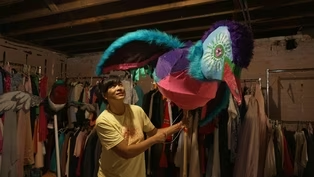
And that was the idea that came to mind was we can have a parade that celebrates local foods, local food producers, the harvest itself, the changing of the seasons, and what better way to do that than with a big parade that has flowers and giant food.
(laughs) So for two weeks we plan, actually it's almost two months we plan the parade and what the sections are gonna be, what the characters in each section are gonna be.
And then we plan the puppet building workshops and the materials needed to build the puppets in those sections to make a giant parade.
(upbeat music) During the holidays, this is where we grab all of our holiday decorations, but you know, here's the cats, because they kinda live up here and the other is Cool Cat and then Red Cat and Gray Cat.
(laughs) - Oh 'cause I'm wearing these really cool gigantic sunglasses.
I think it's just so important to showcase people's artistic ability, but also making it live entertainment for everyone.
I think it's just truly important to share fun stories, bring people together in a strong community-like aspect.
That's why I think community productions and community plays are so important is really bringing the community together and sharing a common story or goal.
- This year it was rain, no rain.
Rain, no rain.
Like watching, we were watching the weather for a week and it kept switching and going back and forth and we asked the puppet artists, you know, how do you make the call?
And they said, the parade, we parade.
No matter what, we go, unless there's lightning, but no matter what we go, I'm like, okay.
So it was a lot of that kind of like extra, keeping an eye on the weather.
But it seems appropriate considering that's what the parade's all about.
It's about nature and the changing of the season.
So to be hyper aware of that and how it was gonna affect our movements seemed appropriate.
But then, you know, people show up and I'm always a little bit worried, like, are people really gonna show up?
I don't know, maybe.
We'll see.
Like, last year we had 64 people in the parade.
This year I think we had maybe 50.
So it was pretty darn good.
Luckily we made enough puppets for everybody.
So we marched, we walked from here to Neer Park and didn't get rained on.
I was water, so I got a lot of exercise being water and there was a section of beavers who were trying to contain water.
And so my job was to try to not be contained.
And I think I ran like, five miles in this one little mile.
(laughs) But once we got to the park, we started the second part of the day on the water.
Art camp families, enjoy the show.
We're gonna have a play on the water at two o'clock.
Check out the market, check out the food, get something to eat, buy a t-shirt and we'll see you on the bleachers at two o'clock.
The Autumn Equinox Water Ballet is a reenactment of the Autumn Equinox on the Mill Pond.
So we reenact that in the water on boats with loud drums beating faster and faster and faster while New London sewer cats and the audience meow, encouraging the sun and the moon to align with the earth.
And when we get there, then we cheer because the autumn equinox has arrived.
And when we did that this year and our cool cat sewer cat announced, "Hurrah, we have made it.
"Autumn Equinox has arrived," pause, and then the rain came.
It just came down (laughs) and it was pretty dramatic.
It was awesome.
(audience applauding) - [Performer] Look at that, perfect timing.
- [Announcer] Thank you all for bearing witness to the Autumn Equinox and our amazing puppet artists.
(audience cheering) (audience applauding) - I think what's really cool about the Puppet Parade is there's so many different points of entry for people who have never participated in community activity in general.
And then on the day you can show up and someone will put something on your head and you'll become a bee and just walk.
Just walk.
That's all you gotta do.
- Where do you want us in the order?
Right here?
We good?
- Stay right there.
- Stay right here.
I love it.
- So it kind of eases a person into what the whole process is to making the final like parade, parade, in itty bitty steps that are fun.
And you meet people who are also doing that at the same time and you get to learn together.
So there's no competition.
- Even though I don't live in New London, I still wanna, I do as much as I can to support the New London Little Theater.
What they do for this community is awe-inspiring and I just want to do what I can to help keep it going.
- What kind of journey has Little Theater Auditorium and the Puppet Parade taken me on?
Oh gosh.
It's like a lifetime of memories and experiences that have obviously gotten me to this moment right now, but have led me to really love the idea of having a puppet parade and have made it possible for me to actually pull it off.
Having grown up in New London and grown up as a student who's come to this theater as a child, and then living in Minneapolis and being a theater artist and all of the technical tools you learn along the way made it possible for me to say we can do this here, which is fun for me to think about.
(bright music) (energetic music) - [Announcer] "Postcards" is made possible by the Minnesota Arts and Cultural Heritage Fund and the citizens of Minnesota.
Additional support provided by Margaret A. Cargill Philanthropies, Mark and Margaret Yackel-Juleen on behalf of Shalom Hill Farms, a retreat and conference center in a prairie setting near Wyndham, Minnesota.
On the web at shalomhillfarm.org.
A better future starts now.
West Central Initiative empowers communities with resources, funding, and support for a thriving region.
More at wcif.org.
(light music)
 New
NewLearn to Ski, Dani Prados, Puppet Parade
Preview: S17 Ep6 | 40s | The Learn to Ski program teaches water skiing, artist Dani Prados; and an autumnal celebration. (40s)
Providing Support for PBS.org
Learn Moreabout PBS online sponsorship

- Arts and Music
The Best of the Joy of Painting with Bob Ross
A pop icon, Bob Ross offers soothing words of wisdom as he paints captivating landscapes.









Support for PBS provided by:
Postcards is a local public television program presented by Pioneer PBS
Production sponsorship is provided by contributions from the voters of Minnesota through a legislative appropriation from the Arts and Cultural Heritage Fund, Explore Alexandria Tourism, Shalom Hill Farm, West Central...