
Women Who Built San Diego
10/12/2026 | 26m 51sVideo has Closed Captions
Four trailblazing women whose skills, leadership, vision and determination helped build San Diego.
Four trailblazing women whose skills, leadership, vision and determination helped build San Diego. Their stories are about creating opportunities, solving problems, building businesses and institutions, and finding ways to survive and thrive.
Problems playing video? | Closed Captioning Feedback
Problems playing video? | Closed Captioning Feedback
Historic Places with Elsa Sevilla: California's History is a local public television program presented by KPBS
Women Who Built San Diego
10/12/2026 | 26m 51sVideo has Closed Captions
Four trailblazing women whose skills, leadership, vision and determination helped build San Diego. Their stories are about creating opportunities, solving problems, building businesses and institutions, and finding ways to survive and thrive.
Problems playing video? | Closed Captioning Feedback
Where to Watch Historic Places with Elsa Sevilla: California's History
Historic Places with Elsa Sevilla: California's History is available to stream on pbs.org and the PBS app.
Providing Support for PBS.org
Learn Moreabout PBS online sponsorship♪♪♪ Elsa Sevilla: History often overlooks the contributions of women, but in this episode, we celebrate trailblazers, pioneers, and visionary leaders who broke barriers and helped build San Diego.
Hello, I'm Elsa Sevilla.
Welcome to "Historic Places," where we document and share the region's history.
We begin with Juana Machado, born at the Presidio of San Diego in 1814.
Juana Machado was a pioneer, a midwife, healer, nurse, and community leader.
She helped build the foundation of a growing San Diego during the 1800s.
♪♪♪ Elsa: Juana Machado was a San Diego midwife and healer from the 1830s to the late 1800s.
Using her knowledge of medicinal plants and childbirth, she delivered hundreds of babies and cared for the sick long before doctors and hospitals existed in the region.
Connie Rascon Gunther: She would follow Father Ubach basically when he was tending to people, and she was instrumental in providing her guidance, and also taking care of the wounded and the healing.
Elsa: Born at the Presidio of San Diego in 1814, Juana came from a prominent Californio family.
Californios descended from early Spanish settlers who arrived after Spain invaded the Kumeyaay nation territory in 1769.
Her father commanded the Presidio, and her mother belonged to one of Los Angeles's founding families.
Connie: She would probably be more recognized throughout the community, and so they looked up to those families because of that status, but it didn't separate them from the day to day activities that they had to accomplish to raise a family.
Elsa: Years later, when Juana married, her father built her the Carrillo Adobe, now located in Old Town San Diego State Historic Park.
The historic adobe is a museum open to the public, offering visitors a glimpse into her life and the world she helped shape.
Connie: They were difficult in those times.
It was a frontier era, there was no stores.
Everything had to be grown, and everything had to be created by the family.
Whatever clothes they needed were sewn, so there were some really difficult times, not the conveniences that we have today.
Elsa: She became one of the few people to live through San Diego's Spanish, Mexican, and American periods.
During the Mexican-American War, Juana used her nursing skills and cared for the wounded after the Battle of San Pasqual in present-day San Diego County.
Connie: That battle was some difficult times because it involved indigenous Americans and us Californios, and we were going through a transition period there, but she was just focused on helping those that needed treatment with any kind of wounds and that, so her heart was out for any pain and suffering of a human.
Elsa: As California passed from Spanish to Mexican and later American rule, many Californios fought to protect their land from claims and land grabs by American settlers moving west.
Juana nearly lost her family's adobe and property, but in 1893, she became one of the few to successfully defend its title in court.
Juana lived a full life.
She died in 1901 at the age of 87 and is buried in the historic El Campo Santo Cemetery in Old Town San Diego.
Today, she is remembered as one of the women who helped build San Diego.
♪♪♪ Elsa: With us is Connie Rascon Gunther, who is the chairperson of the Descendants of Early San Diego.
Connie, thank you so much for being with us.
Connie: Thank you for having me.
Elsa: Connie, can you tell us about Juana Machado's early life and family?
Connie: Yes, Juana Machado was born in San Diego Presidio, and her father was Jose Manuel Machado, who was from Los Angeles, and her mother was Maria Serafina Valdez, who was from Santa Barbara.
Elsa: And then, do we know how they arrive in San Diego?
Connie: They came up through the Baja California.
They were part of the leather-jacket soldiers, part of the expedition.
And so that's her dad's role, being the corporal of the leather-jacket soldiers, soldado de cuera.
Elsa: Why do you think that her contributions are overlooked, and that people may know the name Machado, but maybe not so much Juana Machado and her contributions?
Connie: People are communicated, our stories are kind of vague, and there's not enough emphasis on our history, and I think that kind of leaves a gap in telling our stories.
A lot of the tourism that's done today in Old Town is about the buildings, and very few people make the list of who they actually talk about as well, and I think they're really missing an opportunity of some of the other cultures that are there in Old Town that contributed.
Elsa: What do you think that people can take away from her life and her example in San Diego, and all her contributions?
What can people take from that?
Connie: I think the points that were important was that she learned to build trust with not only the Californios, but all of the different communities that she would help out throughout San Diego, and that she was very skilled with the herbs, Native American solutions to some of the health problems that people were having, she took an interest in that.
Elsa: Connie, thank you so much for sharing Juana Machado's story.
Connie: Yeah, thank you for having me, I appreciate that very much.
Elsa: Next, during the 1850s when women were rarely recognized as business leaders, Dona Vicenta Sepulveda de Carrillo emerged as a visionary entrepreneur and courageous leader.
She managed one of the region's largest ranching operations, overseeing nearly 20,000 acres of land, livestock, agriculture, and trade, breaking barriers.
She helped drive the economic growth of Southern California.
Elsa: The National Historic Landmark Carrillo Adobe in San Diego's Far East County was built by pioneer and trailblazer Vicenta Sepulveda de Carrillo and her family in 1857 on Rancho Valle de San Jose, now Warner's Ranch.
There, Vicenta managed nearly 20,000 acres, raising cattle, livestock, and crops, making it one of Southern California's most prosperous ranchos.
For more than a decade, Vicenta made her home in San Diego.
The adobe later became known as the Warner-Carrillo Ranch House.
Dr.
Kishauna Soljour: Vicenta Carrillo was an influential, and I would say probably one of the most respected women ranchers in 19th century California.
Not only did she have massive landholdings in the tens of thousands of acres, she also maintained a ranch house.
Elsa: But many years later, and after decades of neglect, the historic adobe was abandoned and nearly lost.
We featured it on "Historic Places," and soon after, Save Our Heritage Organization, or SOHO, restored the home in 2011.
Today, the adobe is beautifully furnished with period details that bring Vicenta's world back to life.
It's a museum, and open to the public on weekends.
Kishauna: One of the critical pieces of her success was actually her family, and one of her eldest sons was responsible particularly for the trading posts.
So not only was she sort of being a mother, she also was their boss.
Elsa: Vicenta and her family also operated a major stop along the Butterfield Overland Mail route where travelers, mail, and goods passed through the property on their way to California.
Born in Los Angeles in 1813, Vicenta descended from some of California's earliest Spanish settlers.
Married and widowed twice, she had 15 children, though only 12 reached adulthood.
Kishauna: She confronted a lot of loss, the loss of her two husbands.
She also navigated economic instability, political turmoil, and even thinking about her legacy in terms of her contributions to the local community.
There are historical records that during a smallpox outbreak, she herself was caring for some of her employees.
Elsa: During Mexico's rule over California in 1828, Vicenta became one of the first women to receive a Mexican land grant, and went on to manage more than 35,000 acres across Southern California.
She married into the prominent Yorba and Carrillo families and was widowed twice.
Vicenta is also one of the few people to live through California's Spanish, Mexican, and American eras.
Kishauna: She actually ran into several issues with maintaining the property.
There were several claims to her ownership, and ultimately she did have children, but I would say really by the early 1900s, her family was no longer in charge of that property.
Elsa: Over time, many Mexican landowners lost their property as American settlers used land disputes and costly court battles to take control of thousands of acres of ranchos.
Eventually, Vicenta transferred ownership of her ranch and later moved to Anaheim, about an hour north of San Diego.
She died in 1907 at the age of 94.
Nearly 170 years later, few people know of Vicenta Sepulveda de Carrillo's leadership, resilience, and perseverance.
She deserves to be remembered as a pioneer who helped build San Diego and Southern California.
Elsa: With us is Dr.
Kishauna Soljour, assistant professor of Public Humanities at San Diego State University.
Thank you, Dr.
Soljour, for being with us.
Kishauna: I'm so excited to be here.
Elsa: Can you tell us about Vicenta Carrillo, and how she became a ranch owner?
Kishauna: Vicenta was born in present day Los Angeles in about 1813 to a prominent California family, and she, in addition to being raised in this loving family, then first married a Tomas Yorba, and part of what's interesting about their marriage is that together they managed this extensive property, both that had commercial enterprises, but more importantly livestock.
Where the story takes, I think, a sad turn is that in 1845 he dies, and after his passing he ends up leaving her both the property, the livestock, and the cattle, and she managed it successfully as a widow.
For some, where the story takes another interesting turn is that she marries again, this time to Jose Roman Carrillo, and where people might enjoy the story is that this is when they relocate to San Diego County.
And in the process of moving to San Diego County, not only do they build the ranch house, but they also become key operators along the Butterfield stagecoach route.
Elsa: How important were cattle, agriculture, and trade to the region during this time?
Kishauna: It was the foundation of the economy, especially at that early period, so cattle wasn't just beef to eat.
It was also used for hides and tallow for cooking.
In addition, the sheep that she raised were--produced wool clothing, and then also some of the produce like hay, barley, and wheat fed local travelers, but also maintained the livestock that would later be sold in some of these local markets.
Elsa: Why do you think women like Vicenta have been largely absent from history?
Kishauna: It's one of the things that makes me sad as a historian because for generations, historical narratives mainly focused on the contributions of Anglo-American settlers, military figures, and political leaders, and often women, Latinos, and indigenous communities rarely received any attention, so I'm excited to be a part of a new generation of historians who are going back to some of these primary sources, and figures like Vicenta come to the forefront, at least in my memory, because of their contributions both to, you know, early transportation routes, but also kind of transportation networks that were foundational both to the building of California, but also to the American West as we know it today.
Elsa: What does her story teach us about leadership and perseverance?
Kishauna: Vicenta was a strong person, and not just as a woman, as a leader, as a community figure.
Not only did she have to navigate personal loss with the death of her two husbands, raising 12 children, all while maintaining a thriving business enterprise and a ranch, and it's her perseverance through smallpox outbreaks, the Civil War, and her desire to be respected not only as a business owner, but as a community leader.
It is critical, I think, to her legacy, and it teaches us that perseverance can leave a lasting legacy.
There are people today that are going to the ranch that she lived in and experiencing those moments in history.
Elsa: Well, thank you so much for sharing Vicenta Carrillo's story, thank you for being with us.
Kishauna: Thank you so much for having me, it was a pleasure.
Elsa: During the late 1800s, Black pioneer, developer, hotel owner, and business leader Margaret Tull Robinson built and operated the Hotel Robinson in Julian, one of the region's most important historic hotels, now known as the Julian Hotel about an hour east of San Diego.
Her story reminds us that women of color were not on the sidelines of history.
They were trailblazers who created opportunities, strengthened communities, and helped build the region's economy.
Elsa: In the mountain town of Julian, California, an hour east from San Diego, stands a historic hotel that has welcomed guests for more than a century, but behind its walls is a story few people know, the story of Margaret Tull Robinson, a Black pioneer entrepreneur woman who would leave her mark.
Shellie Baxter: She's one of the first Black female entrepreneurs in San Diego County.
She and her husband owned the Robinson Hotel in Julian, California.
Elsa: Margaret and her husband first opened a bakery and a restaurant before building the 14-room Hotel Robinson in 1897, now the historic Julian Hotel.
Born in San Diego County, Margaret was the daughter of former slaves who became landowners in San Diego County and helped finance the hotel.
In 1886, she married Albert Robinson, a former slave who came west after the Civil War.
Shellie: A lot of it centers on Margaret, where she came from a landowning family, so she came from an affluent family.
Her father is one of the first Black jurors called to the jury in San Diego County, so she came from an affluent family, and it is believed that that's where some of that funding came from, was from her family.
Elsa: The town of Julian experienced a population boom after former slave Fred Coleman discovered gold in 1869, launching the rush and becoming the town's first Black resident.
The Hotel Robinson soon became the heart of the community, welcoming travelers, miners, and local families for decades.
Shellie: You know, every good business starts from a need, and then one of those needs was to have additional space for people to be able to stay, and really fostering the tourism industry in Julian during a time when the gold rush was kind of waning off at that time.
Elsa: Known for her hospitality, business sense, great cooking skills, vision, and determination, Margaret created a place where people gathered, celebrated, and built community.
Then in 1915, Albert passed away, leaving Margaret to carry on alone.
She continued operating the hotel and restaurant herself, proving she was a successful entrepreneur and leader.
Shellie: I'm sure at the time they were more so in like survival mode, you know, just trying to make a living, trying to survive, and not necessarily thinking of the long-term impact that that would have.
Elsa: But in 1921, Margaret sold the hotel for a mere $1500, about $28,000 in today's money, ending three decades as one of Julian's most respected businesswomen.
Historians can only speculate why she sold the hotel.
Some believe she may have faced discrimination or other pressures.
Records offer no clear answers, and little is known about Margaret's life after she left Julian.
Shellie: I think it's so important to see how far back our history goes, how this legacy of strength continues to run through from generation to generation, and just to be able to have that example.
Elsa: Every day, visitors walk the hotel Margaret and Albert Robinson built, unaware of their remarkable legacy, a lasting testament to Margaret Tull Robinson's vision, determination, and perseverance as a woman who helped build San Diego.
Elsa: With us is Shellie Baxter, founding CEO of Our Genetic Legacy.
Thank you for being with us, Shellie.
Shellie: Thank you for having me.
Elsa: Tell me a little bit about Margaret Robinson.
How difficult was it for her in Julian, California to accomplish everything that she did?
Shellie: It was extremely difficult for Margaret Robinson to do what she did in order to be one of the first Black business owners in San Diego County and a hotel in the early 1800s during a time where that just wasn't the norm.
There were no examples, so she was a trailblazer forging her own trail, she and her husband, in building that hotel and creating a successful business.
Elsa: And then do we know what--how did--how were they able to build the hotel, because it was Margaret and her husband Albert, but they also got help, I believe, from her family, but that was a major undertaking to build and then operate a hotel.
Shellie: Absolutely, her family was a huge factor in it.
There's no specific documentation, but we believe that some of the money that came to build the new hotel came from her family because she came from a well-established family here in San Diego that were landowners in the 1870s.
Elsa: How do you describe what she accomplished, and what kind of person she was to do so much?
Shellie: I think it's nothing short of amazing that she was able to do that at that time.
People struggle in modern times to build businesses and do that type of work, where back then when there were so many legal barriers for Black people to own business, own land, to build, and then not just that, but have the trust of the community, and to have the business.
Elsa: And then for Margaret Robinson, how do you want people to remember her?
What kind of woman was she, what can we learn from her in today's world?
Shellie: She's a pillar of strength, Margaret Robinson is just Black woman excellence personified in the sense of making a family, making a living, and being the best at it in her--you know, at that time.
Elsa: Well, thank you so much, Shellie, for sharing Margaret Tull Robinson's story.
Shellie: Thank you for having me.
Elsa: From the 1920s through the 1950s, Belle Benchley elevated San Diego's global reputation.
As the first woman in the world to lead a major zoo, she shattered glass ceilings, transformed the San Diego Zoo into a world-renowned institution that we know today, and inspired generations of women leaders.
Elsa: Today, millions of visitors come to the world-famous San Diego Zoo to experience its animals, lush habitats, and global conservation efforts, but few know the story of the woman who helped build it.
Her name was Belle Benchley, a trailblazer.
She would inspire generations to care about wildlife and became known simply as The Zoo Lady.
Dr.
Sandra Bonura: She came in and saved a crumbling zoo, and she elevated it to be this global icon it is today, and she was the world's first female zoo director, which put San Diego on the map.
Elsa: When the 1915 to 1916 Panama-California Exposition in Balboa Park ended, many of its animals were left behind without a permanent home.
In 1916, under the leadership of Dr.
Harry Wegeforth, those animals became the foundation of what is now the San Diego Zoo, but in its early years, the zoo struggled financially and was deeply in debt.
Sandra: And there's chaos everywhere.
Wegeforth, who was the founder, had already cycled through four directors, male directors, so when she walked in to fix the books, she was horrified, and she was like, "Oh my gosh, why aren't you doing it this way, why aren't you doing it that way?"
"Well, if you know so much," he said, "fix it," so she did.
Elsa: Belle had been a teacher, but was hired as the zoo's temporary bookkeeper in 1925.
As a divorced, middle-aged single mother, she faced an uphill battle, but driven by her determination and a deep love for animals and education, she rolled up her sleeves and went on to achieve remarkable milestones for herself, the zoo, and its animals.
Sandra: And she didn't have a scientific degree, so they dismissed her, and she went in there and she began thinking, "I know how to make money with this zoo, we need some acquisitions."
So that's what she began to do, to get these legacy animals into the San Diego Zoo, and she was doing it pretty much single-handedly.
Elsa: Determined to help the animals and the zoo thrive, Belle launched a groundbreaking educational program, founded "ZooNooz," appeared on radio programs, and pioneered innovative marketing that helped the San Diego Zoo thrive.
Her vision transformed the zoo into one of the world's leading wildlife and conservation institutions.
Sandra: She was doing the job of a director, and acknowledged worldwide and nationwide, but not in San Diego.
She had to keep the title "executive secretary" because she was a woman, and it was just unheard of for a woman to have the title of director.
Elsa: She remained at the zoo for three decades, serving well into her 70s, and became the first woman to lead the American Association of Zoological Parks and Aquariums.
AZA is the organization that sets professional standards for zoos and aquariums, yet despite doing the work of a zoo director for three decades, she never received the title, salary, or recognition.
Only after retiring was she recognized as the first woman to direct a major public zoo in the United States.
♪♪♪ Today, millions visit the world-famous San Diego Zoo because of Belle Benchley's 30-year leadership.
Her legacy lives on as the woman who helped build San Diego by transforming a struggling zoo into one of the world's greatest.
♪♪♪ Connie: With us is Dr.
Sandra Bonura, author and historian.
Dr.
Bonura, thank you so much for being with us.
Sandra: What a pleasure, I'm happy to be here.
Elsa: Tell us about Belle Benchley, and how does she become the director of the San Diego Zoo?
Sandra: Well, Belle Benchley became the director in duties only, not the title, very unconventionally, and she's really sadly unrecognized today as really the woman who first saved the zoo, and then the woman who built the zoo.
Elsa: Can you tell us how she did that?
What were her steps in saving it and then elevating it into what it is today?
Sandra: Well, when she arrived, the zoo was in debt, in $20,000 in that day.
I can't imagine if we did the math today what that would be, but she did that by erasing that debt in quick order.
She was a firebrand, a pistol, 5-foot, eyes of gray, steely, and get out of her way when she's on a mission, so she began going all around to the creditors and saying, "These are your animals too.
You need to give us a break, you need to cancel this debt.
Don't you want those animals fed?"
Elsa: So not only does she save the zoo, but she also creates conservation guidelines for the zoo, and not only just for San Diego, but for other San Diego--for other zoos across the country.
Sandra: Pretty soon, San Diego's animals are living long.
They're breeding, they're creating these babies, which then gives the chance for Belle to actually promote conservation.
I mean, San Diego has such a good reputation for like the first condor being hatched--under her leadership, by the way.
The first two gorillas to survive in captivity for their lives: under her.
The first woman to get koalas here from Australia.
We were just doing things because she was planting the right kind of eucalyptus.
She was looking ahead, how can we sustain this, because--she didn't have a scientific degree, but there was proof in the pudding.
Elsa: Dr.
Bonura, thank you so much for telling Belle Benchley's story.
Sandra: Thank you so much, Elsa.
Elsa: That's all the time we have.
I hope you enjoyed this episode of "Historic Places," "Women Who Built San Diego."
I'm Elsa Sevilla, until next time.
♪♪♪ ♪♪♪ ♪♪♪ announcer: Support for this program comes from the KPBS Explore Local Content fund, supporting new ideas and programs for San Diego.
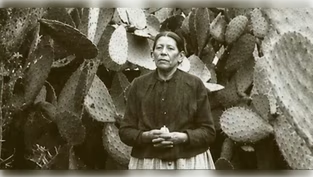
Women Who Built San Diego Preview
Video has Closed Captions
Four trailblazing women whose skills, leadership, vision and determination helped build San Diego. (30s)
Providing Support for PBS.org
Learn Moreabout PBS online sponsorship










Support for PBS provided by:
Historic Places with Elsa Sevilla: California's History is a local public television program presented by KPBS