
Vision for the Future
Episode 31 | 26m 46sVideo has Closed Captions
Learn about the leading causes of blindness in older adults.
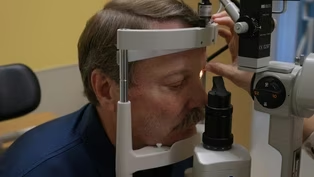
We partner with Vanderbilt Eye Institute to better understand the role our eyes play in our overall health. Today, advances in technology as well as molecular and genetic research are leading the way toward therapeutic procedures that could target eye conditions and prevent or even reverse vision loss. Discover what can be seen through the eyes, our windows to well-being.
Problems playing video? | Closed Captioning Feedback
Problems playing video? | Closed Captioning Feedback
Aging Matters is a local public television program presented by WNPT
Vision for the Future
Episode 31 | 26m 46sVideo has Closed Captions
We partner with Vanderbilt Eye Institute to better understand the role our eyes play in our overall health. Today, advances in technology as well as molecular and genetic research are leading the way toward therapeutic procedures that could target eye conditions and prevent or even reverse vision loss. Discover what can be seen through the eyes, our windows to well-being.
Problems playing video? | Closed Captioning Feedback
Where to Watch Aging Matters
Aging Matters is available to stream on pbs.org and the PBS app.
Providing Support for PBS.org
Learn Moreabout PBS online sponsorship(upbeat jazz music) (Annette chuckling) - When I was a child, I listened to Bing Crosby sing about far away places with strange-sounding names.
And I dreamed about traveling somewhere outside the little valley where I lived.
And then when I was in college, I met John McRay, who also liked to travel, and so we traveled the world together for 61 years, and now I live alone.
John died in 2018, but I have memories of wonderful places and great stories.
This is the city of Jerusalem, the birthplace of three religions.
I lived there on two occasions, and it is my favorite place in the world.
I guess when we're young, we think things are always going to be the way they are at that time.
I had lots of pictures in my mind.
They're still there.
I still call them up.
But I never considered the fact that at some point I would not be able to actually see those places.
- [Announcer] Major funding for "Aging Matters" is provided by (somber music) the West End Home Foundation, enriching the lives of older adults through grantmaking, advocacy, and community collaboration, the Jeanette Travis Foundation, dedicated to improving the health and wellbeing of the Middle Tennessee community, the HCA Healthcare Foundation on behalf of TriStar Health.
- Another of my favorite places, here in the Greek islands from the island of Santorini in the Aegean Sea.
We spent a summer there.
My husband was a writer along with his archaeology, and I was able to go on those journeys to wonderful places like this.
I think we all are so dependent on our eyes that we just can't imagine being without good eyesight.
But on Christmas Day of 2019, I was at my son's house taking a nap, and when I awoke, I had a black spot in my left eye and didn't know what it was.
The next day I went to my ophthalmologist, and she immediately said it was macular degeneration, and we had to treat it right away.
(footsteps tapping) (subdued music) Hello.
- Hi, Ms.
McRay.
How are you doing today?
- Doing well.
- Good.
I've already reviewed your pictures today, and everything looks really stable.
Macular degeneration is also called age-related macular degeneration.
So it does occur in patients who are over the age of 50 or older and can occur in two different forms, but is really a spectrum of disease.
So patients may hear or people may hear dry and wet macular degeneration.
And what it is is really, over time, our cells degenerate.
And so in dry macular degeneration, we just have the degeneration of cells over time.
In wet macular degeneration, which is a bulk of what I treat, we have the growth of new abnormal blood vessels under the retina.
Those new abnormal blood vessels leak and bleed into the retina and can cause vision loss in really what is the central vision for a patient, what we use to see faces, to read, to drive.
Think everything looks good here.
There's no hemorrhage or fluid.
Looking around.
You can sit back for me.
I'm gonna look with one more light, okay?
Patients are living longer, and I think that has to do with part of why we're seeing more patients with macular degeneration, but there are also several risk factors for macular degeneration.
So we know that patients who are of Caucasian descent may be at higher risk for macular degeneration.
There are certain genes that we're studying that can be passed down in families that can also make patients more at risk for macular degeneration.
Smoking can also affect your macular degeneration risk as well as UV light exposure.
And while some of these things are modifiable, many risk factors for macular degeneration are not.
And this is still an active area of research where we're really trying to figure out what is it that at a cellular level or a genetic level really leads to higher risk for macular degeneration.
- As we age, vision degrades.
It's going to happen simply because the visual system, like the rest of the brain and the body, were not designed to last more than than 50 or 55 years.
We've exceeded the lifetime that's been allowed by evolution, which is great, and that's awesome because part of that is also the evolution of technologies that allow us to detect visual diseases much earlier and to try to treat them much earlier.
How are you doing?
- Good.
- Talk to me.
- So, I am dissecting corneas.
- Uh-huh.
I think in the 20th century, we did a great job as vision scientists to create products, pharmacological products in particular, that slow some diseases like diabetic retinopathy or macular degeneration.
We have drugs that we can inject into the eye every few weeks to slow the growth of blood vessels that blur central vision in macular degeneration.
I think in the 21st century where we are headed are to therapies that reprogram the cells in the back of the eye to do what we want them to do.
And one way to do that is with gene therapy.
So, gene therapy in the 21st century, I think, is really going to take us to places we've never been able to go before, both in terms of the breadth of diseases that we can treat, but also in the specificity 'cause the whole idea is to try to reduce the time that people spend in the clinic so that they can spend time living their lives.
- [Avni] Okay.
So here are pictures, and there's no fluid here.
Everything looks really nice and stable.
Our clinical trials are very interesting and really exciting to me, and particularly the wet macular degeneration gene therapy trial.
We've enrolled several patients in this trial, and they undergo surgery in order to get the gene therapy delivered to their retinas.
Annette McRay was able to get gene therapy in both eyes because of a small arm of the trial we're doing where there was bilateral treatment.
And she was one of my patients that no matter what medication I used, she really required frequent injections every single month to control the amount of fluid from her wet macular degeneration.
And for her, since getting gene therapy, she has not required any injections for her wet macular degeneration, and it's remained stable without fluid and without any change to her vision.
- You got tea?
- [Friend] I do.
(chuckles) - I think that these results show us that there are new therapies on the horizon that can alter the course of treatment for our patients.
- There were two things.
I felt that it perhaps would benefit me not to have to continue to get the injections, but I also felt that at 88, there's not very much that I can do to help anybody else.
And if I could use my affliction, if I could use my opportunity to let my eyes be studied to the extent that it might be beneficial to other people, this can be a very daunting kind of experience to go through losing one's eyesight.
So I thought if I could in any way help other people, that would be something that I could do at 88 that not many people would be able to do.
- I would encourage patients who are in their 50s or 60s to see an eye specialist, particularly an ophthalmologist, especially if they have a family history of eye disease like glaucoma or macular degeneration, something that can potentially show up silently at first and so can only really be picked up on an exam with a specialist of the eye.
And looks like you're here for roughly about a three, four-week post-op visit.
How has your vision been since you were here last?
- I knew I had a family history of glaucoma.
My father had it, so I knew I was at higher risk, so, early sort of proactive screening was important for me.
Well, being a cardiologist, you know, family history is extremely powerful.
Hypertension or a high blood pressure is a silent killer.
You may not know it until too late when you have a stroke.
If you have a family history of hypertension or high blood pressure, it's important to get that checked early on and follow it, and treatment should start when it's indicated.
Similar to glaucoma, glaucoma is a silent vision killer, so to speak.
There's no early symptoms, no warning signs, and the only way to find out is to have a comprehensive eye exam when it's appropriate.
- Glaucoma is something that a lot of people have never heard of, don't know what it is.
What I describe it as, it is a, like I said, a chronic, progressive neurodegenerative condition that has to do with damage to the optic nerve.
The optic nerve is the power cable that connects the eye up to the brain.
And so if the power isn't on for your television, your television won't work.
So it's centrally important to vision.
Glaucoma happens when damage occurs to that optic nerve.
Oftentimes it's related to pressure elevation in the eye, elevated above what the eye can handle.
Okay, it's up to me through testing, through assessment, through monitoring to decide, is the pressure in your eye sustainable, or is it gonna lead to progressive vision loss?
The vision loss in glaucoma that happens usually is the side vision or peripheral vision is what we describe it as.
So as glaucoma gets worse, it's very common that people do not know that it's happening because when slowly your side vision creeps in, you get used to that vision of the world because you're still seeing very clearly centrally.
But if you lose that side vision, when it gets to be very severe and has encroached into the very center, it is a debilitating vision loss.
And so we call it the silent thief of sight because over and over, I diagnose a patient at the very end stage because they haven't noticed that slow creeping in of the side vision.
And so that's kind of in a nutshell what glaucoma is.
There's a very genetic component, so a lot of families have glaucoma worse than others.
(somber music) - Within my family, we didn't share medical history with each other.
Whether it's prostate cancer, whether it's glaucoma or other heart conditions, you know, we kind of tough it through or come up with our own remedies to keep it within ourselves.
I tried my own, using Visine to keep my eyes, not going to see the doctor because I never thought something would happen to my eyes, even though my sister had went blind, even though I'm watching my father go blind.
I just had this thing that, "Oh, nothing can happen to me.
I'm healthy."
(family member laughing) But it's good with shades on, though- - Okay.
- Because you got glaucoma, and you can't stand the light.
(both chuckle) So I was diagnosed with glaucoma in April of 2021.
Basically my wife saw me putting drops in my eyes all the time.
And with my wife having glaucoma, I knew how serious it was when your pressure is high in your eye.
Actually when I first got diagnosed, the pressure in one of my eyes was 38.
They kept me there for a couple hours before I could even leave the office.
And that's when I realized that, "Hey, I can have a serious ailment," you know what I mean?
"I can go blind."
(somber music continues) When I was diagnosed in 2021, I did a lot of research in finding out that this particular disease is prevalent among the African American race.
I think there should be more focus on glaucoma within the Black community.
There should be more outreach groups for people that don't have healthcare.
And we need to also let our siblings know, and not only our siblings, our kids know, what are ailments that is genetically inherited in our family.
- It's a good idea if you can talk with your family when you're all together sometimes so that you can understand what diseases may be in your family.
Even if it's not in your parents or your brothers and sisters, it could be an aunt or an uncle or a grandparent.
And so, good idea to get as much of that information as you can.
Having said that, sometimes people don't know their family history.
Sometimes someone's adopted, for example, and they don't know, you know, the history of any genetic conditions that they might inherit.
And that's okay because we can examine them and still be able to counsel them based on the findings of the exam if they have any problems and when they need to be seen again.
If a condition like glaucoma is not detected and goes untreated, worst-case scenario, it can result in total blindness in both eyes.
(somber music) (practitioner knocking) - [Practitioner] Hey, Derek, how's it going?
- [Patient] It's going good.
- The eyes can be a window into our entire bodies in helping us to diagnose diseases such as hypertension or diabetes.
We can see findings on examination of the front of the eyes and how the eyes move around that can indicate neurologic diseases or stroke, for example.
If someone has a brain tumor, it can increase the pressure in their brain, and that pressure's transmitted to the optic nerves that connect the eye to the brain.
When we look in the back of the eyes, we see swelling of the optic nerves that can indicate there's a serious problem.
My advice to someone aging is to make sure that they're getting eye exams at the frequency that's indicated.
For example, patients who are in their 60s or older, every one to two years, even if they have no problems, should have their eyes checked by an ophthalmologist or an optometrist.
In your 50s, a little bit less often, probably every two to three years, and in your 40s, probably about every three to four years.
(light clicks) - What would be the lowest word that you can read down this left-hand column here?
- Certainly, if you have an eye problem, or if you wear glasses, you're getting periodic eye examinations to update the glasses or to monitor whatever problem you have.
But even if you think, "I've got nothing wrong with my eyes," it's still important to periodically get your eyes checked and then follow the advice of your eye care professional in terms of when your next follow exam needs to be because if you develop an eye disease, there's a good chance that you can get effective treatment and give you the best possible outcome for a lifetime.
Or we might detect on an eye exam that you have an issue related to your systemic health, high blood pressure, diabetes, other problems, and that's gonna help you to get earliest diagnosis, best possible treatment, and best long-term outcome.
(gentle upbeat music) - I think we all take our sense of vision for granted because we sense that we're always gonna have it, but when you start to have challenges with it, you start to become fearful of things like, you can't enjoy the nature that God gave us.
And my biggest fear was I wouldn't be able to see my grandkids grow up.
(birds chirping) (Bradford exhales) So I'm extremely grateful that I was referred to Dr.
Groth at Vanderbilt Eye because she's been absolutely the best.
And with her expertise and experience, I'm gonna be able to see my grandkids grow up.
- Is that height okay for you?
- Yeah, it's fine.
- Okay.
When you're young, you always want things to get better, but as we get older, if we can stay the same, that's winning.
We're gonna fight like heck to try to preserve everything we do for as long as you as my patient are living, but we definitely need to celebrate the now.
Very encouraged.
(upbeat energetic music) - I'm a very positive person, and my friends and colleagues, they all go, "You do so well in terms of dealing with this loss entirely of your vision."
And I just keep it as a part of my life.
My life is not my loss of vision, and that's very difficult for everyone.
People at large do not understand, and they think of a way that you're supposed to act.
I should just sit here at home and eat bonbons, watch TV.
That is not me.
As a retired gerontologist, I cannot express enough about how important it is to exercise, to be mobile, to develop strength.
And so I do that by going twice a week to a 50-forward community center.
And then on another couple of days, sometimes three, I go to water aerobics at another center.
And this helps me keep my strength, keep my mobility, even though I do have medical issues.
(cane tapping) - Having low vision or a vision impairment inherently can make it more difficult to stay active and to get up and get around and be independent and be mobile and participate in physical fitness activities or just walking.
But it's important to be able to maintain strength and balance to sometimes counteract some of the visual challenges that cause decreases in depth perception or peripheral or spatial awareness and make it inherently more difficult to be mobile.
- You're not gonna be able to get up off the toilet if you don't strengthen yourself, your core, and have balance.
I'll come over, see how you're doing.
Did you want a pet?
Did you want me to give you a tummy rub?
Is that what you want?
One of the services that has been most helpful in this journey that I'm going through is Tennessee Disability Pathfinders.
They provide support and community services and resources for you.
So all you have to do is give them a call, and they will provide you with whatever you need, and the staff does one-on-one with you.
And my counselor has been very, very helpful for things like finding a vet for me because I have outrageous queens for cats, and she was to find a vet that will come here and understand and help me (grocery cart clanking) And I need to speak about transportation.
Thank you, Mohammed.
- You're welcome.
(cane tapping) - Transportation is extremely important to people who are disabled and absolutely makes my life possible in Nashville 'cause I have a very special company, Mobility Solutions, with Mr.
Mohammed, in which all of the drivers (traffic humming) are very kind.
Thank you so much.
And always are ready to help us in any way that we need.
I know they're coming to get me.
They're not gonna leave me.
They're not gonna drive past and see I have a cane and say they don't wanna deal with me.
I know for sure that they will take care of me.
I can't emphasize how important transportation is.
This makes it a lot safer for me for you to come and pick me up.
I'm very committed to my own independence, and I have to be.
It's me.
Thank you.
- We don't have to let the vision loss define what we can and can't do.
We may have to come at that task from a different angle or in a different way than we used to, and if we can embrace that, then we can thrive.
And that's what I'm trying to show people on a daily basis and get them to the point of realizing that potential.
(keys jingling) - Glaucoma will be the problem.
It is showing itself right now and taking daily my vision.
I don't have any recourse any longer, and it's pretty scary.
I don't wanna really get emotional, but you know what?
Life is what it is.
You either sit down and die because you've become non-mobile, you don't do anything, and life is no fun.
And I just can't do that.
(attendees chattering) (upbeat music) I'm going to introduce one of the organizations that I belong to that's called Disabled to the Front.
And we advocate to the city council, the metro council, for making this city entirely accessible for all of us who are disabled.
(upbeat music continues) (participants singing) ♪ You had me going crazy ♪ - [Emily] I like to go out and dance.
I like to go and do karaoke with my friends at Disabled to the Front.
We go to places to see if they're accessible, and we dance, we sing.
I wanna be able to do that until I die.
So, it's very, very important for me to be independent and to be able to enjoy my life as it is.
(participants cheering) - If you ask someone, "What is it you fear most about getting older?"
most people will answer, "Losing cognitive ability."
But a very, very, very close second is losing sight, and that is because those visual memories help define who we are as human beings and as individuals.
(upbeat jazz music) It's an incredible gift, vision.
So my advice to patients, one, don't ever lose hope because the treatment is right around the corner, and two, ask questions.
Stay informed, not just with the internet, but talk to your physicians.
Talk to your eye doctors.
Make certain that they know you are interested should a relevant clinical trial come on board.
- I've actually looked forward to this part of the study because you two have made it so pleasant, and I've felt very well cared for.
I think if I'm going to say anything to anybody else, it's to take care of your eyes.
Go to your eye exams.
Follow the directions of those who know what your needs are.
Cultivate relationships in your life that provide people who care about you and about whom you care.
And know that it is such a comfort when you reach 88, when your eyesight is challenged, when you have other health needs, it is such a wonderful gift to know that there are those who will care for you, who care about you, and it's a mutual sharing.
You care for others, and then others care for you.
And it's a great, great comfort at this stage of life to be well cared for.
(gentle upbeat guitar music) (anticipatory music) - [Announcer] Major funding for "Aging Matters" is provided by the West End Home Foundation, enriching the lives of older adults through grantmaking, advocacy, and community collaboration, the Jeanette Travis Foundation, dedicated to improving the health and wellbeing of the Middle Tennessee community, the HCA Healthcare Foundation on behalf of TriStar Health.
(light upbeat music)
Video has Closed Captions
Clip: Ep31 | 30s | earn about the leading causes of blindness in older adults. (30s)
Providing Support for PBS.org
Learn Moreabout PBS online sponsorship New Episode
- News and Public Affairs

Top journalists deliver compelling original analysis of the hour's headlines.
 New Episode
- News and Public Affairs

FRONTLINE is investigative journalism that questions, explains and changes our world.
 From My Station
 New Episode
 New Episode
 New Episode
 New Episode
 New Episode
 New Episode
 New Episode
Support for PBS provided by:
Aging Matters is a local public television program presented by WNPT