Alabama Public Television Presents
Tuxedo Junction: Almost Lost Story
Special | 52m 8sVideo has Closed Captions
Explore the story of Tuxedo Junction in Birmingham — the neighborhood, the place and the song.
A documentary about the legendary Ensley-based jazz venue Tuxedo Junction not only highlights the history of the famed building and its many incarnations for Black-owned businesses, it’s also an insightful look at how it became a worldwide musical icon due to Birmingham-born trumpeter and band leader Erskine Hawkins commemorating it in one of the most popular songs of the big band era.
Problems playing video? | Closed Captioning Feedback
Problems playing video? | Closed Captioning Feedback
Alabama Public Television Presents is a local public television program presented by APT
Alabama Public Television Presents
Tuxedo Junction: Almost Lost Story
Special | 52m 8sVideo has Closed Captions
A documentary about the legendary Ensley-based jazz venue Tuxedo Junction not only highlights the history of the famed building and its many incarnations for Black-owned businesses, it’s also an insightful look at how it became a worldwide musical icon due to Birmingham-born trumpeter and band leader Erskine Hawkins commemorating it in one of the most popular songs of the big band era.
Problems playing video? | Closed Captioning Feedback
How to Watch Alabama Public Television Presents
Alabama Public Television Presents is available to stream on pbs.org and the free PBS App, available on iPhone, Apple TV, Android TV, Android smartphones, Amazon Fire TV, Amazon Fire Tablet, Roku, Samsung Smart TV, and Vizio.
(no audio) (pensive music) [Carol] In Ensley, there was something to be proud of.
[Magnolia] I wanna start something so that peoples can realize how important is and was to city of Birmingham.
[Jahman] Oh man, if the walls could talk, they would tell you about the jazz nights they had.
[Bo] It's a great song.
I mean, people played that all over the world.
Tuxedo Junction.
[David] You have to have a place to have your culture.
I have never heard of Tuxedo Junction.
I haven't heard of Tuxedo Junction.
Oh, music is in Alabama's soul, for sure.
No, not really.
I don't know too much about Tuxedo Junction other than what I've heard Erskine Hawkins and you know, all that group that was out there.
But, you know, I can't say I'm knowledgeable about it, yeah.
I don't know anything about them.
They sound like a band if I had to assume.
Yeah, it sounds like a band.
Yeah.
Yes, I'm from Birmingham.
Tuxedo Junction sounds very familiar.
I can't place it.
(upbeat jazz music) (rhythmic jazz music) (rhythmic jazz music continues) I have seen that building all my life.
I had never known what it was, who was in there.
I never knew.
I never knew.
The history that I know is the stories that I've been told.
The stories that you would hear.
And I was like, one story led to another person.
I used to like to just hang around older people because they always had something to tell you.
You can learn a lot.
All you had to do was be quiet.
It's not as much of a book history as much of an oral history.
And I just started asking the people around town and they were so excited they would tell about it and the music that came out of there.
It's like, wait, what used to happen here?
(chuckles) (rhythmic jazz music) My husband, when we were dating, that was my first experience with Ensley because I lived on the other side of town and when we would go to Ensley, you saw this big 7 Up sign and Tuxedo Junction.
It was under the bottom of it on the building.
And I was like, "What is that?"
And he said, "Oh, that's where I used to dance a long time ago."
So my next thing was who was this?
How did this happen?
So, that's when the legwork started.
(bright jazz music) (bright jazz music continues) (bright jazz music continues) Ensley was a cowboy town And Ensley was one of those neighborhoods, really a city in its own right of Birmingham.
And one of the biggest and most populous because it had the largest employer in Birmingham at the time, the Tennessee coal and iron plant was in Ensley and they employed thousands of people.
At the time, Black people weren't really booming, but they had a little bit more than others had because they worked at TCNI, they work in mines in TCNI all day in the hot, sweat, dirt.
The Blacks made the money.
This was money.
Money talk and other stuff walk.
Black people made their money right here.
Steel mill.
It was the biggest money maker in the city of Birmingham.
So it was a booming part of Birmingham.
(rhythmic jazz music) What I found out about Ensley, which totally blew my mind, Germans, French, Italians, whites, Blacks, all lived in Ensley together.
Back at that time.
Ensley was a very thriving neighborhood.
We didn't have to go anywhere to shop or anything like that.
And simply because when we was growing up, we didn't have to take money to the store to purchase things.
All we had to do was take my father's steel plant badge.
Once we give them my father's steel plant badge, we was able to get whatever we wanted to purchase.
[Carol] Tuxedo Junction is a neighborhood and it's where 19th Street and 20th Street meet.
[David] You had African-American culture that was there in the African-American neighborhood around where Tuxedo Junction was, which was formed by the junction of the street car lines there.
And that's why the trolleys interchange right there in the junction.
That's why it called Tuxedo Junction.
That's why the trolleys interchange from Pratt City to North Birmingham to Wylam.
All exchanges went right there in the junction.
My father and others that worked at the steel plant would meet at that two-story building down there.
They would ride a drive and talk to get there.
So after a hard week's work, that was the hangout as you would say it in our time.
But really that's where it all began on that corner.
(lively jazz music) (lively jazz music continues) It kinda became the stopping ground for good entertainment, good food, and a place for African Americans to come together and have a good time.
Ensley had more nice clubs than anywhere in Birmingham, especially for Black people.
And so, if anybody from anywhere came to Birmingham, it was in Ensley where they had to come for a nice time, nice time.
The Tuxedo Junction building was the Nixon building it was called.
And mostly steel workers or the everyday people would get off from work.
They would stop at Tuxedo Junction over in Ensley.
The ballroom was upstairs.
You couldn't go to the ballroom dressed in casual clothes.
You had to wear tuxedos, you had to wear suits.
You couldn't walk in there any kind of way.
They used to save up and rent the zoot suits, give their clothes to the cleaners until they brought the money and the suit back and they keep it the whole weekend.
And there was a boarding house there too.
The boarding house was right next door to Tuxedo Junction.
They'd go in there, take a bath, change, come back out.
They've told their lady to meet them, go eat, come back and have fun.
And everybody was sharp.
Ladies were sharp.
Guys were sharp.
Thought they were all that.
(upbeat jazz music) [Leah] So it was a place where you could feel free, feel fun, get your tension out from the week and just enjoy the good big band sounds that were developed right there in Tuxedo Junction.
(lively jazz music) And it was theirs.
It was their music.
Nobody telling them what to do.
You come in this door, you come in that door, you sit here, you sit there.
No, everybody came in, had fun, sat down to a table, jumped up and danced when they wanted to, and just had fun.
That's all it was about, having fun, original fun.
It was hard times but other times like that, that was good times.
And that was something they treasured.
(lively jazz music) (lively jazz music continues) (bright jazz music) (bright jazz music continues) Well, it's called the History of Birmingham Jazz and it's just one iteration of a series of paintings I do called "Trading Card Series."
And the paintings themselves are small and they're meant to have the essence of your basic trading card.
I'm holding in my hand one of the best books written about Tuxedo Junction.
It's "Tuxedo Junction Back Where I Belong" and it's by Carol Ealons.
And she wrote it herself as a tribute to the history of the place.
It's chockfull of historic photographs and many of my subjects over there, you can't find a photo of them on the internet.
So this book was a Godsend.
(bright jazz music ends) But it was so many that came out of here that we knew nothing about.
Nothing about.
And I want these kids to know in Ensley, there was something to be proud of.
(uptempo jazz music) (uptempo jazz music continues) (lively jazz music) (lively jazz music continues) Erskine Hawkins was famously known as the 20th century Gabriel.
Back in Birmingham he was called Iron Lungs 'cause he could blow so hard.
But when he became a star, it was 20th century Gabriel.
You know, Erskine Hawkins was a product of Birmingham, product of Ensley that spent a lot of time, of course, in Tuxedo Junction honing his own craft before he went off and played for national bands.
(lively jazz music) Erskine Hawkins was like a game changer.
He's one of the few people who wrote his own music.
At a recording session in 1939.
They needed something for the B side of a record that was expected to be a hit called Gin Mill Special.
And so in the recording studio, they kinda patched something together and they recorded it and they called it "Tuxedo Junction" in homage to the place Tuxedo Junction back in Ensley.
When they gave it a title, "Tuxedo Junction," it really became for them this really important nod to their home.
But Erskine, he came up on a masterpiece.
He really did.
The melody of it.
(vocalizing) It just makes you move, you know?
And especially the feel, the feel of how the melody is being played.
(vocalizing) I mean you can't help but move from that.
You know what I'm talking about?
I mean, no way you can listen to that and not move.
(quirky jazz music) (quirky jazz music continues) In the big band era, it was the dance music on the radio and nobody had a TV.
So everybody listened.
You know, the cooks were cooking to the beat of that music and everybody was playing it.
And the shoes shine guy was shining shoes to the beat of that music.
And I used to listen to that song every day in the museum 'cause we would play it on the Loop.
And when I started writing about it, like the foot got to tapping and the people started stretching and everything was to the beat of "Tuxedo Junction."
And I would have it playing when I'd be writing and I'd find myself, I say, "Uh-oh, foot going."
(chuckles) They didn't expect it to become the hit that it did, but it very quickly became a major hit with their audiences.
It went to like number seven on the Billboard Chart.
Back then that was a big thing for an African American artist.
And then the same year, it was released in 1939 by the Hawkins band, Glenn Miller released a version of it.
Glenn Miller was a hugely popular white band leader.
These records were marketed Glenn Miller records to white audiences, Erskine Hawkins to Black audiences.
So it was very segregated in terms of the listenership, but it was through Glenn Miller that like White America discovered this song.
Glenn Miller's orchestra did that song and it went to number one.
It just exploded.
(rhythmic jazz music) There is, as we all know, a very long tradition of white musicians taking the products of Black musicians and becoming rich and famous and celebrated.
Glenn Miller was accused of stealing "Tuxedo Junction" from Erskine Hawkins, which Erskine Hawkins himself rejected that 'cause Glenn Miller apparently approached him after hearing the song live at the Savoy Ballroom in New York and said, "I would love to record that song.
Do you mind?"
And Erskine was like, "Sure."
And of course if Glenn Miller's record made lots of money, that means Erskine Hawkins was getting lots of royalties, which hasn't always been the case in American music.
(rhythmic jazz music) Erskine Hawkins sat down with Buddy Feyne, this songwriter from New York and told him, "Well, here's what the song was about to us.
Here's what it means to us."
And so very quickly, Buddy Feyne came up with those lyrics about, you know, way down south in Birmingham.
♪ Feelin' low ♪ ♪ Rockin' slow ♪ ♪ I wanna go ♪ ♪ Right back where I belong ♪ ♪ Way down south in Birmingham ♪ ♪ I mean south in ♪ People knew nothing about Tuxedo Junction and where it was and all that, but when he wrote the words to it, it's all she wrote because at that time, the words said exactly what the people were going through and what they knew to be true.
♪ We are heading for Tuxedo Junction now ♪ ♪ It's a junction ♪ And this happened also to coincide with the Second World War.
And so, it became sort of an anthem of the warriors.
And this idea of like going back home, right back where I belong resonated with people who'd never heard of "Tuxedo Junction."
And Glenn Miller was like this war hero.
And you know, the song was broadcast to, you know, armed service members overseas.
It was played by military bands.
It just became this anthem of this really important moment in history.
I think it became this, particularly this source of pride in Birmingham and especially in Birmingham's Black community historically and in Ensley itself.
It's a great song.
It's a great song.
I mean people play that all over the world.
"Tuxedo Junction" all over the world.
♪ There's a place and we are headed for ♪ ♪ Tuxedo Junction right now ♪ (upbeat music) I would describe Ensley as the heartbeat of the greater musical picture in the area.
(upbeat music) That building on the corner of 20th Street and Ensley Avenue, at one time my, my father's baby brother had a club up there and that's where my brother Paul and Eddie started singing.
I don't know about present day kids, but I know that adults in Birmingham that are my age or older definitely know that The Temptations are from Birmingham.
And they know it because Eddie sang it all the time.
I mean he said it in every interview.
If he didn't say the word Ensley, he said Birmingham.
Okay, I'll be more than glad to.
♪ If this love that you're running from ♪ ♪ There's no hiding place ♪ ♪ 'Cause love has problems, I know ♪ ♪ But there's problems ♪ ♪ You just have to face ♪ ♪ Oh yes ♪ ♪ So if you just put your hand in mine ♪ ♪ We're gonna leave all our troubles behind ♪ ♪ Keep on walking, don't look back ♪ The song there is "Don't Look Back" and it was on one of the albums that they did in their early years.
In the early years my brother was the only lead singer in the group, The Temptations.
In fact, my brother, on the first two or three albums, my brother did most of the lead singing.
(upbeat jazz music) At that time, Ensley was an area where we as Blacks lived in a certain area and those of the Caucasian race lived in a certain area.
It was kind of a founding corner almost and that building was fairly close to where they all lived.
It was far enough that it wasn't going to disturb anyone, but it was still safe territory.
I do know for a fact that Eddie, Paul, it could have been neighborhood kids did sing on that corner.
Not because they were trying to become The Temptations, it was not a becoming moment.
They didn't know anything about that.
They were doing it because they liked it.
They were doing it because it was about the only thing that young Black men at the time could do.
There was no park in the area, period.
And you certainly could not go to Ensley Park.
African American people were not allowed at that time to go to the park.
So there was no park.
And so, with no park, you stood on the corner.
That was your park, (chuckles) that was your spot.
Paul and Eddie wasn't the only guys standing on the corner singing.
We grew up around gospel music.
Like I say, my grandfather and he raised my uncles and my dad to be gospel singers.
In fact, we never played rhythm and blues in our house.
Never, Eddie and Paul was influenced by gospel music.
I remember when they used to do talent shows, but the group that Paul and Eddie sang would always win.
And I remember as a kid one instance where they lost.
And so, Eddie came to the house and my brother Paul was so upset 'cause they lost.
And so, Eddie told him, say, "Well Paul, we lost 'cause them guys had uniforms.
We didn't have uniforms."
And that's the first time that they purchased uniforms.
But I'm not gonna say uniforms 'cause they only bought a white shirt and a red cummerbund.
(laughs) Eddie was definitely the person, he was the clothes designer in the group.
In addition to that, he chose which outfits they were going to wear for a particular gig.
He had great taste in clothing.
He wasn't frilly, he wasn't fancy.
He was classy.
And so, the group was known for that, that class that they had.
You know, I seen them on "The Ed Sullivan Show" and stuff like that.
But to witness it in person, you know, that just blew my mind.
I saw how the people, how they loved them so.
And when I traveled with them, everywhere they went, I could tell there was no other group as good as they were.
I could see it for myself.
And that just blew my mind.
♪ Girl, it's you that I need ♪ ♪ I gotta get, next to you ♪ ♪ Can't you see these tears I'm crying ♪ ♪ I can't get, next to you ♪ (audience applauding) (upbeat jazz music) Now my experience with the Nixon building is different from my brothers.
My experience was that there was a dentist there and he was the only Black dentist that I knew of.
He was my dentist.
He was my father's dentist.
He was my mom's dentist.
And that's why I knew of the Nixon building.
(upbeat jazz music) Growing up, Dr.
John Nixon was my dentist.
He wanted his own place and he ended up buying the Nixon Building and the reason why he bought that was because he wanted to bring attention to the area that was known all around the world, Tuxedo Junction.
And he wanted to preserve that building from a city standpoint, we were so grateful that he acquired the building and wanted to keep the legacy of the musical history into the area there.
(upbeat jazz music) (somber music) Ensley went down like a Titanic when that steel plant left.
(somber music) You know, there's nothing to sing about these days.
(somber music) To think that, you know, people have heard of it, if they come to Birmingham, they wanna see it and it's like, you really don't wanna see it.
(somber jazz music) (somber jazz music continues) When we see the dilapidation, if I'm six, seven, eight, 10, 12 years old, this space doesn't look that important.
Right, so why am I going to feel like it's important?
(somber jazz music) [Burgin] I don't know what happened to the sign.
(somber jazz music) (somber jazz music continues) (somber jazz music continues) All you could think, when anybody mentioned Ensley, all you could think about was the project.
'cause it was domineering with crime and stuff like that.
(somber jazz music) The crime rate has gone up.
(sirens wailing) (somber jazz music) It has become very violent.
It wasn't like that, you know, growing up.
(somber jazz music) The people did not have the financial resources to maintain the lifestyle that was there.
Those businesses gradually shut down and closed.
(pensive music) And so, there weren't any economic opportunities in that area and the buildings and shops and stores became boarded up, became rundown.
You have to have movement in a building to keep it alive.
And because that movement was not there, many of those buildings just went to ruin.
Somebody from Birmingham doesn't know the extent to which Birmingham musicians helped change the world.
Certainly the world of music, they should know and take real pride in it.
And the rest of the world who only knows Birmingham from a handful of iconic images from 1963 in the height of the civil rights movement, the rest of the world could learn more about what else Birmingham has done.
My favorite place to go in Birmingham, the Civil Rights Institute.
So I would travel there and as a spoken word artist, I would actually like go in and look at the different artifacts and then write poetry and spoken word about the different moments.
(tense music) (tense music continues) (sentimental music) (sentimental music continues) (sentimental music continues) And to just learn about all the change that had happened here in Birmingham, I just was obsessed with it in a way.
This history is what helped to create the America we live in today.
So I wanna be able to tell those stories and to tell other people about those stories.
Because growing up, we weren't told about the civil rights history.
We learned about Rosa Parks, Dr.
King, and that was it.
(sentimental music) So, to be able to learn about all of these different things and then to tell others about it was just really important to me.
I wanted to be in this place where I felt like so much had happened and there was just so much rich history here.
(sentimental music) Birmingham was known around the world for the civil rights movement.
(sentimental music) In many people's mind, they still view us as a civil rights city.
That's the Birmingham that people know around the world.
(tense music) What I saw, my task as the mayor of the city of Birmingham, was to tell the full blown picture of the city of Birmingham.
Yes, we had our issues with integration, segregation, and things of that nature.
There's another side to Birmingham that we wanna tell that story.
The musical history of this community, the educational history of this community.
(slow music) Parker High School starting out as industrial school, Parker used to be the only high school for African American kids in the state of Alabama.
(slow music) It was founded on the Booker T. Washington idea of industrial education.
Students would be trained in a specific manual discipline.
It was segregated by gender so that girls might study sewing or cooking or some kind of domestic work.
Boys might study shoe repair or carpentry or printing or later automotive repair.
Industrial used to have dormitories that were shacks and that's where those children were piled up in those shacks because they didn't have anywhere to put them.
People coming from Mobile, Montgomery, Tuscaloosa, (slow music) All we could do at the time they thought was cook, clean, and plant.
And there was so much more.
And thank God for those ladies and gentlemen that knew that and had enough gumption to push it.
(somber music) The theme of it was a dream that came true.
So, it was the dream for the Black kids to have a school to go to.
Black people from way back when were taught to be submissive.
They say didn't like that.
(uptempo music) Fess Whatley, the maker of musicians he was called.
[Burgin] You really can't talk about the history of jazz in Birmingham without talking about Fess Whatley, who is a really unsung hero in the larger story of jazz period, but was essential to the development of that music in this city.
[Craig] Well they call him the Fess, shorten of professor.
He was the printing teacher, but he was the de facto band director and leader also.
He wanted the same things that were in the white schools.
Teacher here.
These kids need to learn more than this.
I know some people who actually worked with him, were in his bands and they always said the same thing, that he was very, very rigid, very strict.
(lively jazz music) [Carol] And Fess was a disciplinarian.
As a musician, he proposed the idea that music could be an industrial discipline.
It was something that a student could do with their hands that could ensure them work after graduating from high school.
And it was a pretty remarkable reinvention of what this idea of industrial education might mean.
This idea that was kind of intended to keep African American students and graduates in a specific social place, but here at Fess Whatley invent something that transcends that.
I think because he wanted the jazz artist to rise to a certain level, every one of his jazz artists had to learn how to read music.
You couldn't just wing it.
(uptempo jazz music) And it was big for the musicians because it was a potential way out of the city and a potential way to make a living.
And they learned that they didn't have to work in the mills and the mines and the factories.
They could be a musician, achieve certain fame, make money.
(uptempo jazz music) The Fess Whatley students were graduating, putting on tuxedos and playing with Duke Ellington and Cap Callaway and Count Basie in the most sort of glittering ballrooms and dance halls of the world.
[Craig] All the great orchestras, they knew they could hire Birmingham-trained people because they could read music and they were disciplined.
Lore has it that Duke Ellington would say, "Send me a Whatley-trained musician no audition required," because they were scholarly, they were punctual, they could read music.
They knew how to dress, they were professional.
They were characteristically sober.
So they had these certain qualities that Duke Ellington recognized in a Birmingham musician.
The big band orchestra leaders that were Black, they wanted their seats filled with Fess Whatley's students.
When Count Basie needed a chair filled he didn't have, Fess Whatley, because he knew his students could read.
(thrilling jazz music) (energetic jazz music) (energetic jazz music continues) (energetic jazz music continues) Carrie Tuggle was an African American social reformer in Birmingham, late 19th and early 20th century.
She was active in all sorts of aspects of life in Birmingham as a social reformer, as a writer, as a newspaper publisher.
But one of which, and maybe most notably, was the development of the school, the Tuggle Institute, which she founded.
And the Tuggle Institute was initially created as sort of a home and a school for homeless and orphaned and destitute Black youth in Birmingham, as well as youth who had had trouble with the law in some kind of way.
And so she would take these children and give them a home and give them an education.
(energetic jazz music) Carrie A. Tuggle, she saw the gift in Fess.
Fess Whatley was not an orphaned or homeless, but Fess Whatley was sent to Birmingham because they knew that would be a good place for him to get an education.
Carrie Tuggle hired trumpet player named Sam "High C" Foster to teach music at her school.
He was the first professional educator to teach music in an African American school in the city of Birmingham.
And from that began this enormous tradition.
He taught Fess Whatley and High C Foster also taught Erskine Hawkins.
So, there was a culture, a developing culture of music in the schools.
Fess got to be known as John Tuggle Whatley.
She gave him her name.
That's how much this lady believed in him.
Knew he would be something, told him he would be something.
She was like that with all of her kids.
She wanted all of them to make it.
She wanted all of them to learn.
(slow music) (rhythmic jazz music) (rhythmic jazz music continues) (rhythmic jazz music continues) I always was doing for other people, when you do helping other peoples, you cannot feel bad.
So from there I became neighborhood president and then after that, they started The Function at the Junction.
37 years this year.
We would've been 38 but the virus kept us down one year.
(rhythmic jazz music) Your history is here and it's great history.
And you should remember from whence you came, the Bible tell you that.
(rhythmic jazz music) You don't remember where you come from, you don't know where you're going.
(rhythmic jazz music) Mr.
Gordon, Mr.
Lowe, Sammy Lowe, Mr.
Abrams, Parker, all those people.
And they came from the big band era.
They came home and did what Fess had started, teaching the children how to read.
(rhythmic jazz music) I think that especially when we think about music, when we think about spoken word, when we think about film, these are vehicles that allow us to learn so much.
That's why I think the learning about, like the history of music, right, the history of your location, the history of where you're at is important because it gives you context.
And that context also helps you to, you know, figure out why do I move the way I do, right?
Why do I speak the way I speak?
(rhythmic jazz music) And that's where place is so important to culture.
You have to have a place to have your culture, you know?
The Tuxedo Junction was one of those places.
(rhythmic jazz music) (rhythmic jazz music continues) I am doing all this just because it's what I love.
I love music.
I love music that comes from a specific place, a specific time, a specific community.
And in Birmingham specifically, there's such rich legacy of music, particularly jazz, but lots of music.
So I've been drawn to telling those stories and playing that music on the radio and just kinda collecting and preserving what I can of those traditions.
(rhythmic jazz music) We came together with several teachers from the school systems, from the colleges to design a jazz curriculum, which not just teaches the music, but teaches the history of jazz, the theory of jazz, and why jazz exists and how it was formed.
(rhythmic jazz music) (audience applauding and cheering) [Audience Member] Whatley!
How about that?
That was an outstanding piece by our favorite jazz musician.
I blink and the jazz (indistinct), it does set Tuxedo Jazz Function, you know?
So I need to play some jazz out here to keep the stand.
Don't wanna get it twisted.
Next to him we're gonna play by this great jazz hall of fame, rest in peace, stay right round on Avenue J, Joven Cannon's called "Family."
(uptempo jazz music) But jazz is hard.
Ain't complicated.
So you just can't jump out the bed and play it.
You gotta put some time on.
It's the only of America made art form.
We created jazz.
(uptempo jazz music) (rhythmic jazz music) We need to do more in educating the young people on jazz 'cause they don't hear another.
(rhythmic jazz music) See, I've talked to some band teachers and they play all this stuff and I said, "Man, you ever tried to introduce the kids?
Oh man, they don't wanna hear no jazz, man."
But you can't sit here.
You can't sit here until you present it to them.
Most of those young people you see in there, they had good teachers.
You know, I tell people all the time, even at this age, I'll drive a hundred miles just to play.
I would do.
I mean, I do it all the time.
I still do it because, you know, it means a lot.
It's just so much about the music that people, people don't really understand about musicians for sure, why they love it so much, you know?
But I used to tell my teacher before he passed, "Man, you messed me up, man.
I'm hooked on this music thing.
I can't do nothing."
He used to laugh and say, "That's a good thing, man."
You know?
(rhythmic jazz music) In Ensley, nowhere else, in Ensley, I would like to have something done in the memory of Paul William.
And I'm hoping that this would be a step toward that.
Yeah.
(rhythmic jazz music) And that statue was erected, that whole park was done with the city of Birmingham really getting on board with it.
It's a source of pride.
(rhythmic jazz music) We have a notable impact on this art form and for us to really not know that is not good.
(rhythmic jazz music) The south has a history of producing that type of talent.
And to keep that legacy going on, we have to expose our youth to it.
Just like those pioneers were exposed back then.
(rhythmic jazz music) Well hopefully they can revitalize it again and maintain the history of that area to refocus people back on the significance of that building, Tuxedo Junction, Because we got a new generation of young people.
(rhythmic jazz music) If you study the history of jazz, jazz was dangerous music when it came out.
(rhythmic jazz music) I don't know if our children know it as well as we did and as well as I still know, but you don't forget Tuxedo Junction.
It's a theme with Parker High School, you know, it's history.
(rhythmic jazz music) ♪ Birmingham, Birmingham ♪ ♪ Birmingham is my home ♪ (rhythmic jazz music) (rhythmic jazz music continues) (rhythmic jazz music continues) (audience applauding and cheering) [Audience Member] Yeah!
(audience applauding and cheering) (energetic jazz music) (energetic jazz music continues) (energetic jazz music continues) (energetic jazz music continues) (energetic jazz music continues) (energetic jazz music continues) (energetic jazz music continues) (energetic jazz music continues) (energetic jazz music continues) (energetic jazz music continues) (energetic jazz music slows) (audience applauding) A punk club?
I've been living in here, you know, basically all my life and I know all the clubs.
Now we do have a strip club up there (chuckles) and we have a motorcycle club.
We have all the kind of club, but a punk club, I never heard of that.
And named Tuxedo Junction?
Mm-mm.
(uptempo music) I got into music because I wanted to play punk rock.
You know, I played lots of shows at Tuxedo and it was a perfect place to have punk shows and that's what we were doing and touring bands, awesome touring bands were playing there.
So, when I was roughly 15, I loved this band Propagandhi.
I had to go and they were playing at Tuxedo Junction.
When I heard Fugazi was coming through town, they were playing at Tuxedo Junction.
I was like, cool.
But I didn't know where Tuxedo Junction was initially.
I didn't know the history.
I didn't know the part of town.
And my dad said, "Absolutely not."
No way.
No how.
You are not going to Tuxedo Junction."
But then my sister and I hatched a plan to find somebody to drive me there.
No, it didn't have a sign.
There was no Tuxedo Junction sign.
I'm sure of that.
If anybody else says, it's not that I disagree, but I never saw any such thing.
And there's no air conditioning and there's no real PA system.
And it's one of my favorite bands playing just upstairs in this weird old building.
And it was probably the hottest room I've ever been in.
People who were so excited to be there, so into this music, it was so loud.
The floor was absolutely bouncing, right?
It was absolutely bouncing.
And it wasn't just like a, oh, you feel some hardwood kind of moving.
You could see the hardwood moving, like it was going to just take down the building, there was so much energy in the ground.
There were moments where I was like, I could die.
I have no idea what's happening right now.
This place could fall.
Like it could cave.
I was too excited and too young and too, you know, overjoyed with like this experience.
And it was unbelievable.
And like the most chaotic frenzy show of my youth to go see.
♪ No, I don't wanna know, no ♪ (upbeat punk music) ♪ I don't wanna hear ♪ ♪ You bitching in my ear ♪ ♪ No I don't wanna hear you ♪ ♪ I'm too cool for school ♪ ♪ I'm too schooled for tools ♪ ♪ It's not that I can't make it alone ♪ ♪ But I prefer to do it on my own ♪ ♪ Despite the things you're saying ♪ ♪ Now I don't wanna see you downing chasers ♪ ♪ And I don't wanna see your funny faces ♪ To my understanding what had been happening in the 1930s, they were like innovating jazz, which changed the whole world.
And it's still a star on the map across the globe.
(upbeat punk music fades) (no audio)
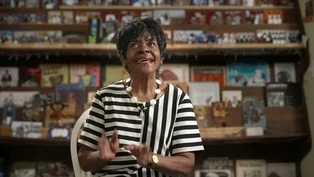
Tuxedo Junction: The Almost Lost Story - Preview
Preview: Special | 30s | Explore the story of Tuxedo Junction in Birmingham — the neighborhood, the place and the song. (30s)
Providing Support for PBS.org
Learn Moreabout PBS online sponsorship












Support for PBS provided by:
Alabama Public Television Presents is a local public television program presented by APT