The Witness is a Whale
The Witness is a Whale
Special | 52m 5sVideo has Closed Captions
Reveals one of the greatest environmental crimes of the 20th Century - the slaughter of whales.
Reveals one of the greatest environmental crimes of the 20th Century - the secret and illegal slaughter of hundreds of thousands of whales by the Soviet Union and Japan during the Cold War. Through never-before-seen archival footage, hidden documents, and personal records kept by Soviet scientists, "The Witness Is a Whale" exposes this ruthless killing for the first time on film.
Problems playing video? | Closed Captioning Feedback
Problems playing video? | Closed Captioning Feedback
The Witness is a Whale is a local public television program presented by KPBS
The Witness is a Whale
The Witness is a Whale
Special | 52m 5sVideo has Closed Captions
Reveals one of the greatest environmental crimes of the 20th Century - the secret and illegal slaughter of hundreds of thousands of whales by the Soviet Union and Japan during the Cold War. Through never-before-seen archival footage, hidden documents, and personal records kept by Soviet scientists, "The Witness Is a Whale" exposes this ruthless killing for the first time on film.
Problems playing video? | Closed Captioning Feedback
Where to Watch The Witness is a Whale
The Witness is a Whale is available to stream on pbs.org and the PBS app.
[music] [Jonathan Pryce narrating] A thousand years ago, the ocean was full of giants.
Whales were so numerous that they shaped how the ocean worked.
They even affected the land.
The evidence is written into their behavior, their character, their communities, and the world that formed around them.
The clues are everywhere.
[music] [music] We must deduce how many whales there once were and what happened to them.
[music] It's time for them to tell their story.
[music] [music] Jonathan: It's said that the ocean has no memory.
The tragedies in its depths and the daily dramas of its creatures seem swept away, leaving no record, but the ocean doesn't forget.
It bears witness to a past.
We just have to know where to look.
To a blue whale, the world is a small place.
They are the largest animal that has ever lived.
They travel to ancestral feeding grounds, carrying the instincts and memories of the riches of the sea.
Clouds of shrimp-like krill emerge from under the ice around Antarctica.
[music] [music] [music] [music] A tongue the size of an elephant pushes 100 tons of water through their baleen.
A quarter of a ton of krill goes down a throat that you could fit a car through.
The great whales could have been rare, as they are now, but there is evidence that they recently dominated the ocean, a keystone species affecting everything, living in vast numbers.
To understand the link between whales and the health of the underwater world, we need to find clues as to how many there once were, and crucially, how many disappeared.
Bowhead whales are Arctic specialists.
By 150 years ago, they had almost all gone.
They have huge heads for breaking through half meter thick ice to breathe.
If any whale could remember the past, it's a bowhead.
Bowheads are the longest living mammals, up to about 260 years.
One of these could have been born before Napoleon Bonaparte or the Declaration of Independence.
Their history is written under their skin.
A few bowheads carry harpoons from two centuries ago.
Aboriginal walrus ivory weapons have been found, and metal harpoons with patents and dates.
Inside is a brain double the size of ours, equally complex.
It would be surprising if memories didn't affect their behavior.
To know what to look for, we need to understand what they went through.
Their future arrived in thousands of ships 200 years ago.
They were crewed by tough men and boys.
[music] Harpooned, the whales would try to escape, and the little boats were towed along with them, known as a Nantucket sleigh ride.
Yankee whalers out of Nantucket harvested enough oil to light every American home.
By 1900, steamboats with exploding harpoons had changed everything.
Whaling was industrialized.
Processing plants led to factory ships, able to take in a day what traditional whalers took in a year.
By 1930, 90% of bowheads were gone, with survivors hiding in isolated pockets.
Many other whales suffered the same fate.
A hundred years ago, a tiny population of southern right whales held out in the South Atlantic.
On the Patagonian coast of Argentina in bays sheltered by the Península Valdés, there is a sanctuary.
The southern right whales still come here because it is safe.
Like blue whales and bowheads, they carry clues to the past.
Their faces have hard patches called callosities.
They may help to fight off rival males, useful in a sea full of whales.
They are also home to a unique community of lice.
Whales play host to many specialist species, and that only happens if there are plenty of whales to act as hosts.
This is a nursery.
Their young are born here.
Only a handful of these whales survived, so a genetic bottleneck with some inbreeding is to be expected.
These days, one in six calves born here are white.
Tiny populations often throw up genetic abnormalities.
Whaling may have changed the shade of this pale whale.
His testimony is in the color of his skin.
[music] The backs of the whales are pock marked where gulls have pecked at their skin as they surface to breathe.
Whales may have fed a lot of other unlikely animals in the past.
[music] The whales soon figured out ways to outwit the birds.
The mothers bend their backs down, called a galleon position.
The whale brainpower on show points towards them being part of an adaptable and sophisticated society.
The calves stay close to the mothers, but amorous males and teenagers often want to join in.
They push the calf aside and try to climb on top of the mother.
Right whales are very buoyant, so it's a struggle.
Most of the time it's not about reproduction.
Whales are very tactile.
They embrace face to face.
They're slow breeders.
In a world full of whales, that helps, but now it's a disadvantage.
Whalers called them right whales because they were the right whales to kill.
They are slow and float once dead.
Right whale hunting was banned in the 1930s, and they started to recover.
By the 1960s, their numbers should have risen to hundreds at least.
Whale scientist Bob Brownell was part of a 1969 expedition to document and film their successful recovery.
They searched the coast of South America, but couldn't find any right whales.
That was not what they expected.
Then they came to a bay behind the Península Valdés.
Bob Brownell: It was just a, you know, it looked like a very desolated place.
Jonathan: Eventually, a handful of whales emerge like victims of a disaster.
Bob: And we found, I don't remember, half a dozen or eight whales, and then we didn't encounter them again.
Jonathan: The rest had vanished.
The memory of the almost empty bay preoccupies Bob Brownell, and 25 years later, he still wants the truth.
There must have been somebody who witnessed this crime.
[music] [music] [music] Jonathan: When there's a cover-up, documents are destroyed, but rarely all of them.
Bob Brownell asked Yablokov for help.
Jonathan: On one of the factory ships was a young scientist, Yuri Mikhalev, who was collecting data.
In the '60s, he was based in Odessa, working on the whaling data from the South Atlantic.
Jonathan: Mikhalev hid the stolen records, photographs, newspapers, and even an old Soviet newsreel showing the whaling flotilla.
These are his original records made while on a Soviet factory ship, the Sovetskaya Ukraina.
Jonathan: A 30-meter whale was processed in 90 minutes.
Jonathan: The records are detailed: location, age, sex, and weight.
From discovering how many died, we can work backwards to uncover how many whales there once were.
It's gone from hundreds to tens of thousands.
If whales lived in such huge numbers, you'd expect clues on the coast as well as in the ocean.
Many whales, when they die, end up on the beach.
Forty tons of food brings life to the land.
Californian condors are rare, but nobody considered that a land-based bird might eat so much whale, yet tests on a 200-year-old museum specimen revealed whale isotopes in its bones.
If whales really predominated in the sea, in places, there would have been dead whales every few kilometers.
For any coastal animals, whales were likely to be a key food.
Polar and grizzly bears living near the coast evolved to be bigger than mountain or forest bears, probably because they had whales to eat, and without beached whales, the lean years are tougher, and now there are fewer bears.
Occasionally, we glimpse what it could have been like.
A single whale feeds animals over a wide area, and lots of bears come to the picnic.
Whales would have fed us too.
Early humans spread around the globe following coastlines.
It's possible that we were only able to cross into North America by surviving on whales.
If the influence of whales on land is significant, imagine the effects in the ocean.
[music] [music] Picture the sea thousands of years ago.
[music] [music] As well as many more whales, the oceans had ten times more fish, with more plankton, more food, more everything.
[music] [music] No one thing seems to have caused the collapse.
The ocean works as a single system.
It is more interconnected than the land.
Animals here depend on each other in unexpected ways.
[music] [music] A keystone species is one that if it goes, its place isn't filled by others.
Rather, the loss cascades through the whole ecosystem, like a building losing its foundations.
[music] Knowing about whales, we can look for clues as to what has happened to the oceans and why.
[music] [music] Most of the ocean is desert, with life congregating around shallow water or nutrient-rich currents.
It has seasons and cycles that we are only now beginning to understand.
Whales migrate around the planet, guided by past memories and instincts of where and when food gathers.
These humpback whales travel to the eastern Pacific in search of anchovies.
[music] [music] [music] [music] [music] [music] Humpbacks work together, eating millions of anchovies each day.
Most of the fish escape.
If they didn't, there would be nothing next year.
Whales and fish evolved together.
They balance each other.
If the whales don't come, anchovy numbers explode, and then they eat more plankton, and when that runs out, anchovy numbers crash, leaving seals, birds, and other fish to starve.
Everything is connected.
The whales from the Southern Ocean move north towards the tropics to give birth and mate.
On the way, they pass through the Cook Strait that separates the North and South Islands of New Zealand.
For 200 years, small shore-based whaling stations lined the coast, but by the 1950s, only the Tory Channel station remained and was celebrated.
narrator: Dividing New Zealand in two halves is Cook Strait, and at its narrowest part, only 12 miles separates the north island from the south.
Looking out over its waters, the men of the Tory Channel whaling stations searching for whales.
From each of these 40- or 50-ton creatures will come up to 6 tons of oil, oil valuable in the making of margarine and other foods.
Peter Perano: We had records of all the whales we'd seen, whales we'd caught.
Everything we saw, we recorded.
Jonathan: Peter Perano remembers 1959 and 1960.
Peter: One year, they were all over the place, and then they just dropped straight off within two years.
It hit us just like that.
Yeah, it was quick.
It was really quick, and they're gone.
Jonathan: It was a mystery, and there were suspicions, but New Zealand whalers told themselves that the humpbacks had maybe found a different migration route.
Thousands of whales can't just disappear.
Alexey Yablokov knew the truth, and in 1993 he set up a network of scientists to find any original documents not destroyed.
Jonathan: As a young man, Dmitry Tormosov, like Yuri Mikhalev, was responsible for monitoring catches on board Soviet factory ships.
[music] Dmitry Tormosov: Blue whale, humpback, sperm whale.
One season, one expedition.
Jonathan: One page for each whale.
[music] Jonathan: By the 1970s, the Soviet whaling flotillas had to be invisible.
Jonathan: Meanwhile, the anti-whaling movement was pushing for a ban on whaling.
People were risking their lives to protect the whales.
[music] Protests focused around the International Whaling Commission, or IWC.
[protesters shouting] female: And say, "No more whaling, no more whaling ever."
Jonathan: Governments send representatives to a meeting each year to negotiate whaling quotas.
male: And regulation to provide for the proper conservation of whale stock and the orderly*** development of the whaling.
[music] [music] [music] Jonathan: Every whale has a different history.
Gray whales tell their own story.
They migrate from Mexico to Alaska, staying close to the shore.
They suck the sand from the sea bed and filter it for shrimp, or feed on mysids and kelp beds.
This way, they're not competing with a sea full of other whales, looking for krill or anchovies.
There's another theory as to why they stay near the shore.
A large number of gray whales would have attracted predators, and shallow water is safer.
It's hard to imagine anything hunting a gray whale, but in fact, their predators are still out there.
Killer whales, or orcas.
They attack many different whales and work as a team.
Almost every whale has adapted to deal with orcas.
A whale's huge size may have evolved in response.
The killers approach silently from behind.
They're not whales, but giant dolphins.
[music] [music] The orca's strategy is to drown the calf.
They want to eat its tongue.
It's their favorite bit, a delicacy.
[music] [music] The battle is finely balanced, as it would be if they evolved together in large numbers.
These are old enemies from an ocean of giants.
The baby has several instinctive strategies.
He spins his body and tries to hide his head on his mother's back.
The mother has other tricks.
She tries to put her body in the way of the orcas.
She slaps at the orcas with her tail.
The calf and mother use every strategy to fend off the orcas.
Though the calf isn't seriously injured, the battle seems lost, but the mother and calf's defenses are well practiced.
It's extraordinary.
The attack is over.
One orca gives the baby a gentle nudge, eye to eye.
Hunter and hunted have evolved to understand each other.
Grey whales have also provided another piece of the puzzle.
An analysis of their DNA reveals an historic breeding group of about 100,000 gray whales on the North American coast.
There were many other populations around the world, now extinct.
Before whaling, we can imagine an ocean of a million gray whales.
There's another species of whale that we know for sure was once common: sperm whales.
[music] Sperm whales were by far the most valuable.
In the 1850s, a single sperm whale was worth about half a million dollars at today's prices.
As recently as the 1950s, there was still no substitute for sperm oil, and it was used in cars and nuclear weapons.
For secret whalers, sperm whales were the jackpot.
Sperm whales are also perhaps the whale most critical to the ocean.
They are a keystone species.
If you remove them, the destructive effects ripple out, and the fragile ecosystem wobbles and falls.
As they dive to hunt a kilometer down, we see the first clue as to why they are so central to the story.
Feces are released and nutrients flood out.
It's what remains of food caught near the ocean floor.
This one effect is so great that they provide nutrients that bring life to whole areas of ocean.
It's called the whale pump.
Whales fertilize the oceans, moving nutrients trapped far below back towards the surface.
This is one of the few sources of iron essential for plankton.
Plankton is the ocean's nursery.
Baby fish, crabs, and lobsters live for years in this miniature world.
Plankton comprises or feeds 80% of ocean life.
If whales are part of the system at all, we may be in trouble.
Plants called phytoplankton provide half of the world's oxygen.
As iron levels fall, the amounts of phytoplankton also fall.
Plankton and whales are linked in other surprising ways.
We've discovered that phytoplankton, like these diatoms, respond to whale song.
They are bioluminescent.
We don't know what the flashing means, but we're beginning to imagine a world full of whale song, with the animals and plants responding, feeding each other and depending on each other.
There's more.
A kilometer down is a different world.
For a marine mammal to enter is extraordinary.
They hold their breath for an hour's dive.
Swarms of creatures emerge from the dark.
Huge squid, like these meter-long Humboldts, feed on blind fish.
Sperm whales hunt giant squid 15 meters long.
We can only imagine that battle.
Sperm whales hunt by echolocation.
They use a huge oil-filled lens on their heads to focus clicks like a beam of light.
They listen to the reflections.
The bottom is a graveyard.
The majority of all the whales that die end up down here.
This carcass is a young gray whale, feeding muusoctopuses, ratfish, hogfish, tube worms, and crabs.
The species that depended on whales falling from above must be starving, and many perhaps are now extinct.
The largest single ecosystem on Earth is the deep ocean floor.
Whales are the ambassadors between one world and the other, even in death.
Sperm whales are special in yet more ways.
They live in matriarchal families and communicate in one of the most sophisticated animal languages.
We can even detect dialects between clans.
They sometimes listen to each other with their mouths open.
Their jaw has hollow bones and acts as an amplifier.
Sperm whales have the largest brains on the planet, six times the size of ours.
Intelligence must have been important in a richer, more sophisticated world.
Now with fewer whales, the nutrient whale pump is less effective.
The ocean floor is impoverished, and diatoms flash, but to ships and deep sea drilling.
A whale-sized hole has left a poorer ocean.
Sperm whales sleep.
We think that they dream like us.
Nightmares are full of memories.
The older whales have witnessed traumatic change.
[music] [music] Whales value their family and gather attentively around the baby.
Childhood can last a decade, adults passing on skills and knowledge that define their whale culture.
Calves have to come up for air more often, so here in the North Pacific, whalers would just wait.
They'd harpoon her, and the whole family would come to the surface to help.
They'd never leave an injured baby.
They'd all be killed.
The records of the number of sperm whales illegally killed are the hardest to find.
Soviet whaling in the North Pacific was based in Vladivostok, with any information locked in state archives.
Heading there undercover is a young academic called Yulia Ivashchenko.
Yulia Ivashchenko: The idea was to search archives and find the available information in Vladivostok, and in particular sperm whales.
It just was astonishing because I was sure that most of these records were destroyed.
I would order as many reports every day as possible, and because I've stayed there for months, and I'll just copy and copy and copy and copy and copy, because it was done pretty quietly without letting the librarian know because they could question, "Why would I do copies of the whole reports?"
Jonathan: What emerges from thousands of hidden documents is that whales were taken in huge numbers, with their location, sizes, weights and ages all recorded.
In the North Pacific alone, 25,000 sperm whales were killed and processed in secret.
An untold personal story emerges too, of individual people and whales.
At the same time, the International Whaling Commission was trying to impose quotas and inspect the Soviet whalers.
Jonathan: The story moves from Russia to Japan.
Jonathan: At the IWC, the Japanese said that they caught large males within the quota.
The Vladivostok archive proved that was impossible.
The Soviets never saw large males.
The Japanese were handing in clumsy lies.
All of the big old males had been taken years earlier.
Scattered families were all that remained.
The IWC conference in 2018 turned out to be the showdown.
The Japanese want to return to commercial whaling.
Our evidence of falsified Japanese documents was presented to the head of the Japanese delegation and chair of the IWC, Joji Morishita.
Joji Morishita: And of the--some of the data are either, there's no way for us to verify it, but my guess is the--there could be some discrepancy between the formal statistics and the actual take.
Jonathan: Since the moratorium on commercial whaling in 1986, the IWC has struggled to achieve more, but now here in 2018, a new proposal is set to reshape the IWC to protect whales.
The Japanese want to stop it.
What happens next will play out in a day or so.
Part of the debate is that there is good news for whales.
Humpback numbers have recovered worldwide to about 150,000.
The whalers overlooking the Cook Strait witnessed one of the worst massacres.
They are still looking for their whales.
Like the International Whaling Commission, they, too, have turned to protecting the whales that they hunted when they were young.
male: I see something right in line with that bloody-- male: Boat out here.
female: All that white water?
male: Yeah, white water, that's the whale.
Jonathan: A few humpbacks are returning.
female: Oh, you're breaching!
There he is.
[music] Jonathan: Communities now make more money whale watching than whale killing, but numbers are building more slowly here than elsewhere.
There is something about witnessing an animal doing well that enriches all of us.
After traveling through the Cook Strait, the whales move on to their breeding grounds in the tropical Pacific.
Here, they sing.
Mothers come here to give birth in warm, protected waters.
Like the right whales of Patagonia, this is their sanctuary.
The positive influence of the whales is beginning to reach out, and life responds.
[music] [music] [music] [music] [music] It's shocking to uncover that we slaughtered about 4 million of these magnificent creatures, and as the oceanic system weakened, we lost many more.
It will take centuries of careful support and protection for their numbers to build back up, but it will be worth it.
Not long ago, whale song must have filled the ocean, yet it is a song that is not always heard.
Joji: In many of so-called anti-whaling countries, now whales are regarded as a special animal.
However, I think it is a fact that many countries, many nations, including Japan, do not regard whales as a charismatic megafauna or a charismatic species.
male: If commercial whaling based on science is completely denied, then Japan will be pressed to undertake a fundamental reassessment of its position as a member of the IWC.
Jonathan: Japan carries out their threat to leave the International Whaling Commission.
In the winter of 2019, the Japanese drop any pretense of only whaling for scientific purposes, and that summer return to commercial whaling in their territorial waters.
We'll never know for sure how many whales they'll catch.
The ocean was built around whales, millions of whales, and as they decline, everything suffers.
The investigation, the behavior, and the data have concluded that 4 million whales were killed out of 5 million alive 300 years ago.
Before then, there must have been many, many more.
[music] Whales have witnessed one of mankind's most senseless crimes.
What is extraordinary is that sometimes they choose to trust us.
We continue to destroy the ocean that they were a part of creating, but there is a fresh generation of whales and people.
One day, we may live to earn their trust.
[music] [music] [music] [music]
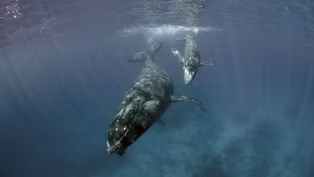
The Witness is a Whale Long Preview
Video has Closed Captions
Coming 7/15 - One of the greatest environmental crimes of the 20th Century is revealed. (1m 28s)
Providing Support for PBS.org
Learn Moreabout PBS online sponsorship New Episode
- Science and Nature

Explore scientific discoveries on television's most acclaimed science documentary series.
 From My Station



 New Season



 New Season

Support for PBS provided by:
The Witness is a Whale is a local public television program presented by KPBS