
Ken Kramer's About San Diego
Episode 105 - The History of a South Bay Community
Season 2025 Episode 105 | 26m 46sVideo has Closed Captions
Go back a century to see a South Bay Community that was once a tiny settlement along the road to TJ
We go back a century to see the history of a South Bay Community that was once a tiny settlement along the road to Tijuana; discover a history timeline next to the trolley tracks downtown; see a celebration of art in Escondido, and view parts of a classic silent movie filmed in Carrizo Gorge. Plus, the story of the Leaning Smokestack of the Union Brickyard, things sent in by you, and more!
Problems playing video? | Closed Captioning Feedback
Problems playing video? | Closed Captioning Feedback
Ken Kramer's About San Diego is a local public television program presented by KPBS
Ken Kramer's About San Diego
Episode 105 - The History of a South Bay Community
Season 2025 Episode 105 | 26m 46sVideo has Closed Captions
We go back a century to see the history of a South Bay Community that was once a tiny settlement along the road to Tijuana; discover a history timeline next to the trolley tracks downtown; see a celebration of art in Escondido, and view parts of a classic silent movie filmed in Carrizo Gorge. Plus, the story of the Leaning Smokestack of the Union Brickyard, things sent in by you, and more!
Problems playing video? | Closed Captioning Feedback
Where to Watch Ken Kramer's About San Diego
Ken Kramer's About San Diego is available to stream on pbs.org and the PBS app.
Providing Support for PBS.org
Learn Moreabout PBS online sponsorshipKen Kramer: Did you know that one of the South Bay stops along the San Diego Trolley has a lot of long ago history?
It's true.
I'll show you where lettuce and potatoes grew in a once upon a time time.
And something else that's at another trolley stop, hop off and take a look, it's free for everybody to see how one woman has put together a San Diego history walk that, in just a few yards, can take you way back in time.
female: They'll text me, show me a picture.
Did you do this?
And I was like, "Oh, yeah, I did that one."
And they're like, "Why don't we hear about this more?"
Ken: And here in the North County, how beauty and creativity have come to one city that is not just encouraging it, it absolutely wants to become known for it.
Male: And this is just one of the ways that we are celebrating.
Ken: Plus, things that aren't here anymore, strange sightings in the desert, couple of memories from me and from you and more stories too, all of them true about San Diego.
Male Announcer: "Ken Kramer's About San Diego," the history and people of the area we call home.
Here's Ken Kramer.
Ken: From Sunnyside to Santa Ysabel and from Webster to Warner Springs, Imperial Beach, Valley Center, El Centro, hi to one and all.
It's time for some stories about San Diego, and may I say we've got a lot of places to go and things to discover, so we should all jump aboard.
Our first stop is a place you may have heard of, but do you know the story about San Diego?
Ken: Trolley Blue Line south towards San Ysidro going to be an announcement, here it comes.
female: Next station, Palm Avenue.
male: La siguiente estación, Palm Avenue.
Ken: Everybody off for Palm Avenue.
Okay, there are the signs and the palm trees.
You've arrived.
Right at the intersection of Hollister and Palm Avenue, which in the 19-teens was its own community, wanted its own post office.
Ken: Yeah, there were a few houses.
It was a little settlement.
In fact, the people thought, why don't we call it the city of Palm Avenue?
But at the Postmaster General, a man named Albert S. Burleson, said, "No, you can't have a post office named Palm Avenue.
It's going to be way too confusing."
And so it was decided Palm City.
We'll name it Palm City right at the crossroads.
You can see on this map, you went south to Tijuana or west to Coronado.
It had its challenges, to be sure.
A catastrophic flood in 1916 washed away part of it, cut it off from rail traffic.
But later, steadily through the years, Palm City began to grow right around where that same crossroads intersection is today.
Ken: There was a gas station.
There was a grocery store.
There was a restaurant.
There was a Greyhound bus station.
Ken: The Palm City District Chamber of Commerce advertised, Come live here where the climate is ideal and the sun habitually shines.
Look at what we have: lettuce, an abundant harvest; spinach, as far as the eye can see; oh, and potatoes, can't forget potatoes; and oil.
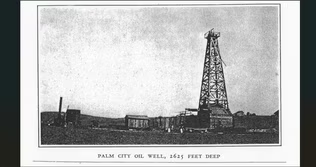
Oh, there was a Palm City oil well.
Unfortunately, funds ran out while they were still just a couple of 100 feet away from payday.
Back then, they couldn't have looked decades into the future to when Palm City would lose its unique identity, becoming an urbanized South Bay neighborhood annexed by the city of San Diego.
What would they have thought of today's diverse and vital population of a Palm City not based on potatoes or petroleum?
Could they have pictured this school or Sunnyslope Park?
Neighbors and visitors gathering today in what a century ago might have been a spinach grove.
Or just to the east, directly adjacent to Palm City, is this Montgomery-Waller Community Park, a really stunning vista looking out over Palm City to Imperial Beach and the Pacific and the Coronado Islands and south to Tijuana, an expanse of acres of rolling grass, all surrounding the spot where in 1883, aviator John J. Montgomery leapt aboard a glider into a steady sea breeze in an historic controlled human flight.
The giant wing is a monument to him and to that accomplishment.
I tell you, this sight, this view, this place is remarkable.
And there are, of course, also the trees, palm trees along Palm Avenue.
That's how this roadway got its name more than a century ago, and the name of the Blue Line trolley stop as well.
And except for the postmaster, it might have been the name of the whole settlement too, but things took a different track.
It became then and is now the Palm City neighborhood, population about 5000, and with its own proud place in the history about San Diego.
Ken: It's easy to forget how important that whole South Bay region, Nestor, the Sweetwater Valley, Oneonta, which became Imperial Beach, how important all that was to agriculture, celery and citrus.
About a century ago, there was a news item.
It said DL Kretsinger, superintendent of fumigation, announced that a lemon tree owned by Mr.
George Hanna was the largest in the county at 19 years of age.
It produced 25 boxes of lemons.
I don't imagine either of them thought that fact would resurface all these years later on "About San Diego."
♪♪♪ Ken: It's sometimes surprising where you find art and delightful when art and history come together, and it's free and you can just go out there and see it.
It's there for everybody to enjoy.
There's an example downtown, super easy to get to, and we thought we'd take a look, so come on with us for a look.
Ken: Let's say you're visiting San Diego.
Do you know where you might go to get a quick history lesson?
I mean, you've got just a few minutes and you're downtown, maybe gonna catch the trolley or a train, and you wanna know about San Diego history.
I've got the perfect place just steps away.
Just north of the Santa Fe station on the trolley track side are these ten columns, and it is here that Betsy Schulz has pieced together a timeline of our city's history.
Betsy Schulz: I'm a public artist, and I create art that is in the public, basically is in the public right away.
Ken: Yeah, like these columns that are connected to a residential condominium complex right next to the tracks.
People walk by all the time on those columns she envisioned what you see here today.
Betsy: Just moving here, of course, everybody falls in love with San Diego and I did, and I wanted to know a lot of more, you know, a lot more about it.
Ken: She started reading everything she could about our history.
Betsy: And not just one book or two books.
I mean, I literally bought everything I could find, and I read it all, and I put little notes down.
Ken: She talked with the Kumeyaay, with tribal elders, so she had all this San Diego history in her mind.
Betsy: And when I saw the ten columns, I had to put this on.
I thought I'll just divide up each era and figure out what makes the most sense based on my research.
Ken: So today, you stop at each column, and it's like jumping back into that particular era, almost like an historical diary.
What were people thinking about?
What were they saying?
What did they do today or this month?
Betsy: So I tried to represent with, you know, a handful of images what that time period might be like.
Ken: 1946 to 1972, the Beatles came to town, the San Diego Coronado Bay Bridge, the suburbanization of San Diego.
Another column is 1916 to 1946.
Betsy: And then this represents the tuna industry here in San Diego and, of course, the Navy.
Ken: 1867 to 1916, a time of so much civic ambition.
See, on the right, there's the old railroad station being toppled and the new modern one on the left.
Betsy: And I love this one because it kind of highlights Balboa Park and when it was first made for the World's Fair.
Ken: So much detail in her sculptural ceramic murals.
Betsy: So everything's handmade.
It's hand-colored, it's all glazed, and it's all fired, so it won't fade.
Ken: You walk along and go further back in time 1820s, 1769, 1542, back to that year and beyond.
This one is devoted to the period before 1542 and the indigenous people who were here first.
Betsy: It's only one column, but literally, it should be like way down the block because there's like thousands of years of this.
Ken: For Betsy Schulz, who through the years has created other pieces from Solana Beach to Carlsbad to Del Mar, this particular historical work by the train station is unique.
It's public art that honors and gives voice to past generations, even in its title.
"The Tracks We Leave Behind," it's called.
It's intricate and engaging and creative and to that curious visitor or any of us in search of a quick history lesson, I'd say it's just the thing about San Diego.
Ken: Now meantime, art of another form has appeared in Escondido, and the people involved are doing it out of a sense that it's really important, interesting, and it's an expression of creativity, and it's fun.
Escondido, go back into history.
It was mostly agriculture, grapes, and then lemons, but times have changed.
Carol Rogers: Escondido has its roots in agriculture, primarily citrus, but there is so much more to this city, and art and culture is deep in our roots here.
Ken: When you think about the history future generations here will celebrate, I'm pretty sure days like this will be important.
Here's what's happening.
A part of a popular walkway has been beautified with public art.
Look at them, the murals, original, imaginative, and beautiful.
And look at them, the artists who created it all and the beaming proud Mayor Dane White, who told us about it.
Dane White: We put a call for art out a few months back, had 44 submissions, and we whittled it down to six that you can see here, and it's awesome.
Ken: It really is.
Well, these six murals are positioned along what's called the Escondido Creek Trail.
Carol Rogers heads up the city's Public Art Commission.
Carol: The theme is flora and fauna, and I think the wonder of that theme is the artists do a tremendous job of interpreting that.
Ken: Where a century ago, there were citrus groves, there is now in so many spots around town art, and the opportunity for relative newcomers to get their start in it.
Andres Marin: Hello, my name is Andres Marin.
Ken: It's one of his first murals in the city.
He says if you're an artist and you're looking for opportunity, Escondido is the place, was for him.
Andres: My painting is called "Tunas Doradas," and it came to me as I was doing a run down the San Pasqual River Valley just with all the colors and the vibrancy and in the valley just made me feel like there was some hope and that, you know, what I was doing was not in vain.
I could continue going forward.
Ken: It's not well enough known I think that, in this city, there is so much public art at a couple of spots here along the creek trail, and in the alleys off Grand Avenue and even on traffic signal boxes that recall the grape days, it's a municipal commitment to celebrate imagination and positive aesthetics and beauty for its own sake.
Dane: And it just enhances the everyday life in the city of Escondido.
Ken: Where there is a heart for art.
♪♪♪ ♪♪♪ Ken: Time for our segment on things that aren't here anymore.
It's nostalgia, yes, for those of us that might remember, but looking back, it can also show us how things have changed.
Let's go back into the archives for this story.
It's something that isn't here anymore.
Now, here is something that everybody in San Diego used to recognize.
It was as familiar as the SeaWorld Tower is today, only this wasn't a tower.
It was a smokestack.
Bernie Arreguin: Just a gigantic thing up in the sky 'cause when we were small at that age, you know, it was just so tall.
Ken: In Rose Canyon, it was owned by the Union Brick Company, where they made 15 million bricks a year.
And some of the workers lived right there on the property.
Bernie: It was like a little community.
Ken: It's where Bernie Arreguin lived as a kid, where his grandmother was born.
His dad and mom, both grandfathers, aunts and uncles worked making, baking, drying, and stacking bricks made from Rose Canyon clay, bricks to build everything.
Bernie: Driveways and walkways, and then the city used them for buildings in the city of San Diego.
Ken: The Union Brickyard had a real operation going in Rose Canyon, acres of bricks stacked up everywhere, the smell of damp earth.
Bernie: A conveyor belt sound constantly going around picking things up and taking them.
Ken: And then there was that smokestack that you could see for miles, made of bricks, of course, 115 feet high.
It became a landmark at the Union Brick Company.
Bernie: And it leaned, it leaned, and that was one of their logos.
We lean towards good bricks, you know.
Ken: And look at it.
You can see it really did lean until January 20, 1962, when the wind blew it over.
They say the bricks from it ended up being used in fireplaces in Rancho Bernardo.
So what happened to the Union brickyard?
Bernie: The freeway was coming in, so the owner sold the property to the state to build the freeway to come in.
Ken: There's an industrial park there now, and you'd never guess this is where the brickyard once was.
Ken: But, you know, it's interesting.
You come here, and you do find lots of pieces of brick lying around.
Maybe they're left over from the days when everywhere you look that was all you saw.
At Bernie Arreguin's house, he's kept a couple of them to remember when he lived here as a boy and so many adult members of his family worked here in the shadow of this old smokestack in Rose Canyon, a landmark that is now just a memory about San Diego.
Ken: One more stop from the archives file and for it, let's go out to the desert.
Fred Gee: The red Volkswagen bug was here.
Ken: The story is there was an accident.
Fred: The kid's sedan was over here crunched together.
Ken: Sounds pretty bad, but it's not what you think.
Nobody was hurt.
In fact, there wasn't really a crash, really.
It was a movie called "Never on Tuesday."
Claudia Christian: My name is Tuesday.
Ken: It's just one of so many films shot out here in and in the desert around Anza-Borrego State Park, going all the way back to silent movies shot in the 1920s in Carrizo Gorge.
Fred: We've worked so closely with the San Diego Film Commission.
Ken: And nobody knows more about all of them than park ranger Fred Gee.
Fred: Cinema history is my hobby, and it's turned into a minor avocation now.
Ken: At La Casa del Zorro, he can show you the very casita where Marlon Brando stayed while filming "The Young Lion."
Oh, Sean Penn was out here, too.
Fred: A lot of his shots of the "Oh My God Hot Springs" recreation out there in Ocotillo Wells.
Ken: And in that "Never on Tuesday," strange cameos by Nicolas Cage.
male: Is anybody hurt?
Ken: And Charlie Sheen.
But in the end, it's the scenery, Fred says.
Fred: Ah, what we offer is variety.
Ken: It's the achingly clear skies, stark panoramas, and endless roads of Anza-Borrego that have fascinated Fred Gee for 34 years out here on the job now and for so many, many decades have tempted filmmakers.
It is something picture perfect about San Diego.
Ken: Well, if you saw that footage of a stunt on a railroad just at the end of that segment, that railroad through the Carrizo Gorge was the stage for a number of dramatic scenes through the silent movie years.
Notable one is called the "Beggars of Life," and it starred Wallace Beery in 1928.
♪♪♪ ♪♪♪ ♪♪♪ ♪♪♪ ♪♪♪ ♪♪♪ ♪♪♪ ♪♪♪ ♪♪♪ ♪♪♪ ♪♪♪ Ken: By the way, there were sound discs connected to "Beggars of Life."
In the theater, you started the sound disc, which was a phonograph record, and synced it with the movie, so the two were running together at the same time.
Sad thing is, the sound discs that went out with "Beggars of Life" are lost, but allegedly, they included Wallace Beery singing a song and the sound of those trains in Carrizo Gorge in San Diego County.
♪♪♪ Ken: All right, let's find out what you have for us.
We never know till we open the email, and there we find all kinds of things, pictures and sometimes hats.
If they are yours and you can share them, they are a treasure every week because they either lead us to or show us places and things as they used to be all around San Diego.
So with thanks to you, what do you have for everybody to see?
1947, Corey Vasina sent this.
Here's Dick Harvey and His Men of Note, a band made up of high school kids, including her dad, a sax player and student at Sweetwater High back then.
They were good.
There's proof of that.
Imperial Valley Camacho's Place, if you know, you know.
Thank you for the baseball cap, Adrian Durso.
Camacho's was for 80 years in El Centro, served Mexican food for generations.
Richard and Juanita Camacho founded Camacho's Place in 1946, just a memory now.
Baseball ticket, Padres and Rockies at PETCO in 2008.
Why was this game memorable?
It was the longest game by innings in the history of both teams.
I know 'cause it just so happens I was there with my broadcast colleagues, Donna M. Stewart and Consumer Bob.
There was a 7th inning stretch and a 14th and a 21st.
In all, it went 22 innings, took 6 hours and 16 minutes, lasted until 1:21 in the morning of the next day before the Padres lost 2 to 1.
And one more ticket, 2004, the first baseball game ever played at PETCO was a college game between the University of Houston and San Diego State.
40,106 people, and to this day, that is the largest regular season crowd ever to attend a college baseball game.
Wanna see something that really didn't work?
This was, believe it or not, for a very brief period of time in 1992, the Padre mascot.
It was called Blooper.
Get it?
Blooper?
And Andy Strasberg, who came up with the idea, still has a sense of humor about it.
Blooper turned out to be an error.
He says a lot of fans just started calling it down in front.
They wanted the chicken.
Ray Haseki took this.
It's where the Padres played for 21 years at the west end of Broadway between Harbor and Pacific Highway.
Thank you to Bill Swank for this photo from 1954.
And another when they were dismantling Lane Field four years later.
Here's a postcard, the border checkpoint in the early 1940s.
Visitors welcome and always treated with courtesy, it says.
The plaza downtown on Broadway between 3rd and 4th, but you notice something?
No fountain at the plaza, so that means it was before 1910.
And from about the same time, this is our courthouse, postcard shot of it.
And if you can see, there were statues up there on the roof, presidents mostly: Washington, Lincoln, Grant, and Garfield.
Used to be a lot more, but after the 1906 earthquake in San Francisco, they were taken down.
For one penny, you could mail this card of the steam-powered ferryboat Ramona that took you back and forth between San Diego and Coronado in the 19-teens and '20s, a wonderful way to travel.
As was this from John Thompson, postcard of the San Diego and La Jolla motor car.
His grandfather mailed it in 1913.
By the way, the car ran on tracks from San Diego to a day of fun in La Jolla, and people really seem to like it.
It's a happy picture.
Like, you can see passengers are smiling.
Now here's an aerial view, 1966.
Do you know what this is?
Work being done, something under construction down there in San Diego in that year.
It's got kind of a familiar shape to it, don't you think?
Do you recognize it on the north side of Interstate 8 in Mission Valley, which looked like this at the time, not much development.
Cy Perkins sent us these.
That round spot out there in the dirt would become San Diego Stadium, long before Snapdragon, later known as Jack Murphy Stadium and Qualcomm.
It was still just taking shape back then, took 20 months to build at a cost of 27 million.
Michael Sutty passed this along to us, the famous Twin Inn Chickens of Carlsbad, along with the note that back in the day, they sold chicken dinners to weary travelers on the 101, a highway landmark these chickens were.
Here's Torrey Pines in 1961, and these are gliders being pulled up into the wind at the Torrey Pines Gliderport.
You hook your glider up to a cable, which gets you up to speed, and then you drift over and around the bluffs.
This was a glider meet going on when this 16 millimeter film was shot more than, what, 65 years ago now.
Well, did you know that the gliderport is an historic place, a national landmark of soaring going back nearly 85 years?
Thank you to Mr.
Burt Seal of San Diego for sending us the takeoffs, the soaring flights, and the happy landings at Torrey Pines.
And remember Dick Harvey and His Men of Note in 1947, high school students?
I mentioned they were good.
They were invited to play at Carnegie Hall in a competition sponsored by Look Magazine.
And while they didn't quite win it back then, I'm betting they had everybody talking about San Diego.
Ken: And that's it for this time in this episode of "About San Diego."
We have a website, which is kind of the central location for more information about the stories you see here.
Just click on Learn.
And it's also the way to get in contact with us if you go to the Contact section.
That's the way to send photos or other things to show on the air, which we really appreciate greatly.
And if you click on Watch, you can see these stories again.
It's KenKramerTV.com, KenKramerTV.com.
We will see you next time.
Until then and as always, I am Ken Kramer.
Thank you for watching and for caring about San Diego.
Bye-bye.
♪♪♪ ♪♪♪ ♪♪♪ ♪♪♪ female announcer: Support for this program comes from the KPBS Explore Local Content Fund, supporting new ideas and programs for San Diego.
The History of a South Bay Community Preview
Video has Closed Captions
Preview: S2025 Ep105 | 30s | Go back a century to see a South Bay Community that was once a tiny settlement along the road to TJ (30s)
Providing Support for PBS.org
Learn Moreabout PBS online sponsorship









Support for PBS provided by:
Ken Kramer's About San Diego is a local public television program presented by KPBS