Prairie Sportsman
Rainy River Sturgeon
Season 17 Episode 1 | 27m 47sVideo has Closed Captions
Kevin Hinrichs of the Royal Dutchman Resort battles monster sturgeon. Then, DNR studies the fish.
Host Bret Amundson joins Kevin Hinrichs of the Royal Dutchman Resort to battle monster sturgeon on the Rainy River and researchers work to better understand the range and population of this unique prehistoric fish.
Problems playing video? | Closed Captioning Feedback
Problems playing video? | Closed Captioning Feedback
Prairie Sportsman is a local public television program presented by Pioneer PBS
Production sponsorship is provided by funding from the Environment and Natural Resources Trust Fund and Shalom Hill Farm. Additional funding provided by Big Stone County, Yellow Medicine County, Lac qui...
Support provided by:


Prairie Sportsman
Rainy River Sturgeon
Season 17 Episode 1 | 27m 47sVideo has Closed Captions
Host Bret Amundson joins Kevin Hinrichs of the Royal Dutchman Resort to battle monster sturgeon on the Rainy River and researchers work to better understand the range and population of this unique prehistoric fish.
Problems playing video? | Closed Captioning Feedback
How to Watch Prairie Sportsman
Prairie Sportsman is available to stream on pbs.org and the free PBS App, available on iPhone, Apple TV, Android TV, Android smartphones, Amazon Fire TV, Amazon Fire Tablet, Roku, Samsung Smart TV, and Vizio.
Prairie Sportsman Premium Gifts
To order, email yourtv@pioneer.org or call 1-800-726-3178.Providing Support for PBS.org
Learn Moreabout PBS online sponsorship(bright music) - [Bret] On today's "Prairie Sportsman," Kevin Hinrichs of the Royal Dutchman Resort welcomes us aboard The Dutchman's Warship to do battle with monster sturgeon on the Rainy River.
- [Kevin] Yeah, you got a good 'un.
- [Bret] Then we join researchers as they work to track the population of these unique prehistoric fish.
- That's a fish.
- For sure.
- Welcome to "Prairie Sportsman," I'm Bret Amundson.
We got a great one for you this week and it starts right now.
(bright exotic music) (upbeat inspiring music) - [Announcer] Funding for "Prairie Sportsman" is provided by the Minnesota Environment Natural Resources Trust Fund, as recommended by the Legislative-Citizen Commission on Minnesota Resources.
By Mark and Margaret Yackel-Juleen on behalf of Shalom Hill Farm, a retreat and conference center in a prairie setting near Windom, Minnesota.
On the web at shalomhillfarm.org.
And by the Friends of Prairie Sportsman.
To become a friend of Prairie Sportsman, visit pioneer.org/prairiesportsman.
- [Bret] Lake of the Woods and the Rainy River, the walleye capital of the world.
While Minnesota's state fish gets most of the attention up here, there's one resort owner just east of Baudette who turns his focus away from Minnesota gold and has fallen in love with a different fishy treasure.
(bright folk music) Today, we're fishing with The Dutchman himself, Kevin Hinrichs, and his friend, Nick Morgan.
Kevin owns the Royal Dutchman Resort and is an absolute sturgeon fanatic.
It's time to get in the Warship.
- I like to call this the stairway to heaven, boys.
(both chuckling) (gentle country music) We do provide a guided chartered service.
I am a US licensed Coast Guard captain.
I am CPR certified and trained.
I will do everything that I can while I'm out on the water to make sure that you have the best day possible while we're fishing.
We also operate a ice fishing business that operates both on the lake and the river.
(pleasant country music) - [Bret] So how far do you normally go when you take people out?
- So a lot of times I'll tell 'em, "I hope you brought a lot of coffee with you, because we got a long ride ahead of us."
And I usually have a slip that comes straight out like this.
And we'll back out, I'll turn the stern up river and drop anchor.
It can be that simple, but usually on average, most trips, we do not go further than a six mile, three miles either way, and we are able to find what we're looking for as long as they're wanting to chomp.
(pleasant country music) All of that, that, that.
That right there, that, that, they're all over down there.
I don't know how to zoom in on it like some people do.
I'm not very high-tech.
This is the first depth finder that a warship's ever had on it.
(pleasant country music) - [Bret] Like, how much activity do you wait for before you go over there and grab the rod?
- I'm looking for a certain bite myself.
Like, the hardest thing for guests right away is they wanna go after every bite.
- Yeah.
- Which we're not gonna hook 90% of the baits stealers unless they swallow it or the hook gets in their mouth just right.
So I'm gonna sit here until I think it's confidently a decent sturge bite that's going on.
'Cause people will tell you hook sets are free, which they are in some sense, unless you're buying the bait, because you're gonna rip your bait off.
And it can get to be that now, like, you pick it up like that, you got slack in your line, you don't even know if he's biting anymore.
Or they'll say, "Oh, yeah, he's biting."
Then you put it back in, and oh, you got him.
What do we got?
Walleye or sucker fish?
Look like walleye bite.
- It's a walleye.
- Oh, yeah.
- Yeah.
Walleye!
I get a family in here, we get out there, we get anchored up.
We throw rods out.
In the summertime, I'll put crawler harnesses on with one ounce weights.
And we'll throw, if there's six of us in the boat, I'll throw four sturgeon rods out and I'll throw two of those out.
Now I can tell you I've caught up to 13 different species of fish.
(upbeat rock music) - [Nick] We got one.
(Kevin howling) - [Bret] Fish on.
(upbeat rock music) - [Kevin] You got a good ‘un.
He look like he might be twisted a bit or what?
Tell him to go back to bottom.
Get that one out of the way.
Keep him right over there for a minute if you can.
(gentle rock music) Yeah, I don't know what he is doing.
You must have hit him on the head with a weight or something.
He ain't doing normal sturgeon things.
(gentle rock music) I just gotta get everything back and out of the way.
I don't think this one's gonna run up alongside the boat.
Oh, perfect.
Yeah, and twisted, oh, there he went.
(Kevin chuckles) (gentle country music) That mad cat's getting a workout right now.
(gentle rock music) Hold Nicky poo.
(gentle rock music) Dino, Dino, Dino!
- Whoo!
- You know this is only a half hour show, so... We're not gonna get premature with the net.
I see a lot of guys get premature.
They grab it right away and it's like, you might as well put that thing back for a while.
But we'll get the handle out anyways and get it ready.
And again, as you can see, like I said, on the Warship, we like to stay in the front of the boat and bring the fish.
Try to control it and direct it.
- Don't just smack around down there.
- [Kevin] You think he's ready?
(energetic rock music) He's gonna come in angry, that one, I guess.
- [Bret] That's a good one.
- [Kevin] I hope he's gonna unspin here and probably take off again.
You ready for me?
Drag over.
- Nice.
- Hey yo, woo!
(energetic rock music) - Nothing better than that, is there?
I mean, you're looking at 60 plus pound fish, somewhere in that range.
Usually that mid 20s girth, whatever length they are is about how heavy they are.
Once you start getting to that 29, 30-inch girth, you can start to stack on anywhere from 10 to 20 pounds extra.
(bright acoustic music) - It's very easy fishing.
The amount of gear you need is inexpensive.
It's a lot of fun, and you can literally catch the biggest fish of your life like that, right there.
It's a huge fish.
(bright acoustic music) - We are a mom-and-pop resort.
We have 14 rooms that consist of 5, 2 bedroom, kitchenettes are like 2 bedroom cabins or villas.
And then we have nine, like, motel-hotel rooms.
(bright uplifting music) The Royal Dutchman Resort, I am not sure where it came from.
I believe the Kanaves, the people who owned it for, like, 35 years, they were the ones who named it from H&M Motel to Royal Dutchman Resort.
But I'm not 100% for certain on that, but it has carried on through many, many years.
I was actually thinking about calling it like the Sturgeon Inn, or My Name's Kevin.
I was gonna name it the Kev Inn.
(both laugh) My grandpa really liked that one, but... (uplifting music) I had never been on Facebook before I bought the resort.
(Bret chuckles) One of the first posts I did, I just happened to call myself the Dutchman.
Dutchman here, dock side on the river.
And it kind of has stuck from there.
Everybody knows me as The Dutchman.
Believe it or not, not so much my face, but my voice.
People look at me for a really long time until I say something, and then they're like, "Holy crap, you're the Dutchman," you know?
(bright uplifting music) So the original building, when it was built in 1955, which that building is all two-bedroom kitchenettes now.
But the original building right there was four rooms with a carport.
We're obviously not the oldest resort up here, but to be in that same air, a year class with, like, Adrian's Resort, when they formed and a few other ones that started up dating back to, like, that '50s era, the golden age.
It's pretty cool that it's still standing and still being used to this day.
(tranquil acoustic music) Yep, yep, yep, yep, yep, yep, yep, yep, yep, yep, yep, yep, yep, yep, yep.
- Oh, yeah.
- Yeah.
That away, Bret.
(howls) - [Nick] I got that drag set pretty tight, so feel like loosening it.
- There he is.
- Don't feel ashamed.
- That's a decent one.
- Yeah.
Oh yeah, yeah, yeah.
Heck yeah, I love it.
- [Kevin] Dino!
♪ Do do doo (Kevin howls) - [Bret] Oh, he's not too happy with me.
- [Kevin] The Warship did do battle with the trailer, so it has a dented deflector up there.
So we're just gonna try to keep it away from, it battles all kinds of things Dan.
How's that feel?
- Pretty good.
- Yeah.
- So strong.
There's so much fun.
- Yeah, yeah.
- He's come up a couple of times and now just gone right back down.
- [Kevin] He's got swirls back there.
- I think he's getting pretty close here.
- [Kevin] Okay.
(dramatic symphonic music) A little bit closer.
- Are you set?
- That perfect?
- Isn't it?
- Yeah!
- Yeah!
- Woo!
(both howling) (inspiring music) - There you go, bud.
There you go.
Nice.
- Yeah.
- This is what the Rainy River is really becoming known for.
I mean, obviously, it's still a great walleye fishery and smallmouth, pike.
There's a lot of species of fish that you can catch in here, but the sturgeon.
- That's walleye there.
- That are in this river are amazing.
It's so much fun and so easy to do.
(inspiring music) - I'll put it like this, when the tug is your drug, the sturgeon is the ultimate fix at the end of the day.
Not to say that I don't love my walleyes, it's just if you're gonna make me choose between one, it's gonna be the sturgeon.
(inspiring music) I knew I was gonna live up here someday.
I just didn't know when or how.
Just the overall size of the lake, I guess, when I saw it the first time.
it puts you into perspective and makes you realize how small we are as human beings.
(inspiring music) As a business owner, you always look, how can I utilize every aspect of my business to possibly make as much money as you can?
And that community room can be looked at as, sometimes in some people's eyes as a wasted opportunity.
Can we turn this into a room, until you see a group of guys, or say, a dad with his kids on an ice fishing trip.
They come in and they put the casserole that mom prepared for them at home, that they brought up with them.
He stuffs it in the oven and you're sitting in there, they're having a good, old time eating and hanging out and chilling, talking about how the day was.
And when he talks to you, he says, you know, I truly appreciate that you guys got this community room here, because trying to feed four kids, going out to eat plus going on a fishing trip, this just wouldn't be doable at all.
My dedicated, devoted mission is to make sure that everybody gets the opportunity to experience Lake of the Woods the way that I did.
We do not charge for kids to stay or fish, because I do not want money to be the reason that they don't get the opportunity to experience Lake of the Woods.
And I mean, in fishing in general.
(bright inspiring music) - [Bret] Yeah, there we go.
(Kevin howls) - [Kevin] Dino, Dino!
♪ Do do doo Come on Dan!
Figure out which way he's down, there, you figured it out.
- There he goes.
- Nope.
- Keeps you trying to go up.
(bright symphonic music) - [Kevin] If he could get off that pack, he'd probably take off, but he just can't.
- [Kevin] All right, bring him over here.
- All right.
- Yeah!
- Nice.
What a fish.
How cool is it we get to have these in Minnesota.
I mean, it's an absolute dinosaur, just a beast of a fish.
Strong, mad at the world.
Easy to fish for, so much fun.
(upbeat symphonic music) - Like I was telling you, I look at a sturgeon fisherman as like a boxer.
He's looking for that opponent that he can't beat, that one that you're scared of, you know, and it's out here.
It's waiting for us, I'm gonna find it.
(tranquil music) (pleasant acoustic music) - Well, we're just down from Willie the Walleye here in Baudette at the DNR area headquarters.
And behind us is the Rainy River.
Now this has become just a world-class lake sturgeon fishery, and that's due to a couple of things.
The cleanup that took place here, the recovery efforts, including the Clean Waters Act back in the 1970s, and then a lot of research that's being done by the Minnesota DNR.
(pleasant acoustic music) So while this is a popular area to target surgeon in the spring, we're here in August, we're gonna head out on the river with the DNR to go check these nets for sturgeon.
(pleasant music) - We went out yesterday, set different gill nets out on the river as part of our juvenile sturgeon and just general Rainy River survey.
Ideally, we're looking for kind of that juvenile stage sturgeon.
So we have two different sites to check today with three different nets at each site.
(pleasant music) - Now part of this process will involve some bycatch, catching walleyes, suckers, sauger and other fish in those nets.
But those fish are becoming a vital part of their research as well.
(pleasant music) So we're out here on the river at your nets that you set out yesterday.
- Yep.
- What's the next step here?
- So we're gonna lift these nets.
We're starting on the downstream side.
So we have three different nets in the water.
We're gonna start with our 2 1/2 inch mesh.
So it's about 100 feet long, and this one's set perpendicular to the shoreline.
Then the next one's what we call an experimental gill net.
So there's 250-feet long of net all strung together, and there's 5 different panels of mesh in that gill net that range from 3/4" all the way up to 2" mesh.
So it's gonna catch a variety of different fish.
We're doing kind of two surveys in one today.
So we're doing a population assessment on the Rainy River itself.
So we're looking at walleye and sauger numbers, sizes, ages, as well as juvenile sturgeon.
So these nets are really good at catching smaller sturgeon.
We'll tag 'em from here and take length and weights on 'em.
(serene music) As they get tangled in the net, sometimes the net rubs on 'em a little bit.
And they get kind of, like, a rug burn, but they have really hard skin, kind of, like, a leathery type of skin and some rough scales.
So they're typically not an issue for 'em.
(serene music) Yeah, so this is a juvenile sturgeon.
So you can see, a lot of times, they're kind of this lighter sandy color compared to the adults are more darker.
And you can see the scutes on its side here, on the top, are really sharp.
When they're younger, they're, I guess, fresher scales, so they still have that sharp feel to 'em.
So we like wearing gloves when we're handling 'em.
And then as they get older and kind of rub up against different stuff in the river and just live their life, they kind of start wearing those scutes down.
- All right, lake sturgeon 2 1/2 inch, 633.
- So each one of these sturgeon that we get, we wand 'em with a, it's called a PIT tag reader.
So we have PIT tags in a lot of these smaller fish.
It's basically like the same type of microchip you'd see like in a dog that you get from a vet.
It just has a unique number that identifies that fish.
And we use these on our smaller fish, 'cause they're really small.
They're kind of just slightly larger than a grain of rice, (serene music) that we inject into 'em with a little syringe.
So if we recapture 'em again, we can look at how much they've grown since the last time we've captured 'em.
And then once they get to be a certain size, then we put what's called a Carlin tag in 'em, which is the external tag that you can see when you're fishing.
It's a yellow kind of dangler tag off their dorsal fin.
(pleasant music) So if we did detect a PIT tag on this one, we'd write down the tag number and then we would add that we put a Carlin on it, 'cause it was over 600 millimeters.
So it's big enough.
The reason why we wait till they're 600 millimeters is just you don't want 'em when they're smaller to have this hindrance that would limit their ability to swim.
(pleasant music) - [Grant] We're gonna take this leading fin spine.
This is a way to age the sturgeon, slight clip.
And it pulls right off.
- So we use a low speed saw, like a diamond blade saw that spins fairly slow, and you can cut a little slice off the end of it.
And then you can age it like a tree.
There's rings on it.
(tranquil music) The sturgeon fishing on the Rainy River's pretty good.
I mean, we've met a lot of our recovery goals for sturgeon population in the river.
The last, like, goal of our recovery plan is to see an 80 incher.
And a lot of us, we kind of debated whether it's out there.
And if it's not out there, it probably will be soon.
- Yeah.
- But I would think that there's gotta be one.
(tranquil music) We do yearly monitoring, netting for taking fish and stuff, and we're seeing pretty diverse year classes.
That was one of the things in our recovery goals, is having several year classes.
And that's one of the things we get from taking our age structures, those fin raises, we can determine the years that the fish were born and then we can kind of backlog it.
So we've seen several year classes, and that's kind of what we've done with our survey this year, with these juveniles is just kind of continuing that, making sure we're still seeing spawning occurring, recruitment happening in the population.
(tranquil music) - Sauger.
234, 40.
So we're gonna be pulling the otoliths out of this sauger, which is a structure similar to like an ear bone if you compare it to humans.
And that's a way that you can get the age from these fish.
- So this would be part of that Rainy River evaluation I was talking about earlier.
We wouldn't normally do this if we were just looking at sturgeon, but since we're already setting nets, makes sense for us to... - Utilize some of the bycatch that we're getting.
- Yep.
(tranquil music) - Walleye.
(gentle music) 282, male, immature.
So the testes or the ovaries are kind of what you look for.
And it's gonna be really small, but this is a undeveloped testi basically.
Super skinny, small red.
And then the females will be a little more fleshy, a little bit larger at this size.
And then clearly, when they're mature, the ovaries will be full of eggs.
(serene music) - Now that we went out and collected all the different aging structures and stuff, so we'll go back and we can look at each site, how many fish we caught at each site.
We can compare that to historical catches in that river section.
We can get ages off those fish that we took a fin ray from so we can go back and look when those fish were born.
We can look at river conditions when they were born to see.
You know, are there thresholds that sturgeon need as far as flow or river level to have a successful spawning year?
For the walleye and sauger, we can look at ages on those as well with the otoliths that we took.
And we can look at the amount of growth that they've had in the river.
We can look at length and age.
So a two-year-old fish, how long are they in the river compared to the lake, are there differences there?
Is it the same population?
Along with the sturgeons who we can look at when now that we have an age and a length for them when we capture them, if they get recaptured again down the line with, we can look at how much it's grown.
(pleasant music) So another way we research these fish is we have what's called acoustic transmitters in these adult fish.
And basically, what those do is they send out a coded ping, and we have receivers intermittently throughout the river.
As the fish swims by one of these receivers, the receivers are listening for those pings, and when it sends it out, it can recognize that sequence of pings.
It'll have an ID number associated with that fish.
So we can tell when a fish swims past a certain receiver.
And then we have this box here too that allows us to basically put in a, what's called a hydrophone into the water, which can also listen for those signals.
We can kind of track fish individually as they move throughout the river system.
And we have receivers out on Lake of the Woods as well right now too.
So we can kind of track 'em all the way from International Falls Dam, all the way down the Rainy River into the lake.
(pleasant music) We don't have a whole lot of data on juvenile fish.
So kind of understanding where they're hanging out throughout the year and what kind of, like, habitat they prefer throughout the year.
And then for the adults, we know some spawning areas.
We're kind of looking to see are there other spawning areas that they're using?
And then looking at, like, when they're spawning, are they going from site to site?
The timing of when they move up for spawning in the springtime and when they leave, if they leave right after spawning, where do they go?
Do they go, you know, all the way to the lake?
Do they just kind of coast down?
Just kind of understanding overall, what are they doing on a year-to-year basis, kind of at different stages of their life.
(pleasant music) (fish chirping) - That's a fish.
- That's a code for sure.
- 39542 - [Announcer] Fish 39542 was 19.1 inches when it was originally tagged on August 14th, 2024 near the Vitus boat ramp.
And including today, it was detected three more times near Baudette in August of 2025.
- We had one fish that, you know, went from the Big Falls area all the way down out into Lake of the Woods in just a couple days.
And we've had some fish that prefer to stay in the river.
They haven't really left the river, or they hang out kind of by four-mile bay down by the lake.
Some fish move a lot and some fish don't move a lot.
And we're looking at, do they come up the same river every year?
Are the Rainy River fish only coming up the Rainy or are they straying?
We don't have a whole lot of data on juvenile sturgeons, so that's why us being able to take some of these younger fish and seeing where they hang out before they, do they go to the lake right away?
Are they hanging out in the river for a couple of years until they get big enough?
Just getting an idea of where those are hanging out.
It seems like just from our preliminary data, a lot of them hang out in the river, and for the first couple years before they start moving out into the lake environment.
But there's obviously fish that move more than others.
- It's research like this that builds a world-class fishery.
And we have one right here for sturgeon on the Rainy River.
(tranquil music) (bright exotic music) - [Announcer] Funding for "Prairie Sportsman" is provided by the Minnesota Environment and Natural Resources Trust Fund, as recommended by the Legislative-Citizen Commission on Minnesota Resources.
By Mark and Margaret Yackel-Juleen on behalf of Shalom Hill Farm, a retreat and conference center in a prairie setting near Windom, Minnesota.
On the web at shalomhillfarm.org.
And by the Friends of Prairie Sportsman.
To become a friend of Prairie Sportsman, visit pioneer.org/prairiesportsman.
(bright music)
 New
NewVideo has Closed Captions
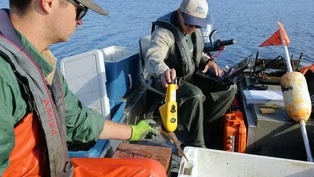
Clip: S17 Ep1 | 12m 18s | Minnesota DNR Fisheries Specialist Tanner Carlson & Fisheries Technician Grant Becker tag sturgeon. (12m 18s)
 New
NewVideo has Closed Captions
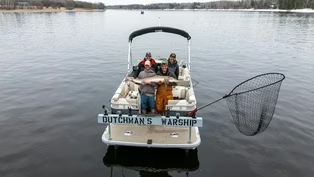
Preview: S17 Ep1 | 30s | Kevin Hinrichs of the Royal Dutchman Resort battles monster sturgeon. Then, DNR studies the fish. (30s)
 New
NewVideo has Closed Captions
Clip: S17 Ep1 | 13m 33s | Kevin Hinrichs shares his passion for sturgeon. (13m 33s)
Providing Support for PBS.org
Learn Moreabout PBS online sponsorship
- Science and Nature

Explore scientific discoveries on television's most acclaimed science documentary series.

- Science and Nature

Capturing the splendor of the natural world, from the African plains to the Antarctic ice.












Support for PBS provided by:
Prairie Sportsman is a local public television program presented by Pioneer PBS
Production sponsorship is provided by funding from the Environment and Natural Resources Trust Fund and Shalom Hill Farm. Additional funding provided by Big Stone County, Yellow Medicine County, Lac qui...