
Outlook for small businesses, Eccalon expands to Detroit, remembering Ron Teasley
Season 54 Episode 9 | 25mVideo has Closed Captions
A look at small businesses, tech firm expanding to Detroit and Negro Leagues veteran Ron Teasley.
American Black Journal examines the trends, challenges and opportunities for small businesses this year. Plus, we’ll talk with the head of a Maryland-based technology firm that’s expanding to Detroit. And we’ll remember baseball trailblazer Ron Teasley.
Problems playing video? | Closed Captioning Feedback
Problems playing video? | Closed Captioning Feedback
American Black Journal is a local public television program presented by Detroit PBS
Outlook for small businesses, Eccalon expands to Detroit, remembering Ron Teasley
Season 54 Episode 9 | 25mVideo has Closed Captions
American Black Journal examines the trends, challenges and opportunities for small businesses this year. Plus, we’ll talk with the head of a Maryland-based technology firm that’s expanding to Detroit. And we’ll remember baseball trailblazer Ron Teasley.
Problems playing video? | Closed Captioning Feedback
How to Watch American Black Journal
American Black Journal is available to stream on pbs.org and the free PBS App, available on iPhone, Apple TV, Android TV, Android smartphones, Amazon Fire TV, Amazon Fire Tablet, Roku, Samsung Smart TV, and Vizio.
Providing Support for PBS.org
Learn Moreabout PBS online sponsorship- Coming up next on "American Black Journal," we're gonna examine the trends, challenges, and opportunities for small businesses this year.
Plus we'll talk with the head of a Maryland-based technology firm that's expanding right here in Detroit.
And we'll remember baseball trailblazer, Ron Teasley.
Stay right there.
"American Black Journal" starts now.
- [Narrator] Across our MASCO family of companies, our goal is to deliver better living possibilities and make positive changes in the neighborhoods where we live, work, and do business.
MASCO, a Michigan company since 1929.
Support also provided by the Cynthia & Edsel Ford Fund for Journalism at Detroit PBS.
- [Narrator 2] The DTE Foundation is a proud sponsor of Detroit PBS.
Through our giving, we are committed to meeting the needs of the communities we serve statewide to help ensure a bright and thriving future for all.
Learn more at dtefoundation.com.
- [Narrator 3] Also brought to you by Nissan Foundation and viewers like you.
Thank you.
(lively music) - Welcome to "American Black Journal."
I'm Stephen Henderson, your host.
We're three months into 2026, and small businesses are cautiously planning for the rest of the year.
Inflation, tariffs, labor shortage.
They are all still creating challenges for small business owners, but are there opportunities for growth?
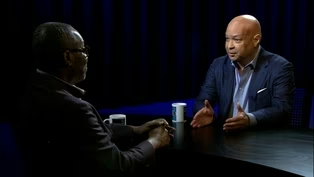
Joining me now to talk about the outlook for small businesses in 2026 is Mark Lee, president and CEO of the Lee Group.
Mark, welcome back to "American Black Journal."
We do this - Good to see you.
- every year.
- Every year.
- I think this is the first time in a long time we've done it in person.
- I think you're right.
- We've been doing this on Zoom now.
- You're exactly right.
- So it's good to see you in person.
- Good to see you as well.
- All right, so let's start with where we are in 2026.
I think, you know, as a small business owner, a very small business owner, things are worse than I imagine that they would be at this point.
I think a lot of people, even if you were not politically aligned with the Trump administration, I think a lot of us felt like, well, maybe the economy will do well under this, and that'll be a silver lining.
I'm still looking for the silver, I guess.
(chuckles) - I think a lot of people are still looking for the silver lining.
- It's been pretty rough.
- Yeah, it's been pretty cloudy.
- Yeah.
- And I think that as you talk about, and by the way, any business is not necessarily a small business.
Every business is a major business.
- Right.
(chuckles) There we go.
- I set the record, including yours.
It's tough.
It's tough.
And I think right now I talk to a lot of businesses and what they're experiencing is just this uncertainty.
This uncertainty is very persistent right now.
People are still feeling the effects.
As you mentioned, your opening about tariffs, high costs, revenue's not increasing.
Revenue, quite frankly, is flat.
Collectively, we look at the trend lines, if you will.
Business confidence is relatively middle of the roads that high, not low in that mid-range range.
So I'm experiencing a lot of, I'm sensing a lot of uncertainty for these businesses.
And they're trying to figure out a, again, navigate these chartered waters.
I think with the President came in office, there was believe or not some optimism in that space.
But now that, you know, several months into his second year of his second term, the optimism has really kind of gone down.
- Yeah, we talk about this each year about how people ought to kind of approach these short term conditions with an eye toward the long term, right?
You don't want to make rash decisions that don't put you in the right position for when things get better.
So let's talk about what some of those things are like, how do you react to the negative numbers that we're all seeing now without overdoing it in a way that doesn't put you in a position to benefit.
- And that's the hard balance right there.
- Yeah.
- And so I think short term, what businesses need to do is to go back and retrench, look at your current plans, look at your current financials.
Make sure that you're on solid ground.
All right?
Look at your revenue projections.
Look at your diversification opportunities.
Can you diversify your income streams?
Don't just sit still.
Now, it's not the time just to sit still.
Work with partners.
Identify larger businesses and other smaller businesses that can become a partner of yours.
'cause right now, the challenge is, if you sit still in this today's economy, we can't predict the future.
We don't know what's gonna happen.
I can also tell you that there's a 30 to 40% chance, according to various economists across the country, that there could be a recession.
- An actual recession.
- Yeah.
An actual recession.
The good news is that's only 30 to 40%, right?
The bad news is that there's an opportunity can still happen.
(Stephen laughing) So you have to continue to navigate those challenges and make sure you go back and retrench and get your foundational principles as well as get your planning, your financials.
- Yeah, you know, the one part of the economy that is doing very well is the stock market.
I mean, investments are doing e extremely well.
Now, most Americans are not participants in the market, but a lot of businesses are, and certainly wealthier individuals are.
But, how do you make or take advantage, I guess, of that part of the economy while also trying to sort of pull up the rear in the sort of core part of your business?
- So let me also want to just say this, that 50% of the American public is not in the stock market, - Not the stock market at all.
- Not at all.
So they're not seeing that benefit of the stock market boom that you're seeing right now.
- Right.
- And I would venture to say that a majority of Black folks, African Americans, are not in the stock market.
- Are not at all.
Yeah.
- So what does that mean?
It means that, so therefore, those who are owning a business may not necessarily have those resources coming in from the stock market.
- Right.
- So the implication is you gottagain, tap into other resources.
So the huge challenge right now is we may not be benefiting from the stock market 'cause we're not playing in it, so to speak.
- Right.
- Whereas the larger white business owners are.
- Right.
- So they could tap into those resources, they might reallocate some of those resources into their business.
So Black business owners can't do that.
So the challenge again is you have to diversify that revenue stream, look at other opportunities to make sure that you can finance and fund your business moving forward.
- Yeah.
Every day I am getting a text message or an email from a bank or some other kind of lender trying to give my business money, trying to say, and I think they're looking at the same things we're looking at.
If revenue's down, costs are up, you might need cash.
But of course, that's a different kind of cash than revenue, right?
You gotta pay it back.
- You gotta pay it back.
- And it's adding to the bottom line.
What kind of council do you give small businesses about a restructure at this point that includes borrowing to get through what, you know, if it's a shorter term, kind of slow down maybe that, that is that bridge that you need.
You know, talk about that versus cost, spending discipline and the other things that you could do.
- That's a great question.
I counsel business owners by saying, look at your financials.
What is your business plan?
What's your long term objective?
So yes, those banks are coming after you right now to try to give you some type of funding, but you wanna be careful.
It's understand there are two types of funding opportunities.
There are quite a few, but two most famous ones, for lack of a better phrase.
One is taking a loan.
So a bank will give you a short term loan, a longer term loan.
The challenge with that is what you have to pay it back.
- Yeah.
- You gotta pay back the interest.
So therefore your cost will go up.
It affects your bottom line.
It affects your revenue and your overall profitability.
There's another opportunity though, a grant, we talked about that before.
- We've talked about that before.
- A grant, you do not have to pay back.
A grant is from an organization that simply provided you with revenue so that you can scale your business.
That you can't address the outstanding challenges.
The only catch is, I just say that respectfully, is that you still have to demonstrate how you're gonna spend that money, what the return is going to be, not necessarily the business return, but what is the grantor getting for the resources they're giving to you.
So to answer your question in a nutshell is look at your financial position.
Look at what your short term and your long term needs are.
Get your costs and make sure you make the decision based on the financial opportunities that you have for yourself and for your business.
- Yeah, you mentioned the differences between African American owned businesses and white businesses earlier in the conversation.
I wanna talk more about what we're seeing with the Black businesses right now with this economy.
How bad is it?
And what kind of things do you think we need to do differently?
Obviously, because we exist in a different space, right now, to deal with the bad economy is not another way to describe it, I think.
- You know, understand that the average Black business owner has less than $10,000 in the bank, and we let that sink in.
That's enough to get you through two weeks of operations.
- Right.
- You know, and a white business owner has significantly more resources.
So what can you do?
Now in an opportunity, leverage technology, leverage AI, right?
There's a lot of discussion about AI and people are nervous about it.
They're a little bit scared of it.
You can leverage AI for your business.
You can get cost efficiencies in terms of, if you integrate AI into your business model.
I have leveraged AI in my business model without spending additional resources.
It has helped me to take me places that've never gone before.
- Huh?
- But again, a lot of small businesses we're afraid of technology.
- I was gonna say, there's a lot of folks who I hear say, "Wow, I don't wanna mess with that AI.
It's not, you know, I don't trust it."
But I feel like the people who are not taking advantage of it are gonna get left behind.
- You gotta embrace it.
- That's a really important message right now.
- That's exactly right.
Right now, you have to figure out how to embrace technology.
Make sure, again, we talked before, embrace your partnerships.
If you have a board advisor, advisors, embrace them.
Now is the time not to be the expert on everything.
You're not.
- Right.
- Now is the, it is the time to leverage your resources that are out there, but leverage technology, leverage those funding opportunities.
Don't just look at the traditional funding opportunities.
Look at additional non-traditional opportunities are out there.
May say, "Mark, what are they?"
I would only say we have a limited amount of time.
- Yeah.
- Make sure you can Google, Just Google traditional or non-traditional funding opportunities for small businesses.
But you gotta begin to think outside the box right now.
- Yeah.
When we think about AI in particular, I feel like people need help just getting introduced to what it's capable of.
And as somebody who is trying to figure out that space too, it's incredible.
I mean, you're drinking from a fire hose.
Can you point people to some resources, people who are just afraid and not sure what to do?
How do they start?
- Start small.
Alright, go ahead and Google any of those AI, artificial intelligence programs out there and just begin to read about it, right?
Start to play around with it.
Remember, understand you might make mistakes, but you wanna start very small.
- Very small.
- Don't start huge.
Don't start large.
That's how I learned about it.
I started playing around with it.
I started typing in key prompts.
I said, oh, this is kind of beneficial.
I relied on other people.
I said, would you educate me?
So number one, start small.
- Yeah.
- Number two, educate yourself.
And number three, begin to implement it very slowly.
Don't come out full throttle because you may not, especially if you're not totally comfortable with that.
You wanna minimize or mitigate that risk.
- Yeah.
Mark, it's always great to see you.
Thanks for being here.
- Thank you.
- The Maryland-based high tech firm Eccalon is locating its new corporate headquarters right here in Detroit, creating up to 800 new jobs.
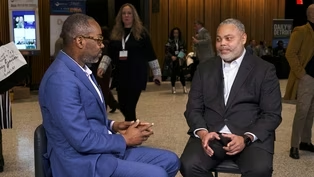
I had a chance to sit down with the company's founder and CEO Andre Gudger at the recent Detroit Policy Conference presented by the Detroit Regional Chamber.
We talked about why he selected Detroit over other cities and the opportunities that he sees in our region.
Andre Gudger, welcome to Detroit.
Welcome to Michigan and welcome to Detroit PBS.
It's great to see you.
- Hey, it's great to see everyone here.
Thanks for having me.
- Yeah.
- Yeah.
It's cold outside, but it was a very warm welcome.
- (laughs) Colder than it is in Maryland for sure.
Although, not right now.
Not this week.
- Yeah.
Not this week.
- So, I want to talk to you about your business and what you guys do, but before we get to that, I just want have you talk about this decision to move your business from Maryland, which is a state I know really well, I lived there for a long time, to Michigan.
We don't hear a lot about people making that kind of decision.
We hear from a lot of people that we're getting it wrong on business attraction and workforce development and all the things that people kinda look at when they try to relocate their business.
So walk me through that decision on your part.
- You know, that's a phenomenal question and a very complicated decision - Is that?
- to be honest with you.
Yeah, you know, when you're in search of finding the right home and reevaluating the home you're in, maybe that is the right home.
You have to boil the ocean.
You're looking at everything.
You're looking at the economy, the people, and quite frankly, you're looking at a workforce or the workforce of the future.
- Yeah.
- And, I will tell you that in Michigan, there is a lot of right happening.
We may not tell the story as well as we want to or need to right now, but it's happening, it's evolving and it's a dynamic picture.
So what attracted us to Michigan was the fact that Michigan wanted us.
- What are those things that we're getting right?
Because I don't think most people here necessarily feel like that's the case.
(chuckles) - Yeah, look, I'm gonna to tell you one thing you got right, was the people.
- Yeah.
- What happens at the grade school level on up, making talented people, multidisciplinary people, interdisciplinary people, sequential thinkers, kind people is the reason why we're here.
And we were more fortunate to have Michigan than Michigan have us.
- So when we talk about Michigan being behind, right?
40th in educational outcomes, 40th in per capita earnings.
What about that doesn't scare you, I guess?
What about that says to you, ah, I can work with that.
- Hey, it's an opportunity for Eccalon bringing in a new industry, bringing in a 22nd century industry.
Bringing in a new economy.
It's right.
So we're gonna bring high paid high tech jobs, high science jobs into the State of Michigan.
We're gonna attract ancillary industries into the State of Michigan, that's alongside of what we do.
And I see the education numbers as an opportunity.
When I meet the people, I talk to the people, it may not be the best test takers in the world, but they're sure smart.
- Yeah.
- And, it's something to build on.
It's a very capable workforce that's very unique in nature because it is very practical.
- Yeah.
- The hands on this of this city, the hands on mission that this state has had, and as it transform into a digital economy, Eccalon can be one of those vessels to get that right.
Help it stay on that narrow path of righteousness.
- We make stuff here, we have for centuries, and that's an opportunity.
- Absolutely.
In fact, when people think of Eccalon, they see us as a machine learning, high science and tech company.
And we do those things.
But we also manufacture, we also study novel materials.
- Yeah.
- We also in the biotechnologies.
So those things will be designed made in Michigan.
- In Michigan.
Yeah.
So let's talk about your company and sort of how it started.
You've got a story too about where all this comes from.
- Yeah, you know, it was one lonely morning in February of 2017, thinking about creating intellectual property that could be transformative and taking the things I learned from the time I was in the government and looking at what this country needed to restore American's dominance across the world.
And I'm locked into that both on the commercial side and on the government side.
And I wanted to birth a company that would create a unique set of minds that could come together and do make the impossible possible.
- Yeah, yeah.
No, that's really great.
Well, we're excited.
You're gonna locate right here in the city of Detroit?
- Yes.
- You said on the riverfront, right?
- Look, it's a phenomenal facility.
It handles everything.
It has the best name in the world.
It's called the Icon.
I didn't name it, - The icon.
(laughs) - I inherited.
So it's, and I have a great partner there, you know, in Bedrock.
And so, it just, the perfect suit came together - Yeah.
- to make something very special.
- Yeah, well, we're excited that you're coming and I'm sure you're excited to be coming here with us.
- Well, I'm elated and nothing, you know, Detroit against everyone now.
- Yeah, yeah.
- I'm part of that.
- Now you're on the right side of that.
- I'm on the right side of it.
That's a hundred percent.
- Well, thanks for being here with us.
- Thank you.
- Yeah.
Okay.
And finally, we here at "American Black Journal" wanna recognize the extraordinary accomplishments of Negro League's veteran Ronald Teasley.
He passed away last month at the age of 99.
Teasley was from Detroit, and he was a guest on this show in 2013, just prior to the Detroit Tigers weekend celebration of the Negro Leagues.
We talked about his baseball career and the legacy of Jackie Robinson.
Here's a portion of that conversation.
I am a huge baseball fan, so it is really an honor to have you here and in particular.
- Well, thanks for having us.
- Tell me a little about your career.
- Well, my career started right here in Detroit.
I attended Northwestern High School and Wayne State University.
I played at both places and had some good years of, I played at both places.
I batted 400 at Northwestern, I batted 500 at Wayne State.
And it's still a school record way.
- Yeah, I was was gonna say those have gotta be records, right.
- That's right.
And after that, thanks to Will Robinson, who was just a icon in sports in Detroit.
He made it possible for me to go to Vero Beach, Florida to try out with the Brooklyn Dodgers.
- Okay.
- And the tryout was successful.
I was signed and then sent to Olean at New York to play in the Pony League.
- Okay.
Okay.
- And, as a result, I met Jackie Robinson in my travels.
We were at the Vero Beach at Dodgertown, and he was gracious enough to stay and talk to us about some of the problems we might face.
- Yeah.
Yeah.
- We'd never forget it for that.
- And so, you know, I think there are a lot of people, including my 9-year-old son who have no real concept of the idea that baseball, there were two different leagues, two entirely separate leagues in baseball.
And that if you were African American, you played with other African Americans and not with with white players.
- That's true.
it was about 18, about, let's see, 1920, we organized the Negro League.
- Right.
- And it was viable, up until about 1960, and when Jackie Robinson signed naturally - In '57.
- to (indistinct).
Yes.
Right.
- Right, right, just give us an idea of what it was like to play in this separate segregated league.
I mean, history tends to sort of suggest that things got better when the leagues integrated.
And I don't doubt that that's true, but I also understand that there were some wonderful things about that league and the players there.
- You're absolutely right.
I can recall when there was racial tension, whenever we would arrive at a town, people would be there to greet us and treat us royally and just like a breath of fresh air.
And we just felt like we were the beacons of hope.
- Right.
- And it's a wonderful thing.
- And if you were an African American child at that point, that was really all you could aspire to, was playing in the Negro Leagues.
- That's correct too.
And also we proved that we could play as well as the teams, the other major leaguers.
- Right.
- Because we played games against them.
- Right, right.
- And I wouldn't, we did not beat them all the time, but we held our own.
- Right.
- And then I think that we showed that we were, if given the opportunity we could compete with the other- - Well, and you had a chance to prove that right, too.
- Right.
Absolutely.
- Absolutely.
I always sort of say that one of the real tragedies of baseball history is that we don't know, for example, whether Satchel Paige was the best pitcher ever in history, because he didn't face so many of those other, and we don't know whether Babe Ruth, for example, was the best hitter ever because he never had to face off against African Americans.
- That's true.
That's true.
- Yeah, so now when in 1957, when Jackie Robinson signs with the Brooklyn Dodgers, - '47.
1947.
- I'm sorry.
'47, not '57, what changes for the Negro League?
How quickly did things really... - Almost immediately.
- Yeah.
- Because I know when I was released by the Brooklyn Dodgers, I signed with the New York Cubans.
- Okay.
- And you could see immediately that there was a lot of chaos.
Players were joining the team and leaving the team and going to Canada to play and going different directions.
And the owners were beginning to lose money.
And almost immediately, the league was going out of it existence.
- Right, but, you said it survived 13 more years until 1960, - About 1960 and 1962.
But it was, they were not making very much money.
So eventually they just faded.
- Our sincerest condolences to the family, friends, and fans of Ron Teasley.
We thank him for being a trailblazer in baseball history.
He's gonna do it for us this week.
You can find more about our guests at americanblackjournal.org and you can connect with us anytime on social media.
Take care, and we'll see you next time.
(bright music)
 New
NewDiscussing the outlook for small businesses with Mark S. Lee, president and CEO of The LEE Group
Video has Closed Captions
Clip: S54 Ep9 | 11m 3s | Mark S. Lee also speaks to the unique economic challenges faced by African American entrepreneurs. (11m 3s)
 New
NewWhy Eccalon founder and CEO André Gudger selected Detroit over other cities
Video has Closed Captions
Clip: S54 Ep9 | 5m 44s | American Black Journal talks with the CEO of a high-tech firm that’s expanding to Detroit. (5m 44s)
Providing Support for PBS.org
Learn Moreabout PBS online sponsorship
- News and Public Affairs

Top journalists deliver compelling original analysis of the hour's headlines.

- News and Public Affairs

FRONTLINE is investigative journalism that questions, explains and changes our world.












Support for PBS provided by:
American Black Journal is a local public television program presented by Detroit PBS