
October 22, 2023 - PBS News Weekend full episode
10/22/2023 | 26m 45sVideo has Closed Captions
October 22, 2023 - PBS News Weekend full episode
October 22, 2023 - PBS News Weekend full episode
Problems playing video? | Closed Captioning Feedback
Problems playing video? | Closed Captioning Feedback
Major corporate funding for the PBS News Hour is provided by BDO, BNSF, Consumer Cellular, American Cruise Lines, and Raymond James. Funding for the PBS NewsHour Weekend is provided by...
Support provided by:

October 22, 2023 - PBS News Weekend full episode
10/22/2023 | 26m 45sVideo has Closed Captions
October 22, 2023 - PBS News Weekend full episode
Problems playing video? | Closed Captioning Feedback
How to Watch PBS News Hour
PBS News Hour is available to stream on pbs.org and the free PBS App, available on iPhone, Apple TV, Android TV, Android smartphones, Amazon Fire TV, Amazon Fire Tablet, Roku, Samsung Smart TV, and Vizio.
Providing Support for PBS.org
Learn Moreabout PBS online sponsorshipLISA DESJARDINS: Tonight on PBS News Weekend, new targets as it continues to bombard Gaza, Israel launches targeted strikes outside the Gaza Strip hitting airports in Syria and a mosque in the West Bank.
MAN (through translator): We saw right I heard a loud explosion.
We rushed over here so people killed and injured or we move them to the hospital.
LISA DESJARDINS: Also tonight difficult conversations, how a group of Jewish and Muslim Americans has worked to understand one another and this conflict.
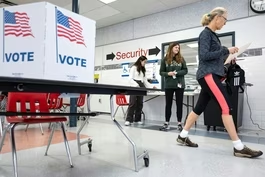
And amid rising concern in the U.S. a deeper look at how to build faith and security in elections here.
(BREAK) LISA DESJARDINS: Good evening.
I'm Lisa Desjardins.
John Yang is away.
Tonight, prospects of an Israeli ground invasion into Gaza are rising.
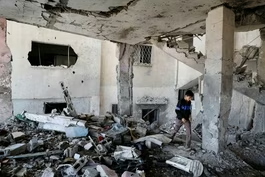
Israeli airstrikes continued to hit Gaza as well as the West Bank, Lebanon and Syria, where the bombings put two international airports out of commission and the death toll climbs nearly 4,700 Palestinians and more than 1,400 Israelis have been killed in the conflict so far.
Sentiments about the war spilled over into the streets of world capitals today from Paris where thousands marched in a show of support for Palestinians to Berlin where large crowds gathered to support Israel and oppose antisemitism.
For more on the unfolding conflict, Leila Molana-Allen is in Tel Aviv with this report.
A warning this piece includes difficult images of war.
LEILA MOLANA-ALLEN: In the West Bank, this house of worship now bears the scars of war.
Israel says Hamas and Palestinian Islamic Jihad use this mosque in the Janine refugee camp to plan attacks.
ALI ALDAMAG, Refugee Camp Resident (through translator): The youth were round and thankfully the neighborhood outside was empty.
We heard a sound like a whistle, and then there was a strike on the roof of the mosque.
LEILA MOLANA-ALLEN: Israel also struck two mosques as a refugee camp in Gaza and two airports in Syria where numerous Iranian proxy groups operate.
Fires broke out on the northern border with Lebanon.
Israel says it struck several Hezbollah targets of the incoming missile fire.
To the south of the Egyptian Rafah Border Crossing, a second convoy of 19 aid trucks and to Gaza.
They carried humanitarian supplies, but did not appear to carry any badly needed fuel.
The UN's agency and Gaza said they would run out of fuel in three days without more and larger deliveries.
They also warned that hospitals already stretched to the limit would no longer be able to operate at all.
The Hamas run-Gaza health ministry said in a statement that the pace of aid will not change the reality of the medical response.
I put this to IDF spokesman Lieutenant Colonel Peter Lerner.
Why is it so slow for that aid to come in?
LT. COL. PETER LERNER, Israeli Military Spokesperson: So obviously it is Egypt that determines what goes in.
We are concerned that that aid will go to Hamas for it to replenish.
Rebuilt.
LEILA MOLANA-ALLEN: On Sunday evening, authorities halted the convoy after they had blasts nearby.
The Israel Defense Forces said it was accidental fire from one of its tanks.
In Israel, mourners at (inaudible) kibbutz dug 10 graves for 10 neighbors killed in the October 7 terror attacks.
GEVA MEIR, Neighbor of Hamas Victim: It's unbearable.
I have so many funerals to be in and you know, I can't even be in all the funerals you can save.
Everywhere is graves.
Everywhere is everyone is dead.
Monsters.
LEILA MOLANA-ALLEN: Forensic investigators at an Israeli morgue are still working to identify some victims.
MICHAL LEVIN-ELAD, Israeli Police's Department of National Forensic Investigations: Hundreds of bodies came every day, hundreds of bodies.
This is something we have never seen in Israel before.
LEILA MOLANA-ALLEN: U.S. forces have also seen attacks by Iran backed militias in Iraq and Syria and Houthi rebels in Yemen directed missiles towards Israel, which the U.S. shot down.
In response, the Defense Department said it would send the USS Eisenhower carrier strike group to the Persian Gulf instead of the Mediterranean Sea.
The U.S. will also send Israel additional missile defense systems and surface to air missiles.
Defense Secretary Lloyd Austin said the military has put more troops on notice to potentially deploy on top of the 2000 already received the order.
On CBS's Face the Nation, Secretary of State Antony Blinken said the U.S. has consulted with Israel about its plans for a ground invasion, but did not say whether the U.S. has asked Israel for a delay to let hostage negotiations continue.
ANTONY BLINKEN, Secretary of State: We give them our best advice.
It's important as we said, not only what they do but how they do it, particularly when it comes to making sure that civilians are as protected as they possibly can be in this crossfire of Hamas is making.
LEILA MOLANA-ALLEN: For now Israeli troops await their orders on the border with Gaza.
Tanks poised for if and when a round invasion is launched.
For PBS News Weekend, I'm Leila Molana-Allen.
LISA DESJARDINS: Late Sunday night 14 additional aid trucks crossed into Gaza from Egypt.
More than 1,000 miles north of Gaza, more deaths in another war.
Six people were killed in Ukraine overnight in a rocket strike at a male center.
It happened just outside Kharkiv, Ukraine's second largest city.
Local officials said a Russian missile tore into the privately owned warehouse.
According to the company air raid sirens went off just moments before the attack and employees did not have time to find shelter.
14 others were injured.
Back in this country.
House Republicans now have a full slate of candidates in the reopened race for Speaker of the House.
Nine House members filed ahead of today's deadline.
They are Jack Bergman of Michigan, Byron Donalds of Florida, Tom Emmer of Minnesota, Kevin Hearne of Oklahoma, Mike Johnson of Louisiana, Dan Meuser of Pennsylvania, Gary Palmer of Alabama, Austin Scott of Georgia and Pete Sessions of Texas.
On NBC Meet the Press this morning, former Speaker of the House Kevin McCarthy said the chaos has got to stop.
REP. KEVIN MCCARTHY (R) California: I just know this is not a time to play games.
This is embarrassing for the Republican Party.
It's embarrassing for the nation, and we need to look at one another and solve the problem.
LISA DESJARDINS: Republicans hope to choose a speaker nominate Tuesday.
That day will mark three weeks since the House had a permanent leader.
Still to come on PBS News Weekend, how Muslim and Jewish faith groups are coming together during a time of war.
And a Brief But Spectacular take on black women sex and the black church.
(BREAK) LISA DESJARDINS: As House Republicans have grappled with their own divisions this week, it reflects a larger sharpening partisan chasm in America.
The split is far more than rhetorical with renewed and rising threats of violence amid the House speaker's race and as the 2024 election ramps up.
Last month, a group of election experts warned that American democracy is under great stress, adding we can no longer take for granted that people will accept election results.
Their report outlines 24 recommendations spanning law, media, politics and tech to protect American elections.
Rick Hasen is the director of UCLA Law School's Safeguarding Democracy Project and convened a panel of experts that drafted that report.
Rick, thank you for joining us.
You know, 2020 was three years ago now.
But clearly, there are still many Americans on in power, who deny or doubt 2020 results, including one who was nominee for Speaker of the House just this past week.
Can you help us with where are we in terms of that questioning of basic election results and where are we headed if nothing changes?
RICK HASEN, UCLA Law School: Yeah, well, you know, it's become a political talking point to not admit that Joe Biden legitimately won on the last election of United States, that's actually the optimistic story so I would hope that someone as intelligent as Jim Jordan would know that if you looked at the reliable evidence, the last election was fairly conducted.
So it's a way of showing fidelity to Trump, it's a way of sticking it to the establishment and hoping that it's cheap talk, a little bit worried about 2024, because many of those people who stood up to Trump, who said the election was in stone, many of them are gone, they lost in primaries, they've retired, they've been forced out of office, if they're election officials, or they're just fed up.
And so we're having this turnover.
And hopefully, we'll be able to make it through another election cycle without it actually mattering.
When people who are in power, are deciding that they want to overturn the election and not play by the rules that we set up.
LISA DESJARDINS: Rick, your report is all about how to make it through that next election.
You have a lot of recommendations in here.
But several of them deal with speed, trying to, you know, build up confidence by posting election results more quickly, for example, but how could that happen?
And make sure it's accuracy?
Is it just a technological and resource issue?
RICK HASEN: It's not just a technological and resource issue.
So, as you know, we have a decentralized election system.
So the rules are different county by county, not even state by state.
And different jurisdictions do things differently.
So just to take two examples.
In some jurisdictions, you can't process those absentee ballots until Election Day or near Election Day.
That takes a lot of time.
That's why we saw such a delay in places like Pennsylvania, by election night, Trump was way ahead of the ballots that had been counted, because he was ahead among ballots that were cast in person.
But over the days afterwards, it shifted and Biden ended up winning the state fairly comfortably.
In some other states like California, there are many days after Election Day by which ballots can be returned.
So it's not a question about processing the ballots.
But the question about how long and just the volume in California, some of it is also how they deal with ballots that are problematic, maybe someone forgot to sign it, or there's some issue.
So, we have a lot of technical recommendations for how we might speed up the process.
Some of it can be done by law, some of it requires more resources.
But the idea is in that period, between the time that the election is over, and the time that results are, at least unofficially finalized.
That's a dangerous period that we've recognized.
And if we could shorten that period, it would be better for everyone.
LISA DESJARDINS: I know you also focus on transparency, and also on protecting election workers.
In fact, looking at your report, that's the third recommendation that you have in here is trying to buffer security and protections for some of those election officials.
What needs to happen there that hasn't already happened.
Are we way behind in that or no?
RICK HASEN: Well, the biggest story about election officials, election workers now is attrition.
We're losing tremendous brain power and experience because people are fed up.
Election workers and election Officials are not paid all that well.
It's a very high stress job.
And then you add on top of a death threats and people harassing you, you know, why would you continue in this job?
So first and foremost, I think we need to boost the pay of election officials and election workers, we need to have public officials from both sides of the aisle support them say they're doing good job.
And we need to provide different kinds of security for them.
For example, maybe their home addresses should not be easily available through voter registration databases or otherwise, just like we protect victims of domestic violence.
We need to provide security at places where ballots are being tabulated.
But we also -- we can't keep the public completely out of that.
Because if you close and lock all the doors, then people are wondering what's going on behind closed doors.
So in some jurisdictions, you can watch a 24-hour feed, a very boring feed of here's the room where the ballots are being kept.
And here's where they're being tabulated.
And you know, so there are things that can be done.
They're not really, you know, controversial things.
They do require resources.
But they're really necessary because those election workers are the frontline for our democracy.
LISA DESJARDINS: And just in the last seconds, we have left, perhaps a tough question.
One of your recommendations is that those losing elections should accept the results, which seems simple.
But it's a core problem here.
How does that change?
RICK HASEN: So, you know, Donald Trump has claimed that there has been fraud in every major election he's participated in even elections he's won.
You're not going to convince a certain segment of the Republican Party, that elections are fairly conducted unless Trump wins.
But providing evidence to people in the middle that elections are being unfairly conducted, which starts with conducting fair elections.
Do that, be transparent.
The idea is to convince most people that elections are being fairly conducted and to have channels of communication so that people who want to get more facts who are concerned about whether elections are being properly conducted, can have confidence that they actually have been and that the people are doing the right thing or behind the scenes, ensuring that our democracy continues to function.
LISA DESJARDINS: Rick Hasen of UCLA.
Thank you for joining us.
RICK HASEN: Thank you.
LISA DESJARDINS: The conflict in the Middle East has been a broad subject for decades, including in American, Jewish and Muslim communities.
But for almost as long interfaith groups have sought to bring their communities together to find common ground.
That doesn't make watching the current war any easier, but some groups have found a blueprint for how to keep discourse civil and focused on humanity.
Ali Rogin has more.
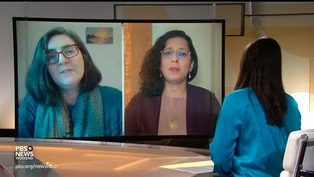
ALI ROGIN: Almost two decades ago, religious leaders in the Los Angeles area founded NewGround a Muslim-Jewish partnership for change.
Their goal was to strengthen ties between those two communities and work together on issues important to both like poverty and climate change.
Central to that was building tools to talk about the conflict in the Middle East in a way that deepens each group's understanding of the other.
Two leaders from NewGround join me now, Andrea Hodos is the associate director, and Tasneem Noor, is the program's director, thank you so much to the both of you for joining me for this important conversation.
I'd like to start by asking, how are you both feeling?
It's been a tremendously difficult time since the events of October 7.
Can we start with you, Andrea?
ANDREA HODOS, NewGround: I'm a Jewish Angeleno.
I work with Muslims and Jews, with Palestinians and Israelis.
I have family in Israel.
I have friends were people on the ground in Gaza, and on the ground outside of Gaza and in Jerusalem.
I'm nauseous, I'm grieving.
I'm angry over the grotesque murders, and kidnappings of Israelis.
I'm just shaken by the horrific retaliation on millions of Gazans who have nowhere to flee.
We're also really inspired by the ways that our community is holding together in in really important ways, even in this difficult moment, even when not everyone can come back to the table.
ALI ROGIN: Tasneem, how about you?
TASNEEM NOOR, NewGround: I'm taking a lot of deep breaths, intentionally.
And I'm encouraging everyone that I talked to, to take a lot of deep breaths.
And to be very honest, all the time when I feel it the most is when I'm lying down or not doing anything, and my body just feels a key like when you would if you have fever or something.
I'm toggling between showing up being true to myself being true to my friends, my community, while also taking time to breathe and sleep when I can.
ALI ROGIN: I'd love to ask about Andrea, what you mentioned is inspiring you these days, the conversations, the interactions that are taking place among members of your community.
ANDREA HODOS: Well, there have been a number of times one was Sunday evening, the folks who have the capacity right now to come together in interfaith settings came together in a park Pan-Pacific park.
There is real deep generational trauma that has been triggered all around.
And it's happening in real time.
And just in the circle at the end, as people were sharing what they wanted to let go of in this moment and what they wanted to hold on to in this moment.
You know, I realized I could feel the neurons kind of knitting back toward one another, and people really reaching out and we need to grab the people who have the capacity to do this in this moment.
Because the health of our city really depends on it right now.
TASNEEM NOOR: I think, even myself, when I enter a conversation, there's an anticipation of like, oh, this is going to be so hard.
This is going to be hard.
And then I go into it.
And there is actually love.
And underneath the anger, underneath the grief, underneath the pain, I can see people's hearts.
I'm hearing people reach out to their friends.
I'm hearing people say I'm thinking about that person.
And this is not me, or, you know, like the social media is not representing the people that I'm talking to.
And so that inspires me that there is so much more than what we see on social media posts that are just angry and so vicious.
I see people's hearts and that inspires me.
ALI ROGIN: And what would your advice be for people who want to have these conversations who want to come back together, but are feeling like they can't?
Because obviously this is such a fraught issue for so many.
TASNEEM NOOR: So where do we start?
We have to start with ourselves.
I think we have to be true to our values.
And I know in my tradition there is a value and in the Jewish tradition as well there is a value of reaching out to people when we are grieving.
There is a value of looking for the goodness, even in the hardest of times looking for ease, even in the deepest of difficulties.
And I hope that once we do the word vomit in a safe space, we can then come back and be true to ourselves and say, Okay, what am I really holding?
What am I really standing for, and just show up with a lot of authenticity and compassion.
And also, I think they're really want to invite people to be open to radical listening, when and as you become able, but to never lose sight that just being heard just being held, is a powerful way of disarming so much of the angst and the anger that we hold.
ANDREA HODOS: We know that once people feel like they've been seen and heard, it gives them an opening to hear and see other people, even through pain, even through deep differences.
And so if there's someone you really care about, and you've been reticent to reach out, remember that they want to know that you care enough about them to know where their pain is and what their pain is about.
And you need to be ready to actually receive that and hear it even if it's hard for you to hear.
And let them know that say, I've been thinking about you've been on my mind, I want to know what's hurting you right now.
And if now isn't a time for you to talk, that's okay.
Not everyone is going to be ready right now.
People need their own time.
But if you want to reach out, you should not hold back from doing that.
Just remember, you want to hold compassion for people the way that you would want them to hold compassion for you.
Even if you are feeling betrayed or abandoned by your friend a bit or you've been feeling in isolation.
It's actually more important that you reach out in those moments.
ALI ROGIN: Andrea Hodos, Tasneem Noor with NewGround, a Muslim Jewish partnership for change.
Thank you both so much for your time.
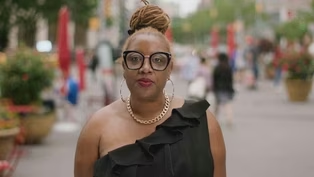
LISA DESJARDINS: Deesha Philyaw debut short story collection the Secret Lives of Church Ladies was a finalist for the 2020 National Book Award.
Her works center on memory with themes of race, desire and pop culture.
Tonight, Philyaw shares her Brief But Spectacular take on black women sex and the black church.
DEESHA PHILYAW, Writer: I grew up in Jacksonville, Florida, and I grew up being sent to church.
So I was always surrounded by women outside and inside of the church and that really shaped a lot of the questions I had about womanhood and about sex.
I wrote the Secret Lives of Church Ladies a collection of nine short stories about black women, sex and the black church.
I understand you feel the need to offer some explanation for stepping out with someone like me some reason for why I turn you on.
Why do you turn me on?
Is that you want me when there's so many reasons you shouldn't.
That turns me off.
The stories in the collection have to do with desire and longing, love, sex, family and mothers and daughters.
You tell people up here that you're from the south and nine times out of 10 they say the same old thing.
I'm sure you miss the sunshine.
Rhonda and I both miss taking sunshine and easy morning commutes for granted.
But what we really miss are the laughter and embrace of our mothers and grandmothers and aunties, kin and not kin.
My entire collection is rooted in memory and nostalgia brought together with my imagination.
We miss their Bear Brown arms reaching to hang clothes on the line with wooden pens.
We miss their sun tea brewed all day and big jars on the picnic table in the backyard.
Then later loaded with sugar and sipped over plates of their fried chicken in the early evening.
We miss lying next to them at night in their four poster beds with two soft mattresses covered by iron sheets and three generation old blankets.
We missed tracing the soft folds and their skin when we held hands and watch their favorite TV shows in their beds.
Being able to channel memory in my work helps me to be a better writer.
I think it takes me back to the sounds, the smells how I felt growing up and that's shows up in a lot of my short stories.
We miss how they made our Easter dresses and pancakes and a way out of no way but we lost all those things when we chose each other Only the memories remain which is why even though we grew up in different places, so many of our bedtime conversations start with remember when, as we lie there in the dark with our nostalgia, and nothing to distract us from it, not even each other.
Not anymore.
Thank you.
My name is Deesha Philyaw.
And this is my Brief But Spectacular take on black women, sex and the black church.
LISA DESJARDINS: And you can watch more Brief But Spectacular videos online at pbs.org/newshour/brief.
And that's our program for tonight.
On Monday, how the war between Hamas and Israel is creating bitter divisions on some college campuses.
I'm Lisa Desjardins.
John Yang will be back next weekend.
For him and all of my colleagues, thanks for joining us.
A Brief But Spectacular take on Black women, sex and church
Video has Closed Captions
Clip: 10/22/2023 | 2m 57s | A Brief But Spectacular take on Black women, sex and the church (2m 57s)
How faith groups are coming together during a time of war
Video has Closed Captions
Clip: 10/22/2023 | 7m 25s | How Muslim and Jewish faith groups are coming together during Israel-Hamas war (7m 25s)
Israeli airstrikes hit Gaza, West Bank, Lebanon and Syria
Video has Closed Captions
Clip: 10/22/2023 | 4m 38s | Israeli airstrikes hit Gaza, the West Bank, Lebanon and Syria amid fears of widening war (4m 38s)
What steps can be taken to secure U.S. elections
Video has Closed Captions
Clip: 10/22/2023 | 6m 28s | Exploring ways to build faith and security in U.S. elections (6m 28s)
Providing Support for PBS.org
Learn Moreabout PBS online sponsorship
- News and Public Affairs

FRONTLINE is investigative journalism that questions, explains and changes our world.

- News and Public Affairs

Amanpour and Company features conversations with leaders and decision makers.











Support for PBS provided by:
Major corporate funding for the PBS News Hour is provided by BDO, BNSF, Consumer Cellular, American Cruise Lines, and Raymond James. Funding for the PBS NewsHour Weekend is provided by...