
March 17, 2024 - PBS News Weekend full episode
3/17/2024 | 26m 45sVideo has Closed Captions
March 17, 2024 - PBS News Weekend full episode
Sunday on PBS News Weekend, with hundreds of thousands of Americans relying on Catholic hospitals, why some people are facing barriers to reproductive health care. Then, we look at concerns over declining support for LGBTQ+ rights, reversing years of increasing support. Plus, how pioneering chemist Stephanie Kwolek followed her passion and invented a revolutionary fiber.
Problems playing video? | Closed Captioning Feedback
Problems playing video? | Closed Captioning Feedback
Major corporate funding for the PBS News Hour is provided by BDO, BNSF, Consumer Cellular, American Cruise Lines, and Raymond James. Funding for the PBS NewsHour Weekend is provided by...
March 17, 2024 - PBS News Weekend full episode
3/17/2024 | 26m 45sVideo has Closed Captions
Sunday on PBS News Weekend, with hundreds of thousands of Americans relying on Catholic hospitals, why some people are facing barriers to reproductive health care. Then, we look at concerns over declining support for LGBTQ+ rights, reversing years of increasing support. Plus, how pioneering chemist Stephanie Kwolek followed her passion and invented a revolutionary fiber.
Problems playing video? | Closed Captioning Feedback
How to Watch PBS News Hour
PBS News Hour is available to stream on pbs.org and the free PBS App, available on iPhone, Apple TV, Android TV, Android smartphones, Amazon Fire TV, Amazon Fire Tablet, Roku, Samsung Smart TV, LG TV, and Vizio.
Providing Support for PBS.org
Learn Moreabout PBS online sponsorshipJOHN YANG: Tonight on PBS News Weekend, with hundreds of thousands of Americans relying on Catholic hospitals, why some people are facing barriers to reproductive health care, then concerns over declining support for LGBTQ plus rights, reversing years of increasing support.
WOMAN: And I think what's happening is that you see many Republican leaders and red states really trying to amp-up the volume, so to speak on LGBTQ rights, and really trying to claw back some of those rights across the country.
JOHN YANG: And for our Hidden History series of pioneering chemists Stephanie Kwolek, followed her passion and invented a revolutionary fiber with widespread applications.
(BREAK) JOHN YANG: Good evening, I'm John Yang.
Today Israeli Prime Minister Benjamin Netanyahu dismissed growing U.S. criticism of his leadership, his prosecution of the war with Hamas and his plans for a military ground operation and Rafah.
Netanyahu said international pressure would not deter him from carrying out the assault on Rafah and pressing for total victory.
The Prime Minister approved plants for the operation late last week after meeting with his war cabinet.
It comes as President Biden says the high death toll from fighting in Gaza is hurting Israel.
And as Senate Majority Leader Chuck Schumer, the top ranking Jewish U.S. official and a strong supporter of Israel said Netanyahu has lost his way and said there should be new Israeli elections.
Today on CNN State of the Union, Netanyahu fired back.
BENJAMIN NETANYAHU, ISRAELI PRIME MINISTER: I think what he said is totally inappropriate.
It's inappropriate for him to go to a sister democracy and try to replace the elected leadership there.
That's something that Israel, the Israeli public does on its own.
We're not a banana republic.
JOHN YANG: Talks in search of an agreement for a pause in fighting the release of Israeli hostages from Gaza and a Palestinian prisoners from Israel are set to resume soon in Qatar.
In Russia polls have closed after three days of voting an early return show of President Vladimir Putin with nearly 88 percent of the vote as he seeks a fifth six-year term.
Earlier, anti-Kremlin demonstrators lined up outside polling places at noon.
The hour is set by supporters of the late opposition leader Alexei Navalny for a mass protest.
Meanwhile, Ukraine launched a series of drone attacks in the Moscow region and beyond.
Shelling in the Russian border city of Belgorod killed at least two people and injured a dozen more.
26-year-old man has been charged with murder in Pennsylvania and carjacking and weapons violations in New Jersey in connection with yesterday's shooting deaths of three members of the man's family in two different locations.
His capture yesterday ended an hours long standoff with police at a Trenton, New Jersey home.
The man has shut down a St Patrick's Day parade and amusement park and led to a Shelter In Place Order.
Police said the shootings were the result of a domestic situation.
There's been another volcano eruption in southern Iceland, prompting evacuations and declaration of a state of emergency.
It's the latest in a series of eruptions since December.
A glowing two mile fisher sent lava onto major roads.
A nearby small town and popular geothermal spa were evacuated following the eruption.
Officials say barriers protecting residential areas are holding for now.
Still to come on PBS News Weekend, what's behind the decline of support for LGBTQ plus rights, and the life, career and achievements of scientists and chemists, Stephanie Kwolek.
(BREAK) JOHN YANG: Every year, more than 3.6 million babies are born in the United States.
And according to KFF Health News, more than a half million of them are about 16 percent are delivered in Catholic run hospitals.
In most cases there no complications and the birth is much like one in any hospital.
But if there's an emergency pregnant people can find themselves caught between accepted medical standards and the religious base policies of Catholic run facilities.
KFF Health News found that for nearly 800,000 Americans, there's little choice.
They have only Catholic or Catholic affiliated birth hospitals within an hour's drive.
KFF Health News reporter Rachana Pradhan is one of the writers of the story, which is the product of almost two years of reporting.
Rachana, you talked to a lot of women who had complications while being treated in Catholic run hospitals.
What did they tell you?
What is there a story, one particular story that sort of emblematic to you?
RACHANA PRADHAN, Reporter, KFF Health News: Absolutely, John.
And I will say that, in particular, talking to clinicians, like physicians and nurse practitioners and other medical clinicians that treat patients in these hospitals, really were the ones that shared incredible stories with us.
One in particular involves a nurse midwife who spoke with me who used to work, do deliveries at a Catholic hospital in Maryland, she encountered a woman who showed up at this hospital because her water had broken before her fetus was viable, so the baby would not survive outside of the womb.
And what she told us was, this patient expressed a desire to terminate the pregnancy because she knew that there was little chance of survival.
And what happened was, as this nurse midwife told us, the doctor said that they couldn't do anything, because there were still detectable fetal heart tones.
And so their hands were totally tied.
That is not often what would happen in a non-Catholic hospital, and goes against accepted medical standards for treating that kind of pregnancy complication.
JOHN YANG: What are some of the sort of the range of medical choices that clinicians and healthcare providers would want to make or have wanted to make at a Catholic general hospital but have not been allowed to because the hospitals policies?
RACHANA PRADHAN: I think, in particular, what we found based on talking to clinicians, reading research, and also talking to patients are that these very fraught and difficult situations in which someone's pregnancy goes awry, in which a complication happens that's quite serious and could obviously threaten the viability of that baby.
In situations like that, these ethical and religious directives that apply to Catholic health care facilities, essentially, what they say is that these hospitals are prohibited or limited in doing certain procedures that the Catholic Church finds to be immoral.
So overarchingly what this can affect is care during pregnancy complications, it can affect birth control the availability of birth control at these facilities.
And in situations like the one I just talked about, it means that the pregnancy terminations may not be offered.
Because these Catholic healthcare standards, the baby is still alive.
And so that would constitute an abortion and they are obviously opposed to abortions.
JOHN YANG: Do these hospitals have any policies on referrals, referrals to other facilities that might be able to do those things?
RACHANA PRADHAN: Yes.
So the Catholic health directives do address referrals.
And this doesn't only apply to pregnancy terminations, but other types of care too, namely, procedures that can prevent pregnancy.
So both men and women, frankly, vasectomies, or let's say, a woman who wants to get her fallopian tubes removed because she does not want to have any more children.
They're also restricted from making referrals.
Because in the eyes of the U.S. Conference of Catholic Bishops, which is the organization that crafts these directives, and the church, a physician referring for a procedure or care that they have deemed immoral, that also goes too far.
And so it can limit the ability for a patient to receive care at another facility, or at the very least, they have to take it much more upon themselves to figure out where they might be able to go because the Catholic health care facility cannot get so involved.
JOHN YANG: to the church leaders like the diocesan Archbishop's, did they have a role in the medical policies of hospitals?
RACHANA PRADHAN: So the ethical and religious directives are really broad guidelines.
And what we learned is that, depending on a particular Bishop of a particular diocese, sometimes policies will apply more strictly in certain places than others.
And so I think that's actually, at least based on the conversations we have with clinicians, I think that's actually part of the frustration is that these things are not black and white.
And they can change depending on who essentially is in charge.
And the bishops obviously have a role in this.
They're not based on what we learned.
They're not the ones who are making these difficult calls in certain situations to provide health care, but they are responsible for overseeing enforcement of the directives broadly.
JOHN YANG: What do Catholic hospitals say?
Or how did they they responded or reacted to your reporting?
RACHANA PRADHAN: Well, the Catholic Health Association, who we spoke with for our story before it published, they say that the ERDs, as they are known, do not prevent physicians from providing medically indicated care, especially in these situations involving very serious potentially life threatening pregnancy complications.
And they also took issue with our story.
After it came out, they released a statement that said that it perpetuates myths about Catholic health care/.
I will say that we stand by our reporting, as you noted, we worked on this for nearly two years and talk to many, many, many people, including patients, doctors, nurse practitioners, midwives, and others who have really studied this field a lot, and could very clearly state what the impacts are on patients.
JOHN YANG: For women who feel that they were not treated properly or didn't receive the proper medical treatment at these hospitals.
Is there any legal recourse for them?
RACHANA PRADHAN: So broadly speaking, most of the states in the country, we found have liability shields for hospitals, when they refuse to perform certain types of care because of moral or religious objection.
And those laws exist all over the US.
And they apply to at least some hospitals in every not every state, but really the vast majority.
For other types of medicine for a whole host of procedures, you could potentially take up a medical malpractice case against an individual provider or a hospital.
But in these situations, basically what state law says in the states is that the hospitals are shielded from being held liable in these types of situations.
JOHN YANG: Rachana Pradhan of KFF Health News, thank you very much.
RACHANA PRADHAN: Thank you, John, for having me.
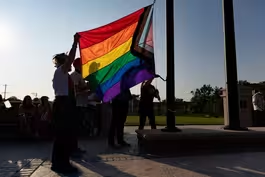
JOHN YANG: For the last few decades, the story of LGBTQ plus rights in America has been one of increasing public support.
But now a new survey finds that for the first time in years, there's a slight decline in that support.
William Brangham takes a closer look.
WILLIAM BRANGHAM: Throughout 2023, the Public Religion Research Institute, or PRRI, interviewed over 22,000 adults for what it calls its American Values Atlas.
Last week, the Organization released its findings on views about LGBTQ rights in the US.
The survey showed for the first time support fell for key policies regarding LGBTQ rights, backing for same sex marriage dropped two percentage points, support for non-discrimination protections dropped four points and opposition to people refusing services based on religious grounds dropped five points.
To help us understand this data, we are joined by CEO of PRRI Melissa Deckman.
You've been doing this survey for years.
And this being the first time you've seen it a downward tick in those numbers.
What how do you explain that?
MELISSA DECKMAN, CEO, Public Religion Research Institute: Yeah, we were somewhat surprised to see after several years of increasing support among Americans for LGBTQ rights, that we saw a decline.
But I think if you look under the hood, so to speak, and look at the data more closely, it's really largely driven by party polarization.
And so we saw much deeper declines, for example, among Republicans in terms of their support for these issues, whereas Democrats tended to stay relatively stable.
And I think what's happening is that you see many Republican leaders in red states, really trying to amp up the volume, so to speak on LGBTQ rights, and really trying to claw back some of those rights across the country.
And I think that's had a spillover effect nationally in terms of the attitudes of Republicans, especially on issues with respect to LGBT rights.
WILLIAM BRANGHAM: In your survey, you're talking to people who both affiliate with a particular religion and also non-religious people as well, correct?
MELISSA DECKMAN: That's right.
So our surveys are done among Americans nationally.
One great thing about the ABA is we also have enough data to look at opinions in all 50 states.
But essentially, we get a snapshot of all Americans, including people of faith and people who are unaffiliated.
I think it's also important to bear in mind that despite these declines that we've seen, the vast majority of people of faith continue to support the rights of LGBTQ Americans, especially with respect to same sex marriage and non-discrimination laws.
WILLIAM BRANGHAM: So for someone who might look at this and think, Oh, what a 2 percent decline or a 5 percent decline is not that substantial.
What Why does this really stand out to you?
MELISSA DECKMAN: I think it stands out.
Because with respect to LGBT rights, we're generally there has been a growing increase in support among Americans.
And part of that is a reflection of the fact that more Americans, especially younger Americans, are identifying as LGBTQ.
So younger Americans, more Americans have friends who are LGBTQ, they themselves are LGBTQ, they have colleagues.
So there has been this assumption that as we become more, I think, accepting of LGBT Americans in our daily lives, that it would just naturally lend itself to people being more supportive of protecting the rights of LGBTQ Americans.
But I think this data shows you that that's not necessarily an assumption that is true.
And so it's something important to monitor and keep aware of.
WILLIAM BRANGHAM: I mean, is it perhaps also possible that as people start to identify more publicly and assert their rights and take a more prominent place in society, that we could be seeing the traces of a backlash year?
MELISSA DECKMAN: I think that's exactly what you're seeing.
One of the things that we analyze in the report is we look at the relationship between Christian nationalist views and support for LGBTQ rights.
As you might imagine, Americans who have a tendency to support Christian nationalism are far less likely to support the rights of LGBTQ Americans, in part because of the theological opposition to the idea of really homosexuality and being queer to begin with.
And so I think that there's that important relationship there that we have to really keep in mind.
WILLIAM BRANGHAM: You're talking about are there other below the top lines here other data points that really that were of interest to you?
MELISSA DECKMAN: We were really surprised in our findings that younger Americans have trended downward with respect to support for LGBTQ rights.
If you look at our data, we find that roughly one in five Americans aged 18 to 29 identify as LGBTQ.
But yet what's happened over the past couple of years is that there's been a slight decline among younger Americans.
I think the assumption was that because younger Americans are more likely to identify as queer that we'd always have younger Americans being more supportive.
Again, though, you have to look under the hood.
It's really party polarization that is driving down support among younger Americans for same sex marriage, for example.
So one number really stands out to us.
If you look at young Americans attitudes about same sex marriage, and 2020 among Republicans, two thirds supported same sex marriage rights.
But in last year's data among young Republicans aged 18 to 29, it's less than half, that's a really big cratering of support.
I think there was often an assumption among many political analysts that younger Republicans would moderate the party with respect to things like LGBTQ rights, or even abortion rights or climate change, et cetera.
But what we're finding in this data is that younger Republicans are very conservative socially.
WILLIAM BRANGHAM: So interesting.
For people who are LGBTQ or work to help solidify their rights, what does this survey data tell you about what work lies ahead for them?
MELISSA DECKMAN: Well, I think there's the survey data, it really points, as we like to say, the canary in the coal mine idea that you can assume that such rights are going to be held in perpetuity or will increase.
And you can also assume just because the vast majority of Americans support these rights, that those rights are going to be legally protected, especially in wake of the Dobbs decision.
There's now a conservative majority on the Supreme Court.
And there's indication that the rights of same sex marriage are going to be on the line you're going to have legal challenges from conservative groups are going to be fighting to rollback those rights.
And I think that this is just a good reminder that those rights shouldn't be taken for granted that it's going to take political organizing, and that elections have consequences.
WILLIAM BRANGHAM: All right, that is the CEO of PRRI, Melissa Deckman.
Thank you so much for being here.
MELISSA DECKMAN: Thank you.
JOHN YANG: The fiber Kevlar is stronger than steel, and it's revolutionized everything from body armor for the military and police to sports equipment.
Its inventors the subject of tonight's hidden histories for Women's History Month.
Here's Ali Rogin.
ALI ROGIN (voice-over): Skis, brake pads, racing sails, spacesuits.
MAN: I think this is just a fantastic looking suit.
ALI ROGIN (voice-over): And perhaps most famously, the bulletproof vest.
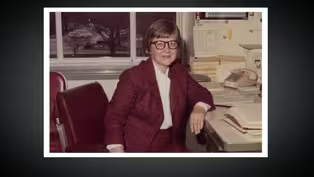
These products and many others are made with Kevlar, a strong lightweight fiber invented by researcher Stephanie Kwolek in 1965.
It all began when DuPont Chemicals asked researchers to make a fiber that could withstand extreme conditions.
STEPHANIE KWOLEK, Chemist: The solution was very, very fluid.
I mean, it was almost like had the consistency of water.
ALI ROING (voice-over): Synthetic fibers start in liquid form and are spun into a strand.
STEPHANIE KWOLEK: So when I asked the technologists to help me with the spinning, he refused, because he said, this will never spin.
It's too fluid.
It's it probably has particulate matter in a because it's cloudy and so forth.
ALI ROGIN (voice-over): But Kwolek was convinced it would work and persuaded him to give it a try.
STEPHANIE KWOLEK: Well, the results came back and they were sort of unbelievable.
ALI ROGIN (voice-over): The fiber was lightweight, heat resistant, and five times stronger than steel.
STEPHANIE KWOLEK: There of course, was immediate excitement.
Because everybody realized the potential of this discovery.
ALI ROGIN (voice-over): But Kwolek did not set out to become an inventor.
Growing up outside Pittsburgh, she considered fashion inspired by her mother who sewed.
Later as a bright student, she thought about teaching.
By the time she started college in the midst of World War II, she was determined to go to medical school.
She chose to major in chemistry at Carnegie Tech, now called Carnegie Mellon University.
But when she graduated, her plans changed again.
STEPHANIE KWOLEK: Since I could not afford to go to medical school at that time, I had to go out and seek employment.
ALI ROGIN (voice-over): She got several job offers, but one stood out for its interesting work, and for paying men and women the same starting wage.
STEPHANIE KWOLEK: And so I took the job with the DuPont Company.
The only problem was that I became so enamored of the work that I totally lost interest in medical school.
ALI ROGIN (voice-over): When she started DuPont Research Laboratory was in the middle of a race to discover fibers that would revolutionize not just fashion but war and space travel.
MAN: Miss Gloria Glamour fields for the ultimate in hosiery.
ALI ROGIN (voice-over): Just a few years earlier, the company had created the first synthetic fiber nylon.
MAN: No baggy needs all the forming wrinkles during the life of a nylon stocking.
ALI ROGIN (voice-over): That fiber success and wartime rationing of natural materials like silk and rubber will set off and intense competition between companies like DuPont and Monsanto.
STEPHANIE KWOLEK: There was tremendous interest in new fibers, and new ways to make fibers.
ALI ROGIN (voice-over): Over the next few decades, the group created the methods and techniques that would be used to make spandex.
MAN: That's one small set for men.
ALI ROGIN (voice-over): New polyester and acrylic fabrics.
MAN: These curtains are made of Dacron polyester fiber.
ALI ROGIN (voice-over): And the flame resistant Nomex.
But there was another stiffer stronger fiber waiting to be discovered.
Kevlar.
In 1964, Kwolek's research group was tasked with finding a fiber to make durable, lightweight tires to improve fuel efficiency in cars.
STEPHANIE KWOLEK: It got to be a race, but it was a very, very, very secretive race.
So that very few people outside of our laboratory knew what was going on.
But it still was a lot of fun, particularly if you want.
ALI ROGIN (voice-over): And they did.
Kwolek crack the problem in 1965, discovering a version of the polymer that could be spun up into a fiber.
Fiber B as it was known internally became Kevlar, the basis for a whole family of products.
Kwolek spent the rest of her career at DuPont.
She mentored other women in her field and worked to introduce young people to science, writing letters and giving lectures.
STEPHANIE KWOLEK: I really did not think of the bulletproof vests.
We had Dr. Joe Rivers, who at that time, was already looking for fibers to use to and making bulletproof vests.
And I remember the very first time that I spun the one for B that he came over and he said if you can possibly spare a tiny bit of that fiber, I would like to test it and see if it'll be useful and a bulletproof vests.
ALI ROGIN (voice-over): She was named on a total of 28 patents and won several awards for her work, including the National Medal of Technology.
Kwolek was inducted into the National Inventors Hall of Fame in 1995.
At the time, she was only the fourth female inductee, but to Kwolek her crowning achievement was making Kevlar possible.
STEPHANIE KWOLEK: I was fortunate enough to do something that would be a benefit to mankind.
It's been an extremely satisfying discovery.
I don't think there's anything like saving someone's life to bring you satisfaction and happiness.
ALI ROGIN (voice-over): Kwolek died in 2014 at the age of 90, but her greatest invention is still saving lives today.
For PBS News Weekend, I'm Ali Rogin.
JOHN YANG: On the PBS NewsHour Instagram right now, here with Oklahoma State Representative Mauree Turner had to say to more than 100 students and LGBTQ plus supporters following the death of a 16-year-old transgender student.
All that and more is on our news, our Instagram.
And that is PBS News Weekend for this Sunday.
On Monday, the latest in our series, America's safety net examines the challenges millions of Americans face getting housing choice vouchers.
I'm John Yang.
For all of my colleagues, thanks for joining us.
Have a good week.

How Catholic-run hospitals restrict reproductive health care
Video has Closed Captions
Investigation finds policies at Catholic-run hospitals restrict reproductive health care (7m 13s)
The life and achievements of chemist Stephanie Kwolek
Video has Closed Captions
The life and achievements of chemist Stephanie Kwolek, inventor of Kevlar (5m 46s)
What’s behind a decline in U.S. support for LGBTQ+ rights
Video has Closed Captions
U.S. support for LGBTQ+ rights is declining after decades of support. Here’s why (6m 41s)
Providing Support for PBS.org
Learn Moreabout PBS online sponsorship
- News and Public Affairs

Today's top journalists discuss Washington's current political events and public affairs.

- News and Public Affairs

FRONTLINE is investigative journalism that questions, explains and changes our world.












Support for PBS provided by:
Major corporate funding for the PBS News Hour is provided by BDO, BNSF, Consumer Cellular, American Cruise Lines, and Raymond James. Funding for the PBS NewsHour Weekend is provided by...