
June 18, 2026 - PBS News Hour full episode
6/18/2026 | 57m 46sVideo has Closed Captions
June 18, 2026 - PBS News Hour full episode
June 18, 2026 - PBS News Hour full episode
Problems playing video? | Closed Captioning Feedback
Problems playing video? | Closed Captioning Feedback
Major corporate funding for the PBS News Hour is provided by BDO, BNSF, Consumer Cellular, American Cruise Lines, and Raymond James. Funding for the PBS NewsHour Weekend is provided by...
June 18, 2026 - PBS News Hour full episode
6/18/2026 | 57m 46sVideo has Closed Captions
June 18, 2026 - PBS News Hour full episode
Problems playing video? | Closed Captioning Feedback
Where to Watch PBS News Hour
PBS News Hour is available to stream on pbs.org and the PBS app.
Providing Support for PBS.org
Learn Moreabout PBS online sponsorshipAMNA NAWAZ: Good evening.
I'm Amna Nawaz.
Geoff Bennett is away.
On the "NewsHour" tonight: The U.S.
lifts its blockade on the Strait of Hormuz after the U.S.
and Iran sign a memorandum offering a pathway to a peace deal.
A new Tennessee law requires children's immigration status to be reported to ICE if they're receiving government-funded medical services.
Advocates now fear some kids won't get the care they need.
And composer Andrew Lloyd Webber on the success of a reimagined "Cats" musical and the evolution of his illustrious career.
ANDREW LLOYD WEBBER, Composer: If you can have the kind of career that I have had doing the one thing that I really enjoy, I can't do anything other than say I'm the luckiest man alive.
(BREAK) AMNA NAWAZ: Welcome to the "News Hour."
The U.S.
announced today that it's lifting the blockade of the Strait of Hormuz to let ships pass through.
Sea traffic there has been at a standstill since nearly the start of the war.
And Iran's supreme leader, Mojtaba Khamenei, blessed the deal with the U.S., saying it was -- quote -- "desperation" that drove President Trump to the bargaining table.
Liz Landers begins our coverage again tonight.
J.D.
VANCE, Vice President of the United States: First of all, I think the president's peace plan in Iran is already bearing real fruits for the American people.
LIZ LANDERS: Vice President J.D.
Vance, a self-professed skeptic of foreign wars, is now the face of President Donald Trump's tentative agreement to end the war with Iran.
J.D.
VANCE: Their economy is in absolute dire straits.
But in order for them to get any integration into the world economy, they're going to have to show us and verify for us that they are changing their behavior.
And that's why the deal is set up in the way that it is.
LIZ LANDERS: The 14-point memorandum of understanding opens the Strait of Hormuz, with the U.S.
ending the naval blockade and Iran ensuring prewar ship movement for 60 days, while lifting sanctions immediately on Iranian oil and petroleum products.
It also sets up future talks on the nuclear ambitions of the country, while forcing the Iranian regime to downblend their highly enriched uranium.
The agreement was read to reporters yesterday.
The White House has yet to release the text.
The United Nations nuclear watchdog welcomed the interim agreement today.
Director-General Rafael Grossi said his agency would be involved in technical discussions to implement the agreement.
RAFAEL GROSSI, Director General, International Atomic Energy Agency: And now it's for us to sit down with our American colleagues, our Iranian colleagues, and start formulating the concrete steps that will have to be taken.
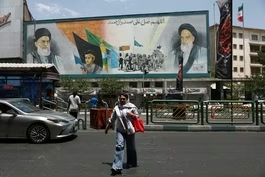
LIZ LANDERS: In Tehran today, some Iranians reacted with skepticism and pessimism about the newly signed deal.
FARIDEH HAJIAN, Tehran, Iran, Resident (through translator): I have no hope at all that this agreement will be carried out, because America has proven numerous times that it's nothing but a liar.
LIZ LANDERS: A sentiment echoed by Israelis today.
OHAD BUBER, Tel Aviv, Israel, Resident: I honestly don't know much about it.
I just know that it doesn't stop the war and it doesn't stop the hate.
And it sucks for me, because I really believed in Trump and I believed that he would end the war.
LIZ LANDERS: But Israel and Hezbollah, neither a party to the agreement, presented potential stumbling block on the ground in Lebanon.
The memorandum of understanding says that Lebanon is included in the cease-fire.
But today's attacks killed at least three people in Southern Lebanon, according to Lebanon's state news agency.
Iran has said continued Israeli attacks would breach the agreement.
The angry denunciations of the deal from Israeli leaders drew unusually sharp criticism from Vice President Vance.
J.D.
VANCE: If I was in the Cabinet of the Israeli government, I might not be attacking the only powerful ally that I have anywhere left in the entire world.
LIZ LANDERS: More shifting rhetoric on one of America's strongest allies that reflects a White House where broader messaging is apparently malleable.
In February, the day the war began, President Trump's view on Iran's missiles was clear.
DONALD TRUMP, President of the United States: We're going to destroy their missiles and raze their missile industry to the ground.
It will be totally again obliterated.
LIZ LANDERS: And then just yesterday: DONALD TRUMP: I'm saying that if other countries have them, it's a little bit unfair for them not to have some.
LIZ LANDERS: In March, the president originally suggested that regime change was an objective and the Iranian people could take control of their government.
DONALD TRUMP: But we have had regime change if you look already.
We're dealing with different people than anybody's dealt with before.
It's a whole different group of people.
So I would consider that regime change.
LIZ LANDERS: But on Tuesday, he said: DONALD TRUMP: Now, you talk about regime change.
I never cared about regime change.
It's never a part.
LIZ LANDERS: And the administration has lowered expectations about what happens to the Iranian stockpile of highly enriched uranium, initially saying: DONALD TRUMP: We have to take that -- I call it the nuclear dust, right?
But we have to take that nuclear dust.
We're going to take it.
And that's part of our negotiation with Iran.
LIZ LANDERS: But the agreement only stipulates that Iran must downblend the material on site, pending broader negotiations.
J.D.
VANCE: They have promised not to enrich.
They have promised that they would allow inspectors in to destroy that highly enriched stockpile.
And then, of course, it's not usable anymore.
You take it somewhere else.
LIZ LANDERS: This afternoon, the president made sure to tout the stock market, saying: DONALD TRUMP: The stock market just hit a new all-time high.
The 401(k)s just hit a new all-time high.
And oil is dropping like a rock.
Other than that, it's another day in paradise.
LIZ LANDERS: Meantime, Vance was expected to attend a signing ceremony with the Iranians in Switzerland on Friday, but told reporters today that timing may slide into the weekend.
For the "PBS News Hour," I'm Liz Landers.
AMNA NAWAZ: For more now, let's turn to a Republican former foreign policy official.
Michael Doran was senior director for the Middle East on the National Security Council in the George W. Bush administration.
He's now a senior fellow at the Hudson Institute.
That's a Washington think tank.
Welcome.
Thanks for being here.
MICHAEL DORAN, Former National Security Council Staffer: Great to be here.
Thank you.
AMNA NAWAZ: I'm sure you have already seen some of the criticism from some in the president's own party.
Here's what Senator Bill Cassidy had to say about this framework deal.
He said: "Iran's nuclear ambitions were not curbed, and they learned that threatening the Strait of Hormuz works."
He also called it the worst foreign policy blunder in decades.
Do you agree with that?
MICHAEL DORAN: No, I don't agree with that.
From my perspective, it's a mixed bag, but I'm willing to give the president the benefit of the doubt.
He's gone to war against Iran and its proxies three times just in this term, once against the Houthis, Operation Midnight Hammer, and now Epic Fury.
I think he's really done more to degrade Iran's capabilities than any other president, and I think we should give him a little leeway.
AMNA NAWAZ: With this agreement, though, Iran is now saying it won't work towards a nuclear weapon, the state of Hormuz is open.
Both of those were true before the war.
So what's fundamentally changed?
MICHAEL DORAN: Well, what's fundamentally changed is that Iran's nuclear program has been destroyed, for all intents and purposes, and they're not enriching uranium.
And I think the most important clause of the memorandum of understanding is that the nuclear status quo will remain in place as long as the MOU is in place.
So as long as they're negotiating, there's not going to be any enrichment.
That's a fundamentally different quality that we have had with Iran since they started enriching uranium in 2006.
AMNA NAWAZ: You have wrote about this in a piece recently that the agreement buys the U.S.
time to allow ships to leave the Persian Gulf, also time for the U.S.
to rearm, to replenish its stockpiles, and get ready to attack Iran again, as President Trump has threatened to do if they don't comply with the deal.
Doesn't that timeline also allow for Iran to replenish its stockpiles and get ready?
MICHAEL DORAN: Yes and no.
I think we have the upper hand there, because, like I said, number one, they're not enriching uranium, so we don't have that pressure on us.
And then we can also see what they're doing with missiles and with proxies.
And if they start to misbehave, then we can strike them.
And they know that.
They're under enormous economic pressure when we have a kind of economic choke hold on them.
So I think that there is a -- we don't have to be -- we have a little bit of room for error here and we can test and see where this will go.
AMNA NAWAZ: You mentioned the missiles and the proxies, though, as Liz Landers has pointed out in her report, there's no language about stopping support for proxies in the region in this framework deal.
And the president has seemed to walk back that goal of ending their missile capability.
They were striking allies in the region just a couple of weeks ago.
How are allies in the region safer now?
MICHAEL DORAN: Well, the number one thing he's -- the president is focused on is ending a nuclear -- a nuclear Iran.
I don't actually believe that this larger framework is ever going to come into being.
I think the Iranians are going to behave the way they always do.
AMNA NAWAZ: You mean a larger deal on the nuclear ambitions?
MICHAEL DORAN: On -- yes, on all of it.
I think this is really basically, in essence, a deal to open up the strait and to relieve -- to allow the Iranians to sell some oil, get some frozen assets returned to them in return for allowing us to get all of our allies' oil out.
It pushes all of the larger issues into the distance.
I think we're going to be in MOU land.
I mean, we have 60 days of an MOU, which is renewable, and we're supposed to negotiate this larger deal during that time.
I think what we're going to find is that, six months from now, we're still going to be in MOU land.
And that's OK with me if we're still in MOU land.
MOU land can go on forever, because they're not enriching uranium while that's happening.
AMNA NAWAZ: We have heard the president explicitly say oil supplies would be depleted in a matter of weeks if the war had gone on.
In your view, did domestic energy and political pressures force the president to make a deal at this moment?
MICHAEL DORAN: I think so.
I think it was the three ends.
It was markets, munitions, and midterm elections.
So he was looking at a spike in oil prices and he was worried about the effect that that would have on the midterms.
But, also, he's concerned about the expenditure of interceptors that -- we don't know the exact numbers.
I mean, this is one of the things the best kept secrets, but it's not a secret that we went - - we burned through a lot of our interceptors.
And that made a lot of our allies nervous around the world.
AMNA NAWAZ: Michael Doran of The Hudson Institute, thank you so much for being here today.
We appreciate your time.
MICHAEL DORAN: Thank you.
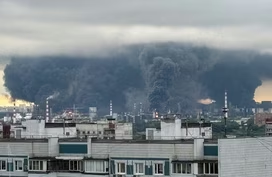
AMNA NAWAZ: In the day's other headlines: Dozens of Ukrainian drones struck targets, including a major oil refinery near Moscow today, their second hit on Russian energy targets in a week.
Eyewitness video captured the explosion at a fuel depot with the massive storage lid flying into the air like a popped cork.
A drone also hit this residential building nearby.
The barrage turned the skies over Russia's capital city into a ceiling of smoke.
Speaking in Brussels today, Ukraine's President Volodymyr Zelenskyy said the strikes were in response to Russia's attack on a historic monastery complex earlier this week.
VOLODYMYR ZELENSKYY, Ukrainian President: Our mid-range strikes are seriously disrupting Russian military logistics, but Putin is not stopping this war.
AMNA NAWAZ: Russia's Defense Ministry said today's Ukrainian assault was the largest since the war began more than four years ago.
And Foreign Minister Sergey Lavrov vowed that strikes on Ukrainian targets will continue -- quote -- "on a regular basis."
The U.S.
Supreme Court today sided with a Texas man who said his marijuana use shouldn't make it a crime for him to have a gun.
The justices unanimously found that the federal ban against all regular drug users from owning guns violated the Second Amendment.
That same law was used to convict Hunter Biden back in 2024.
He was later pardoned by his father, then-President Joe Biden.
The Trump administration has defended the law, despite arguing against other gun restrictions.
Today's opinion was a narrow one, applying only to drug users who are not considered dangerous.
In parts of the Midwest today, residents took stock of the wreckage after powerful storms tore through the area.
Cell phone videos showed what appeared to be a large tornado hitting Effingham, Illinois, overnight.
By daybreak, the extent of the damage was clear, though authorities say there were no serious injuries.
Meantime: WOMAN: Fighting the current.
AMNA NAWAZ: Downpours from what was Tropical Storm Arthur swamped entire Gulf Coast neighborhoods.
More rain is expected through tomorrow from Mississippi to the Carolinas.
And from floods to flames.
Firefighters in Washington state have been working to contain a blaze near Spokane that's destroyed at least 15 homes and forced about 1,500 people to evacuate.
Authorities say they found possible human remains in one of the homes.
In Los Angeles, officials say there's no longer any threat of hazardous air after a massive warehouse fire east of the city.
It tore through a cold storage warehouse, sending large plumes of smoke across the Boyle Heights neighborhood.
Authorities say it started on the building's roof, which is covered in solar panels, and reached an ammonia line which led to several small explosions.
That prompted a shelter-in-place order, which has since been lifted.
There have been no reports of injuries.
In Washington, D.C., Janeese Lewis George has won the city's Democratic primary for mayor, meaning she will almost certainly become the first new leader in the heavily Democratic city in more than a decade.
The Democratic socialist had run on issues like education and affordable housing.
She's also pledged to push back against federal intervention in local affairs, telling reporters today about the need to stand up for the city's autonomy.
Earlier this month, President Trump said he would consider putting Washington under direct federal control if Lewis George becomes mayor.
Former President Barack Obama celebrated the opening of his presidential center in Chicago today.
The nation's 44th commander in chief was joined by his family, a host of celebrities, and three former presidents.
In his remarks, Mr.
Obama said that the $850 million center was an expression of thanks to the city that gave him his start in politics.
President Trump was notably absent, and Obama did not mention him by name, but there were some nods to the current administration, with Obama remarking, in his words, how precious our democracy truly is.
BARACK OBAMA, Former President of the United States: People aren't looking for perpetual anger and division.
They are looking for fairness and common sense and mutual respect, that, deep in our gut, we want to find a way to turn towards each other again, not further away.
AMNA NAWAZ: The Obama Presidential Center is expected to draw more than a million visitors annually.
It officially opens to the general public tomorrow, on Juneteenth.
On Wall Street today, stocks ended higher ahead of the Juneteenth holiday weekend.
The Dow Jones Industrial average rose about 70 points.
The Nasdaq jumped nearly 500 points, or almost 2 percent.
The S&P 500 closed about 1 percent higher to close out the trading week.
And in New York today, joy and confetti filled the air as the city celebrated its first NBA championship in more than half-a-century.
An estimated two million people lined the famous Canyon of Heroes in Lower Manhattan, forming a sea of orange and blue, the Knicks colors.
It was the first ever ticker tape parade for the Knicks, despite winning two titles in the 1970s.
The route ended at City Hall, where Mayor Zohran Mamdani presented the Knicks with keys to the city and addressed what this moment means for New York.
ZOHRAN MAMDANI (D), Mayor of New York City: So often when this city comes together, it is because we are forced to by a moment of tragedy or adversity.
What a gift it is to be brought together by pure unfiltered joy.
For as long as we live, we will remember this feeling of a city together, a city alive, a city overcome by happiness.
AMNA NAWAZ: The celebrations cap off a dominant and improbable run for the Knicks, who beat the San Antonio Spurs for the title in five games.
Owner James Dolan has said the team has accepted an invitation to visit the White House.
No date has been set, but they would be the first NBA champions to do so during President Trump's time in office.
Still to come on the "News Hour": an injured Israeli soldier recounts his experience on the front lines of the war with Hezbollah; where pardoned January 6 rioters are today, from new convictions to public office; Andrew Lloyd Webber reflects on the reimagined musical "Cats: The Jellicle Ball"; and Americans give a warm welcome to World Cup fans from across the globe.
Major surges of ICE agents have largely faded from public view, but immigration crackdowns are still ongoing in many communities, especially where there's cooperation with state and local authorities.
In Florida, where Governor Ron DeSantis partnered with ICE, there were more than 90 arrests a day earlier this year.
And in Eastern Tennessee, more than 100 people were arrested in an ICE operation just a few weeks ago.
Stephanie Sy looks at a new law in Tennessee that goes further than any other and has critics worried it will cut off lifesaving care for children of undocumented immigrants.
STEPHANIE SY: Amna, in the spring, the state's Republican legislature passed a law requiring state agencies to report undocumented people to ICE if they receive benefits.
Many of these families ineligible for Medicaid or other insurance have been turning to a last resort state special services program for their kids' medical care.
According to The Tennessean, earlier this month, about 400 families received a letter informing them that they will have to disenroll from that program by the end of this month or have their status reported.
Michele Johnson is executive director of the Tennessee Justice Center, which is raising alarms about what may already be happening to these children.
And she joins us now.
Michele, thanks for joining the "News Hour."
I understand this amounts to a relatively small number of children, but I understand there's some of the most vulnerable, cancer patients, those that need ventilators to breathe and those with disabilities.
The law does not kick these kids off the program, though I have heard that was on the table at one point.
So what does it do and what are the practical impacts you're concerned about?
MICHELE JOHNSON, Executive Director, Tennessee Justice Center: Well the letter gives mothers an impossible choice.
It says you can either willingly disenroll from this program that is your only pathway for your child to get lifesaving care, or you can stay on the program and we will turn over your information to ICE, which mothers know means that these children and -- could be deported to could be detained in things like Alligator Alcatraz, where they not only won't get the care they need, but they won't even get nutrition.
So, I mean, the choice that these mothers have is impossible.
And both of these choices lead to, according to doctors in our state, almost certain death for these children.
STEPHANIE SY: Alligator Alcatraz, of course, the detention facility in Florida.
Michele, are you already hearing about families who are afraid of being deported unenrolling the program?
And do you have examples of pediatric patients that may already be losing access to critical care?
MICHELE JOHNSON: Absolutely.
We have been talking to families for the last two weeks, families who are on the road to citizenship, who have done everything, followed every rule and received this letter and are scared that we have created an environment in this country, and particularly in this state, that is terrifying for people.
And so a client that we talked to yesterday has already disenrolled, and her 10-year-old with severe spina bifida who needs surgery in order to not be in pain, they had to cancel the surgery.
The provider canceled the surgery.
So he is now in unnecessary pain.
And I can't really imagine, as a mother, watching your child suffer, watching your child suffer not because of a serious illness that they're born with, but because the elected officials in your state want to have a political issue that they can run on.
And that's what this comes down to.
It's choosing politics over the lives of these children.
STEPHANIE SY: Well, speaking of politics, one of the law's proponents, Republican Mark Cochran, has been quoted in local press as saying this law - - quote -- "ensures Tennessee public benefits are reserved for those legally present in the U.S.
and directs appropriate referral to ICE, while fully upholding all federal mandates for emergency and lifesaving care."
You just gave that example of the child with spina bifida.
Is it true what he says, that this is -- children still have an alternative?
What is your response to his comment?
MICHELE JOHNSON: Well, I have done health law for poor children for the last 32 years.
And the emergency room does not address the health needs of these children.
There is a law that says, if a child is on death's door, the hospital must take them in and stabilize them.
But we have kids with cancer, toddlers with cancer that need chemo.
And the emergency room will not provide chemo.
That is not something that they have to do.
And I know this because I have been trying to get health care for children over the last 32 years, and that's not part of the law.
STEPHANIE SY: It's supposed to go into effect on July 1.
And we should note that we did invite the state health commissioner to join us, but he declined.
What is your organization doing right now to help these families?
MICHELE JOHNSON: First and foremost, we're letting the public know that this is being done in their name with their tax dollars, and we're asking them to call the governor.
The governor has said he's a faith-filled man.
And I can't fathom that he intended to sign a bill that would do that to these most vulnerable angels, angels in our state.
Second, we're preparing to file suit.
We will file suit in short order, because it's illegal.
It's not just immoral, but it's illegal.
And, last, we're working with families to figure out, is there any way to get any benefits, even some benefits donated?
But the fact is, their health care is so complex that even if they can get part of their needs met, they cannot know that they will be safe.
We're the only state doing it because Stephen Miller told our head of our House that this was something that would curry favor with the public.
The public that I talk to on both sides of the aisle say killing children is not -- it does not reflect our values and we're better than that.
I really hope the governor will take a second and live out his values.
STEPHANIE SY: Stephen Miller, of course, a chief adviser to the Trump administration and one of the architects of its immigration policy.
That is Michele Johnson with the Tennessee Justice Center joining us.
Michele, thank you.
MICHELE JOHNSON: Thanks for having me.
AMNA NAWAZ: A linchpin of the U.S.-Iran deal signed yesterday relies on two forces not part of the deal, Hezbollah and Israel.
Their deadly back-and-forth continues, with the potential to scuttle the agreement.
Many of the Israeli soldiers are reservists, called up again to fight Israeli adversaries at great personal cost.
Nick Schifrin met one Israeli officer on the border in March and recently spoke with him again after the latest fighting with Hezbollah came close to claiming his life.
NICK SCHIFRIN: For Captain Micha, life has become slower and more quiet.
He was wounded about two months ago fighting for Israel in Southern Lebanon and is now recovering at home outside Tel Aviv.
He holds on to his faith and his desire to return to his men, despite his injury and trauma.
CAPTAIN MICHA, Israeli Defense Forces: My greatest fear is actually to forget.
So I actually don't mind talking about it.
I think it's important.
NICK SCHIFRIN: This is him back in late March patrolling Southern Lebanon through a village emptied by the Israeli military, past the Lebanese homes flattened by Israeli airstrikes.
Before the tenuous and faltering April cease-fire, Israel's campaign in Southern Lebanon was relentless.
The military razed entire towns and villages, pushing out the population.
Lebanese authorities say more than one million have been forced to flee their homes and more than 3,000 were killed.
Israel invaded and occupied deeper into Southern Lebanon than it had in a quarter-century.
Israel says it wanted to put a buffer between Northern Israeli residents and Hezbollah, which had fired thousands of rockets and missiles into Northern Israeli communities, killing dozens of Israeli soldiers and a handful of Israeli civilians.
I visited the border in late March.
Metula, Israel's northernmost town, is where Micha and I first met.
CAPTAIN MICHA: Our job as reservists and our job as the IDF in general is to create a barrier and to create a -- to make sure that we are what is between them and what we consider our enemy.
NICK SCHIFRIN: In the days and weeks after, the military ordered him and his unit to create that barrier inside of Lebanon.
On April the 18th, they were protecting a bulldozer.
CAPTAIN MICHA: The bulldozer went over an explosive device and basically took out of the ground and all the explosive device and it exploded on our men.
It was a massive explosion.
Initially, I got injured.
I have many pieces of shrapnel in my legs.
And, initially, I didn't realize -- I mean, I have got -- I had immense pain in both my legs, but I was still able to run backwards and get on the radio and see how my soldiers were doing, because I didn't actually realize that something hit me.
NICK SCHIFRIN: One of his soldiers was killed that day, Sergeant First Class Lidor Porat, who was 31 years old.
CAPTAIN MICHA: He actually volunteered to come to my unit.
He was in a -- he wasn't in as much of a combat unit, as we were.
And about a year ago, he had a friend that was in my platoon, a soldier of mine, and just as life would have it, he ended up losing his life in the battlefield.
NICK SCHIFRIN: The bomb tore through one of Micha's arteries and multiple veins.
He survived thanks to quick care.
His is a soldier's stoicism.
CAPTAIN MICHA: The actual moment itself, in a way, was a shock, but also it's what you come to expect when you go to war.
I think the thing about war, and when you go into enemy territory, is you know that people are trying to harm you and kill you, and we were evacuated pretty quickly.
NICK SCHIFRIN: Hezbollah has made Israel's invasion of Southern Lebanon even more deadly, thanks to drones.
Hezbollah videos show first-person view or FPV drones targeting Israeli soldiers precisely.
These drones are often operated using long fiber-optic cables, the same technology I filmed in Ukrainian trenches, with Ukrainian soldiers targeting Russians.
CAPTAIN MICHA: We have known that they had these kind of capabilities for a while, and I think it was a matter of time until it became so popular to them in such a mass scale.
If you would actually see the numbers of how many drones are hitting or trying to attack Israelis every single day, and the number of casualties and injuries, I think we will see and we can see that slowly, slowly, the army's getting better at adapting.
NICK SCHIFRIN: But Micha is a reservist, and the Israeli army and society have struggled to adapt to sending reservists to war repeatedly since the October 7 Hamas terrorist attack.
Of 900 days after that day, he deployed more than 500 when we first met in March.
CAPTAIN MICHA: The impact of these wars since October the 7th has been immense on Israeli society, especially on reservists, really straining the fabric of Israeli society.
So I think that there's nothing we have felt more than that.
If I have a soldier, that any of my soldiers will come up to me and tell me, "Micha, my wife is finished, I need to go home," so we will send them home, because there is no point to protect our home if there's no home to go back to at the end of the day.
My mom has four reservist sons.
She hasn't slept in about 10 years.
I got married shortly before October 7, and I have been 500 days in reserve, so, I mean, I have seen my soldiers a bit more than I have seen my wife since I have been married.
The first thing I told my wife when she came and saw me after the surgery, it was 3:00 a.m., and she came into the ICU, and she asked me how I am.
I told her that -- the first thing I told her was that: "I'm sorry, but once I'm recovered, I'm going back to the unit."
So she wasn't very happy.
NICK SCHIFRIN: And why do you want to go back to your unit, despite the risks?
CAPTAIN MICHA: Because the risks have always been there.
It's not a new risk.
Someone needs to be on the front line, and if all of us will say that another person will do it, then no one will be there, so it's my time.
And it's my time now and it'll be my time in a few months when I fully recover.
NICK SCHIFRIN: But he's planning a future for after the war.
He's studying to practice law.
Until then, he checks his phone for news from his men.
His recovery depends on theirs as well.
For the "PBS News Hour," I'm Nick Schifrin.
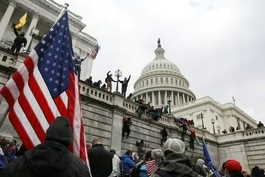
AMNA NAWAZ: New concerns are emerging about President Trump's sweeping pardon of January 6 defendants after a recent report found that nearly 100 of them have been arrested, charged, or convicted of additional crimes since the attack in 2021.
Continuing efforts by President Trump and his allies to recast the events of that day have reignited debate over accountability and the rule of law.
Our White House correspondent, Liz Landers, takes a closer look.
LIZ LANDERS: The January 6 attack on the United States Capitol in 2021 has been called the most documented crime in American history.
More than 1,500 people were charged with crimes related to the attack, which almost prevented the peaceful transfer of power.
MAN: We have a breach of the Capitol, breach of the Capitol!
LIZ LANDERS: Four years later, a presidential pardon from President Trump only hours after he was sworn into office a second time.
DONALD TRUMP, President of the United States: So this is January 6, and these are the hostages, approximately 1,500 for a pardon, full pardon.
LIZ LANDERS: Now a new study finds that, in some cases, the criminal behavior that defined January 6 didn't stop when the rioters left the Capitol that day.
A new report from the nonpartisan publication Lawfare found that 97 people charged in connection with the Capitol riot have been arrested, charged, or convicted of new crimes since the attack.
That's a recidivism rate of one in 16 convicted rioters.
Lawfare's review found the new offenses ranged from minor infractions to serious felonies; 14 rioters have been charged with sex crimes or crimes related to child sexual abuse material.
Others have face charges like property damage and driving under the influence.
One rioter was convicted of reckless homicide in 2025.
BRENDAN BALLOU, Former Federal Prosecutor: These acts of massive violence.
LIZ LANDERS: Brendan Ballou is a former Justice Department attorney who spent two years prosecuting rioters who attacked the Capitol on January 6.
BRENDAN BALLOU: I think it's unsurprising that so many January 6 rioters have since committed violence, because I think that was the point of Donald Trump's pardons.
These were people that committed violence in the president's name.
He pardoned them because they committed violence in his name.
LIZ LANDERS: Some of those January 6 defendants Trump pardoned are now running for public office.
Adam Johnson, the self-dubbed lectern guy who carried Nancy Pelosi's podium through the Capitol Rotunda, is running to be a Florida County commissioner.
Tyler Dykes, who was sentenced to 57 months in prison for his actions on January 6, recently lost his bid in South Carolina for a seat in Congress.
RYAN ZINK, Pardoned January 6 Defendant: I am a January 6 defendant.
Guns up.
LIZ LANDERS: So did Ryan Zink, who's running for Congress in Lubbock, Texas.
And one convicted rioter now even works in a highly sensitive role in the Pentagon.
Elias Irizarry was 19 years old when he broke into the Capitol on January 6.
He later called the day's events a disgrace.
A Pentagon spokesperson confirmed that Irizarry is a political appointee in the department, calling him -- quote -- "a qualified patriotic young professional."
The Washington Post reports that Irizarry works as a special assistant in the special operations and low-intensity conflict policy office and that he has a top security clearance.
Last month, the Justice Department announced a controversial plan to try to further help January 6 rioters and others who feel they've been targeted by the U.S.
government.
The $1.776 billion anti-weaponization fund, which immediately sparked a bipartisan backlash, is now on hold after a federal court blocked it indefinitely.
And acting Attorney General Todd Blanche told Congress the DOJ does not intend to move forward with the fund.
But President Trump continues to insist those convicted of storming the Capitol on January 6 deserve some kind of monetary settlement.
DONALD TRUMP: These are people that are great people that were destroyed.
Their families have been destroyed.
Many suicides.
They committed suicide.
People that went there to -- with love.
They went there with love.
DANIEL HODGES, D.C.
Metropolitan Police Department: The whole situation is so absurd, right?
LIZ LANDERS: Metropolitan Police Officer Daniel Hodges was pinned against a door and trapped in a tunnel defending the Capitol that day.
(SCREAMING) DANIEL HODGES: They fought for him, and that's all that matters to him.
It doesn't matter that they committed crimes, that they assaulted me and my colleagues, that they threatened Congress, that they tried to stop the peaceful transfer of power.
All that matters is that they did his bidding.
And he wants to make sure that they are willing to do that again in the future should he wish it.
LIZ LANDERS: Hodges says he's faced harassment and death threats since he spoke out about what he experienced on January 6.
DANIEL HODGES: If these people were given money, then it would empower them, give them the resources and make them feel like they're untouchable to carry out their threats and any potential further violence.
LIZ LANDERS: Enrique Tarrio, the former leader of the Proud Boys, was convicted of seditious conspiracy for his role in organizing the attack on January 6.
In January of this year, he told PBS News he has no regrets about what happened five years ago.
Would you do it again?
ENRIQUE TARRIO, Former Proud Boys Leader: I would definitely do everything I did again because I'm not guilty of that crime.
And he's not alone.
LIZ LANDERS: Since he returned to office, President Trump and his administration have embraced a campaign to rewrite the story of January 6.
The official White House Web site hails the pro-Trump mob that stormed the U.S.
Capitol as -- quote -- "peaceful protesters" who were provoked by law enforcement.
It also claims the violence that day was instigated by law enforcement and then-House Speaker Nancy Pelosi.
Last month, the Justice Department acknowledged it has been removing hundreds of news releases from its Web site about criminal prosecutions connected to January 6, saying it is proud to get rid of what it calls -- quote -- "partisan propaganda."
Former federal prosecutor Brendan Ballou says the effort to rewrite the narrative of January 6 is very dangerous.
BRENDAN BALLOU: I think the president is trying to rewrite the history of the past because he knows how relevant it is to the future.
If he can get people to forget January 6, or, worse yet, if he can get people to think of it as legitimate political discourse, then he knows he can get people to accept any attack on democracy without consequence.
LIZ LANDERS: Brandon Fellows was at the Capitol on January 6, entering the building through a broken window and photographed sitting in Senator Jeff Merkley's office.
Fellows was convicted and spent more than three years in jail for his actions.
Do you think your actions that day were anti-American?
BRANDON FELLOWS, Pardoned For January 6 Convictions: No, actually, very, very American.
It was like Boston Tea Party-lite.
I don't think I did anything wrong.
If anything, I think a lot of us should have -- actually helped save the country and partook in a real insurrection.
LIZ LANDERS: Fellows was among those pardoned by President Trump last year.
Do you think that there has been a rewriting of what happened on January 6?
BRANDON FELLOWS: I think it needed to be rewritten because the narrative was just one-sided in many ways.
And, also, they have continually tried, the media, and, at times, the government has tried to keep it one-sided.
The courts have tried to keep it one-sided.
It's a very complicated thing to try to summarize that day.
Despite only being four hours, there's so many different stories and a lot to unpack.
LIZ LANDERS: Officer Daniel Hodges says that what happened that day is not complicated at all.
And he says the record makes that clear.
DANIEL HODGES: I think that the attack on the Capitol is one of the most recorded mass crimes in American history, if not human history.
So the people have an abundance of evidence to use to judge for themselves.
Yes, there are absolutely people trying to change how we perceive the events of the day.
But I think that the crimes and the violence of the events of the day will speak for themselves.
And people can judge for themselves exactly what happened.
LIZ LANDERS: For the "PBS News Hour," I'm Liz Landers.
AMNA NAWAZ: Well, one of the biggest hits on Broadway right now is a new version of "Cats," the legendary musical based on T.S.
Eliot's poetry about a tribe of felines called Jellicles.
It's an imaginary name, now reimagined in "Cats: The Jellicle Ball," and critical acclaim has followed.
The musical received nine Tony Award nominations and won three.
Senior arts correspondent Jeffrey Brown took in the show talked to composer Andrew Lloyd Webber, who created it and so much more, for our arts and culture series, Canvas.
JEFFREY BROWN: The high energy spectacle is certainly still there.
And the songs get their moments.
The words and characters are still based on a cycle of poems originally written for children by renowned poet T.S.
Eliot.
But in some important ways, this is a new "Cats."
And the man who wrote the music and started it all back in the late 1970s, Andrew Lloyd Webber, sees something very exciting.
ANDREW LLOYD WEBBER, Composer: I can see a "Cats" that is not just reimagined, which it is.
It's not just a revival, but for some reason, I think it gets closer to the heart of Eliot's writing than any version of it that I have seen before, any other.
JEFFREY BROWN: "Cats: The Jellicle Ball" gets there in an unexpected way.
No more cats in a London junkyard.
Instead, directors Zhailon Levingston and Bill Rauch have set the action in New York's queer ballroom scene, where contestants in and out of drag and never far from a history of oppression and ostracization sing and dance, competing and flaunting their styles and personalities, celebrating their culture.
ANDREW LLOYD WEBBER: It sort of feels organically right.
JEFFREY BROWN: Because it reaches into these kind of differences in humanity.
ANDREW LLOYD WEBBER: I think it does.
I think it touches on something which is -- it's very hard to define, but it's very rare when it happens, and I do think that this production has done that.
JEFFREY BROWN: Now 78, Lloyd Webber knows something of making theater magic.
In the late 1960s and early 70s, working with lyricist Tim Rice, he composed the music for "Jesus Christ Superstar" and "Evita."
But as he told me outside the theater where "The Jellicle Ball" is playing, when he first dreamed up the idea of a kind of musical review featuring singing cats, he was met with derision.
ANDREW LLOYD WEBBER: Suddenly, your back is to the wall and everybody says, this is the most disastrous idea.
Nobody should ever be doing this.
JEFFREY BROWN: Is that what people were saying to you at the beginning?
ANDREW LLOYD WEBBER: Yes.
I mean, it opened with some of the investment missing, and I had to get a second mortgage on my house to pay for the production costs.
JEFFREY BROWN: Suffice it to say he was able to pay off his mortgage.
"Cats" was a cultural phenomenon, beloved, parodied, running on Broadway for nearly 18 years, a record later surpassed by another Lloyd Webber megahit, "Phantom of the Opera," which opened on Broadway in 1988 and ran a remarkable 35 years.
Across the street from the theater at Broadway's Sardi's Restaurant, we talked about the art and craft of musical theater, including advice from famed director Hal Prince.
Do you work thinking about the entire show from the beginning, or are you thinking about individual songs?
ANDREW LLOYD WEBBER: You have to think of the entire show.
I have learned the hard way that a great story is what you need.
If the story has for some reason not been quite right, then no amount of music, no matter how good, will really, really make it a great evening or even save a show.
Sometimes, a very good story can carry a not-so-good score, but I have never found it the other way around.
JEFFREY BROWN: Does the same thing apply to individual songs?
I mean, do you know you have got a great song or is it only great within the context of hearing it within the production?
ANDREW LLOYD WEBBER: Well, I would go so fast to say some of the greatest songs ever written for musical theater, we wouldn't know if they had been in shows that hadn't worked.
It comes back to the fact that so many factors in musicals, if -- I always remember that one of the things that Hal Prince said to me when I was very young.
He wrote to me when I'd had a big flop musical in London to sing, I'd keep some of those tunes for something else, but he said: "You can't listen to a musical if you can't look at it."
And, by that, he meant that the production designer's got to be right.
Every aspect has got to be right for a show to really click.
JEFFREY BROWN: Knighted and later bestowed with a life peerage -- he's Lord Lloyd Webber -- he wrote an anthem, "Make a Joyful Noise," for the 2023 coronation of King Charles and has composed more than 20 musicals in all.
He's seen plenty of misses among the hits, taken his share of critical punches and kept working.
What about when there have been failures?
How have you dealt with it?
What about when there has been critical negative?
ANDREW LLOYD WEBBER: Well, you move on.
You move on.
And you also know that if the thing's actually any good, it'll resurface again in some way.
Or if it's not, or if the story's not quite right, then it probably won't.
JEFFREY BROWN: In fact, he's lately seeing something of a renaissance of earlier works presented by a new generation of directors, including a new version of "Sunset Boulevard," originally on Broadway in the '90s, and now "Cats: The Jellicle Ball."
ANDREW LLOYD WEBBER: A lot of things have come together at the same time.
JEFFREY BROWN: But does that surprise you that this is happening?
ANDREW LLOYD WEBBER: I always feel that the shows, if they're any good, would stand the test of time.
I think for me, now, all these years later, seeing it as "The Jellicle Ball," it's incredibly moving now, because they are real people as cats.
And the fact that, for example, 19 of them had never been on Broadway before, all these things, somehow there's a kind of raw quality, which is cats are street things, aren't they?
JEFFREY BROWN: So are you surprised all these years later at how many times you -- it all has come together for you?
ANDREW LLOYD WEBBER: Well, I'm very lucky.
I mean, I have... JEFFREY BROWN: Is that how it feels, lucky?
ANDREW LLOYD WEBBER: I do feel that, because I feel that you're very lucky in life if you know what you want to do.
You're incredibly lucky if you succeed in doing what you want to do and you can make a living out of it.
But if you can have the kind of career that I have had doing the one thing that I really enjoy, I mean, in a way, I can't do anything other than say I'm the luckiest man alive.
JEFFREY BROWN: Hardly slowing down, he has several new projects in the works.
In addition, a highly acclaimed new production of "Evita" comes to Broadway next year.
As for "Cats" and its more than nine lives, "The Jellicle Ball" has been extended at least into next January.
For the "PBS News Hour," I'm Jeffrey Brown on Broadway.
AMNA NAWAZ: Most of the headlines from this first week of World Cup matches have been from the games themselves, but, off the field, the constellation of American host cities and the way they have embraced teams from around the globe as their own have sparked their own memorable moments.
Residents in Lawrence, Kansas, have welcomed the Algerian team to their city, where flags now adorn storefronts and cheers for the Greens, as they're known, echo through the streets.
In Dallas, team Croatia found everything is bigger in Texas, including an enormous flag unfurled for a welcome parade downtown.
And Boston is the site of a Tartan Army takeover playing host to team Scotland, whose fans let a 5,000-strong bagpipe March and reportedly drained local bars dry in celebration.
MAN: I haven't seen Boston party like this in a very long time, so having it be in Boston especially, a city with a lot of immigrants, a lot of passion for the sport, it's great.
It's great to see.
AMNA NAWAZ: Boston Globe reporter Emily Sweeney has been covering the excitement around the games and the parade of international pride that comes with it.
WOMAN: Haitian people, we always have energy, whatever the circumstances.
WOMAN: To be a Cape Verdean is already a victory.
We already won.
WOMAN: Vivo Cape Verde!
(CHEERING) MAN: As soon as that goal went in, I went, I'm going to America.
AMNA NAWAZ: And Emily Sweeney joins us now from Boston.
Emily, welcome to the "News Hour."
Thanks for joining us.
EMILY SWEENEY, The Boston Globe: Yes, thanks so much for having me.
AMNA NAWAZ: All right, so just give us a sense of what it is like there in Boston, hosting the Scottish team, and also all these World Cup matches.
What's the vibe?
EMILY SWEENEY: Yes, well I got to say, I have never seen so many kilts in my life.
(LAUGHTER) EMILY SWEENEY: I walked out of the newsroom, my office building, and, seriously, like, you look around, to your left, your right, kilts, kilts, kilts everywhere.
There's people singing in the streets.
The energy is great.
The vibe has been totally positive.
And I think Bostonians have been, like-, pleasantly surprised at just how cool all the tourists coming in for the World Cup have been.
AMNA NAWAZ: You told the story of this one Scottish superfan I want you to tell us more about, a man named Craig Ferguson.
He walked 3,000 miles from Los Angeles to Boston for the match.
Why did he do that?
And what was it like when he arrived on Boston Common?
EMILY SWEENEY: Yes, so he walked a long way in a kilt across the country, and he was using Boston Common as his finish line.
And so I was there along with countless Scottish fans who were there to, like, cheer him on when he arrived.
And I got to say, it was a huge, huge crowd on Boston Common, people playing bagpipes, people holding flags, singing.
It was such a -- I mean, the crowd was huge.
It was really hard to even get to Craig when he arrived.
But I got to say, and he was raising awareness for mental health and raising money for mental health.
So it was a really good cause, a really good day, and I was shocked at just how large the crowd was.
AMNA NAWAZ: It's not just the Scottish fans, we should point out.
We know greater Boston is home to the third largest Haitian community in the country.
I know you covered the lead-up to their match, Haiti versus Scotland.
Tell us about that.
EMILY SWEENEY: Yes.
So, like, all the people, all the local fans and fans from abroad.
I mean, Haiti has waited such a long time to return to the World Cup.
It's been over 50 years, and so it was like 1974 was the last time they were in it.
And the fans that I talked to and interviewed were just so excited.
Some of them have literally been waiting 50 years to see this moment, and they were just so pumped before the game.
And so I joined them for like a pregame celebration.
And, again, there was music.
There was dancing.
People had the colors out.
It was just a really good time and everybody was so positive.
And we had, like, Scottish fans come in too.
And they joined.
It was really cool to see.
It's been amazing.
AMNA NAWAZ: We should note here too, Emily, it's not just Boston.
We're seeing cities and towns around the country just open their arms and embrace these teams from around the world.
Why do you think that's resonating the way that it is with everyone who's watching?
EMILY SWEENEY: Well, with all the crazy things going on in the world, it's really nice to see just people from all different places just getting along and all coming together for, like, one thing to watch soccer, a great sport.
And I got to say it's brought so much joy to the city of Boston.
I got to say, everywhere you look, you will see, often on statues -- we have lots of statues in Boston, lots of history -- there's orange traffic cones appearing on the statues' heads.
And I got to say, it looks great.
You have these very serious statues with a nice orange cone.
And it's a little tradition that was brought over from Scotland that has been shared by the Tartan Army with us.
And it's been great to see all the traffic cones appearing on our statues.
(LAUGHTER) AMNA NAWAZ: So, Emily, I should point out too, you cover a lot of different things for The Globe as their social video journalist.
I think this is the first World Cup you have covered.
Has any one moment stuck out to you?
What's it been like for you to cover this?
EMILY SWEENEY: Oh, geez.
Well, it's hard to pick.
Being at the watch party with the Cape Verde fans, we have a large Cape Verdean community in Massachusetts, in Greater Boston and Southeastern Mass.
And it was their first World Cup.
And holding off Spain and seeing the goalkeeping, the defense.
And just -- and the fans were just going crazy for it.
And it was just awesome, awesome to see.
And I felt honored to be just a part of the crowd for that.
That was really cool.
AMNA NAWAZ: So much joy.
We can't thank you enough for taking the time to share it with us today.
Emily Sweeney of The Boston Globe, appreciate your time.
EMILY SWEENEY: Thank you so much.
AMNA NAWAZ: Remember, there's always a lot more online, including a look at our latest PBS News/NPR/Marist poll that shows President Trump's approval rating on the economy has hit a new low.
That is at PBS.org/NewsHour.
And that is the "News Hour" for tonight.
I'm Amna Nawaz.
On behalf of the entire "News Hour" team, thank you for joining us.
 New
NewAmericans welcoming World Cup fans from across the globe
Video has Closed Captions
How Americans are welcoming World Cup fans from across the globe (6m 1s)
 New
NewAndrew Lloyd Webber on creative process behind his musicals
Video has Closed Captions
Andrew Lloyd Webber on the creative process behind his acclaimed musicals (7m 42s)
 New
NewCritics warn law could threaten care for immigrant children
Video has Closed Captions
Critics fear new Tennessee law could cut off life-saving care for immigrant children (6m 55s)
 New
NewInjured Israeli soldier recounts experience on frontlines
Video has Closed Captions
Injured Israeli soldier recounts experience on frontlines against Hezbollah (6m 27s)
 New
NewMarkets and midterms pushed Trump to Iran deal, Doran says
Video has Closed Captions
'Markets, munitions and midterms' pushed Trump to Iran deal, Michael Doran says (5m 12s)
 New
NewNews Wrap: Ukraine strikes major oil refinery near Moscow
Video has Closed Captions
News Wrap: Ukraine strikes major oil refinery near Moscow (6m 40s)
 New
NewTrump's reframing of Jan. 6 reignites accountability debate
Video has Closed Captions
Trump administration's reframing of Jan. 6 reignites accountability debate (7m 58s)
 New
NewWhite House defends Iran agreement as U.S. lifts blockade
Video has Closed Captions
White House defends Iran agreement as U.S. lifts Strait of Hormuz blockade (4m 57s)
Providing Support for PBS.org
Learn Moreabout PBS online sponsorship
- News and Public Affairs

Today's top journalists discuss Washington's current political events and public affairs.

- News and Public Affairs

FRONTLINE is investigative journalism that questions, explains and changes our world.

 New Episode




 New Episode
 New Episode
 New Episode
 New Episode
Support for PBS provided by:
Major corporate funding for the PBS News Hour is provided by BDO, BNSF, Consumer Cellular, American Cruise Lines, and Raymond James. Funding for the PBS NewsHour Weekend is provided by...