
January 4, 2024 - PBS NewsHour full episode
1/4/2024 | 57m 46sVideo has Closed Captions
January 4, 2024 - PBS NewsHour full episode
Thursday on the NewsHour, the future of Ukraine's fight against Russia hangs in the balance amid a combat stalemate and questions over U.S. support. New documents from House Democrats detail how Donald Trump's businesses received millions from foreign governments while he was president. Plus, Palestinians report being arrested and mistreated by Israeli forces because of their social media posts.
Problems playing video? | Closed Captioning Feedback
Problems playing video? | Closed Captioning Feedback
Major corporate funding for the PBS News Hour is provided by BDO, BNSF, Consumer Cellular, American Cruise Lines, and Raymond James. Funding for the PBS NewsHour Weekend is provided by...
January 4, 2024 - PBS NewsHour full episode
1/4/2024 | 57m 46sVideo has Closed Captions
Thursday on the NewsHour, the future of Ukraine's fight against Russia hangs in the balance amid a combat stalemate and questions over U.S. support. New documents from House Democrats detail how Donald Trump's businesses received millions from foreign governments while he was president. Plus, Palestinians report being arrested and mistreated by Israeli forces because of their social media posts.
Problems playing video? | Closed Captioning Feedback
How to Watch PBS News Hour
PBS News Hour is available to stream on pbs.org and the free PBS App, available on iPhone, Apple TV, Android TV, Android smartphones, Amazon Fire TV, Amazon Fire Tablet, Roku, Samsung Smart TV, and Vizio.
Providing Support for PBS.org
Learn Moreabout PBS online sponsorshipGEOFF BENNETT: Good evening.
I'm Geoff Bennett.
AMNA NAWAZ: And I'm Amna Nawaz.
On the "NewsHour" tonight: The future of Ukraine's fight against Russia hangs in the balance amid a combat stalemate and questions over U.S. support.
GEOFF BENNETT: New documents from House Democrats detail how Donald Trump's businesses received millions from foreign governments while he was president.
AMNA NAWAZ: And Palestinians report being arrested and mistreated by Israeli forces because of their social media posts in the wake of the October 7 Hamas attacks.
OMRAN OKKEH, East Jerusalem Resident (through translator): My phone has news groups, and most of the people participate in them, and the policeman told me, because of this, that I am communicating with Hamas.
(BREAK) AMNA NAWAZ: Welcome to the "NewsHour."
Israel and Hamas are still locked in heavy combat tonight in Gaza, but much of the day's focus has been on Lebanon.
A top Hamas commander, Saleh al-Arouri, was buried in Beirut after being killed in a suspected Israeli drone strike.
GEOFF BENNETT: That attack on Tuesday sparked fears of a regional war between Israel and the Lebanese militant group Hezbollah, which is an ally of Hamas.
Today, thousands turned out for Arouri's funeral procession waving Palestinian and Hamas flags.
Leaders of Hamas insisted they are undeterred by his death.
AHMAD ABDUL-HADI, Hamas Representative in Lebanon (through translator): This crime will not affect the resistance nor Hamas, because Hamas has lost the best of its martyrs, including its founder, and continued in the resistance, culminating in the October 7 operation.
It will continue, God willing, until liberation and return.
AMNA NAWAZ: Meantime, in Gaza, Israeli forces pressed their offensive, centering on the southern city of Khan Yunis.
The Hamas-run Health Ministry reported another 125 deaths since Wednesday.
And in the occupied West Bank, Israeli troops ended a two-day raid in Tulkarm.
They said they detained hundreds of suspected militants.
The Islamic State group claimed responsibility today for a double suicide bombing in Iran that killed 84 people.
The Sunni extremist group said it struck a blow at Iran's Shiites.
Wednesday's attack targeted crowds honoring general Qasem Soleimani.
He'd been killed in 2020 by an American drone strike in Iraq.
Today, Iranians paid tribute to those killed and 284 others who were wounded.
State officials again vowed revenge.
KAZEM GHARIBABADI, Iranian Deputy Chief of International Affairs of the Judiciary (through translator): We will not be silent until justice is served.
We have various capacities to deal with terrorist groups, and, naturally, we will use all of them, such as intelligence and security capacities and other tools we have for the administration's of justice.
AMNA NAWAZ: The bombing was the worst militant attack inside Iran in decades.
A U.S. drone strike in Iraq killed a top commander of an Iranian-backed militia today.
The Pentagon confirmed it hours later.
The Baghdad attack left a charred hulk of a car.
It followed a spate of attacks on U.S. troops in Iraq and Syria since the Israel-Hamas war began.
In Western Japan, at least 84 people are now confirmed dead after powerful earthquakes this week.
Nearly 180 others are still missing, many of them elderly.
Officials sharply raised that number in the last 24 hours, as soldiers and others continue rescue operations.
Back in this country, a sixth grader was killed and five others were wounded at a school shooting in Iowa today.
Police say a 17-year-old opened fire at the school in Perry, Iowa.
It was the first day back for students after winter break.
The suspected shooter was found dead of an apparent self-inflicted gunshot wound.
Authorities did not provide any information about a possible motive.
Protesters shut down California's State Assembly as they demanded a cease-fire in the Israel-Hamas war.
The action was organized by anti-war Jewish activist groups.
Lawmakers had just convened the year's opening day when they were drowned out by protesters singing and chanting.
Legislative leaders tried to continue, then called a recess and finally adjourned.
On Wall Street, stocks were mostly lower again, as investors awaited the December jobs report due out tomorrow.
The Dow Jones industrial average did gain 10 points to close at 37440, but the Nasdaq fell 82 points.
And the S&P 500 lost 16.
And a 13-year-old Oklahoma boy has reached a pinnacle in the pantheon of video gaming.
Willis Gibson is the first person to beat the original version of Tetris, the Nintendo game involving falling blocks.
His livestreamed video caught the moment last month when the game reached its limit's and crashed and left him stunned.
WILLIS GIBSON, Player: Oh my God.
Oh, my God.
AMNA NAWAZ: Willis' mother says he spends about 20 hours a week playing Tetris.
He also plays competitively and has won about $3,000 to date.
Congratulations, Willis.
Still to come on the "NewsHour": Harvard remains embroiled in controversy after its president is forced out; we speak to the secretary of homeland security about strains on the U.S. immigration system; the remarkable life and legacy of tap-dancing and Broadway star Maurice Hines; plus much more.
GEOFF BENNETT: The White House said today that Russia has started firing ballistic missiles provided by North Korea into Ukraine.
And the U.S. is concerned that Iran will soon agree to sell Russia missiles.
We take a look now at the war in Ukraine as it enters its third calendar year.
For Ukrainians, it's a grim new year as the war grinds into 2024.
The year had barely started when air raid alarms started across the country and explosions lit up the predawn skyline.
Russia has stepped up its onslaught of aerial attacks throughout the region, scorching residential blocks in downtown Kyiv, the port city of Odesa, and Kharkiv, among several other cities targeted in recent weeks.
IRINA NIKITINYA, Kharkiv, Ukraine Resident (through translator): What a present Russia made for us this new year.
They are black souls, simply black souls.
They bomb residential areas.
There are people here.
How can one do such a thing?
GEOFF BENNETT: On Tuesday, Ukrainian President Volodymyr Zelenskyy characterized the uptick as conscious terror.
VOLODYMYR ZELENSKYY, Ukrainian President (through translator): In just a few days, these last days from December 29 until today, Russia has already used almost 300 missiles and more than 200 drones against Ukraine.
GEOFF BENNETT: At the same time, the conflict has spilled increasingly into Russian-occupied territory.
Last month, Ukrainian cruise missiles blew up a docked warship in Crimea, hampering Russia's fleet power in the Black Sea.
And a recent explosion in Belgorod killed 24 people.
Russian authorities blamed Ukrainian shelling.
On New Year's Day, Russian President Vladimir Putin said the attack warrants yet another tit-for-tat response.
VLADIMIR PUTIN, Russian President (through translator): Of course, it's a terrorist attack.
There's no other way to call it.
Should we respond the same way?
Of course, we can.
We can hit squares in Kyiv or in any other city.
GEOFF BENNETT: For over a year, there have been no significant territorial gains by Ukraine or Russia.
This map shows Russian-controlled regions in Ukraine one year ago.
Today, it is virtually unchanged, despite Ukraine's counteroffensive efforts on the front lines and despite high expectations from its Western allies.
The U.S. and European nations have armed Ukraine with package after package of tanks, air defense systems, and enough resources to train and equip 17 armored brigades.
JOE BIDEN, President of the United States: Welcome back.
GEOFF BENNETT: The U.S. alone has contributed $75 billion in aid, most of it toward military assistance, since the war started nearly two years ago.
But the future of that funding is engraved out.
Congressional Republicans already balked on an aid deal with the Biden administration last month, stuck weighing the money for Ukraine against other concerns, namely Republican demands for a crackdown on migrants at the southern border.
Just like the war, negotiations remain frozen, as the West grapples with what to do next.
The front lines of the war have hardly moved in the last few months, but could the course of the war change in 2024.
We have two perspectives now, from Charles Kupchan, who served in the National Security Council staff during the Obama and Clinton administrations.
He's now a senior fellow at the Council on Foreign Relations and a Georgetown University professor.
And Andrea Kendall-Taylor is a former senior intelligence official who focused on Russia and Eurasia.
She's now at the Center for a New American Security.
That's a bipartisan part as a national security and defense policy think tank.
Thank you both for being here.
The war in Ukraine has been described to me by a defense official as a war of inches at this point, that even with the extensive support that the West has given Ukrainian forces, there have not been any significant breakthroughs.
Andrea, is what we're seeing, is this the definition of a stalemate?
ANDREA KENDALL-TAYLOR, Center For a New American Security: Well, I think that's certainly the narrative that is coalescing.
And it is true, as you say, that the front lines haven't meaningfully changed in many, many months.
But I think that narrative of a stalemate is both wrong and it's unproductive.
It's wrong because both Ukraine and Russia are really in a race to rebuild their offensive capability.
We know that Russia has not changed its objectives in Ukraine.
And if given any breathing room, it will progress in its goal to subjugate Ukraine.
And I think it's unproductive because it's leading to a greater sense of fatigue both here in Washington and in other European capitals in terms of their willingness to sustain the military aid for Ukraine.
So, rather than stalemate, I actually think 2024 is a really critical year that will shape the trajectory of this conflict.
And that's why it's so important that U.S. Congress passes the legislation to sustain the military aid to Ukraine.
GEOFF BENNETT: Charlie, how do you see it?
Is Ukraine positioned to achieve anything more than incremental advances at this point, especially as the harsh winter sets in?
CHARLES KUPCHAN, Former National Security Council Official: Well, the Ukrainians received an enormous amount of training, enormous amount of armor over the course of 2023.
They launched a major offensive primarily in the south, and they ran into miles of Russian defenses, tank traps, minefields, various kinds of fortifications.
And, as a consequence, they did not succeed in taking back a great deal of land.
In fact, over the course of this year, Russia actually has advanced more than Ukraine, not by much, but a little bit in the north, while Ukraine was more or less stalemated in the south.
And so the question then is, what now?
I think we need to come forward with more economic assistance, more military assistance, but I also think we need to pivot Ukraine from an offensive strategy in which it burns through more and more of what we give them to a defensive strategy aimed at defending themselves for the long term and rebuilding the 82 percent of the country that is under Kyiv's control.
GEOFF BENNETT: I want to come back to that.
Andrea, a question about the support, the 60 billion-plus dollars that right now is a point of contention on Capitol Hill.
If Ukraine did get that money, what's the best-case scenario?
Would they then be positioned to win the war?
ANDREA KENDALL-TAYLOR: That aid will basically allow Ukraine to fortify its defensive positions, but while concurrently enabling Ukraine to train its new units and equip those new units so that they would be positioned to wage a new offensive in 2025.
I mean, I think the goal here is to really help Ukraine get through what will be a very difficult year and position them to reapply pressure on Russia in 2025 to try to change the Kremlin's calculus about what it's willing to tolerate and for how long.
Right now, President Putin is riding high.
He believes that he's blunted the Ukrainian offensive.
He sees the fatigue in Western capitals.
And so he has no reason to get to the negotiating table.
So it's really incumbent on the United States to position Ukraine to be able to ride this year out and apply new pressure on the Kremlin, such that it judges that it can't win a long war.
And, in that case, they get into negotiations in a position where Ukraine has the leverage to impose a lasting peace.
GEOFF BENNETT: Picking up on that point, what would those negotiations look like, adding your perspective that Ukraine should focus on consolidating, as opposed to continuing its offensive?
CHARLES KUPCHAN: I think we need to have a plan to make sure that Ukraine has what it needs to defend itself.
And I think that the prospect of a new offensive, of trying to break through Russian lines, of taking back Donbass and Crimea, that doesn't look likely.
And, as a consequence, I think you have to say, let's make sure that Ukraine 2024, 2025, and onward has what it needs to defend itself.
And then, once we get a stalemate that the Russians and the Ukrainians both agree is the case, that's when I think the door opens to diplomacy.
Will the Ukrainians in the near term get back their land?
I doubt it.
But I think their chances of restoring territorial integrity are better at the negotiating table than on the battlefield, especially after Putin leaves power, although that may take quite a while.
GEOFF BENNETT: And, Andrea, what's your read of The New York Times' reporting recently that Putin had signaled through intermediaries that he was willing to negotiate an end to the war?
I mean, what's his cost-benefit analysis at this point?
ANDREA KENDALL-TAYLOR: Yes, I personally don't put a lot of stock in that reporting, in large part just watching his demeanor and his public statements.
He believes that he has the upper hand in this conflict and he's watching a West that appears to be tiring in its support for Ukraine.
And so it's hard to imagine that he would be willing to enter into any negotiations that Ukraine would find acceptable.
I think, at this point, if Putin is even thinking about negotiations, which I don't think he is, but if he is, when he's thinking about negotiations, he's thinking about the subjugation of Ukraine.
And those terms would be entirely unacceptable.
So it's not a productive place to enter into negotiations.
GEOFF BENNETT: And President Biden has said repeatedly that, if Putin is successful in seizing Ukraine, that he won't stop there, that other parts of Europe could be at risk.
Do you share that assessment, that view?
CHARLES KUPCHAN: I think it's unlikely that Putin, however the war in Ukraine goes, is going to attack a NATO country.
He's having a very hard time fighting a war with Ukraine.
I don't think he wants to fight a war with Ukraine, plus 32, assuming Sweden joins, NATO members.
So I think, so far, both sides have avoided an escalation in the war.
But I do think that we also need to ask not just what Ukraine needs, but what can Ukraine get?
And the debate here in the United States is a tough one.
The debate in Europe has also essentially put on hold more assistance to Ukraine.
And I also think we need to, ask what are the blowback effects here?
Does this undermine the political center in Europe?
We have upcoming European Parliament elections this spring.
We have got a big election here in 2024 in this country.
We have to keep an eye on how the war in Ukraine is playing domestically, as well as what -- how the war is going there.
And that's part of the reason that I think a defensive strategy, telling the American people that we're giving Ukraine what it needs to defend itself for the long haul, is the best case to be made.
ANDREA KENDALL-TAYLOR: The one point I would articulate a bit differently than Charlie is, I do think that Russia is likely to remain a durable threat, including to NATO countries.
And you look at Russia's mobilization of its economy, it's put its economy on a wartime footing.
It's increased production of drones, of missiles to levels that are greater than they were before the war started.
The war in Ukraine really has become the primary justification for Putin's regime.
And I worry quite a bit that, particularly if he's successful in Ukraine, that he could turn his sights, including against a NATO country under the right conditions.
And so this isn't something that's going away.
And,really, the United States and NATO need to prepare for a long-term confrontation with Russia.
GEOFF BENNETT: Thank you both for your insights.
Andrea Kendall-Taylor and Charlie Kupchan, appreciate it.
AMNA NAWAZ: House Democrats released a new report showing foreign countries spent millions at former President Donald Trump's businesses while he held office.
The release appears to be a political counterpunch to Republicans' impeachment inquiry into President Joe Biden and his family's foreign business dealings.
Lisa Desjardins joins us now to unpack it all.
Lisa, good to see you.
LISA DESJARDINS: Hi.
AMNA NAWAZ: So let's start with this report.
Break it down for us.
What does this report allege?
LISA DESJARDINS: OK, let's keep this simple.
At the center of this report is the Emoluments Clause.
Remember that?
Article 1 of the Constitution prohibits any U.S. officeholder from accepting emoluments from a foreign power, emoluments meaning some form of compensation.
The argument from House Democrats here is that, by not divesting himself when he became president, President Trump was accepting emoluments by still getting profit from the Trump Organization, which was run through a trust, but he still earned the profits.
So let's talk about what the report says specifically.
What's new?
The numbers here.
At least $7.8 million, the Democrats say, looking through accounting filings and other filings, did he receive from foreign powers.
That includes 20 foreign governments.
Now, when you break that down a little bit more, it's about Trump Tower and Trump hotels.
Almost entirely, that's where this money went, and it's from 2017 to 2019.
Let's look at the map of the countries that they say are involved here all around the world.
The biggest one, China, that's where the most money is involved.
These are the countries where more than $25,000 was spent at Trump properties while President Trump was president.
Now, the argument here is that -- not just that he profited, but really that he violated the Constitution.
Trump himself has said he gave the profits to the United States Treasury.
AMNA NAWAZ: And since the report has come out, have President Trump or anyone in his organization explained these numbers?
LISA DESJARDINS: Yes, I have been back and forth with the Trump Organization today.
The campaign says this is a Trump Organization issue.
It's not a political campaign issue, though, obviously, politics are involved on both sides here.
And I want to say what the Trump Organization said was interesting specifically about that big amount of money coming from China.
The China portion represents $5 million of that $7 million, so that's really the most of the foreign national payments here.
So let's look at what we're talking about there.
So, China, we're talking about a large bank, the Industrial Bank of China, one of the largest in the world.
That is state-funded; $5.4 million that bank spent at Trump Tower during President Trump's time in office.
But here's the thing, Amna.
The Trump Organization, and verified by the committee later, said that was part of a 20-year lease that that Chinese bank entered into in 2008 before Trump had even entered the race for president.
So, let's be careful here.
The Democrats are not establishing a quid pro quo.
There's no direct evidence of that.
What they're saying is, it violates the Emoluments Clause,that there was money being given to the Trump Organization that he profited from that he shouldn't have.
The Trump Organization says, no, he gave all the profits back, that this was no kind of conflict of interest, and that this is entirely political.
James Comer, the Republican chair of the House Oversight Committee, says this is a parody.
He said what this was about, in his quote, he said: "He has," President Trump "has legitimate businesses, but the Bidens do not."
So, no surprise, it's really about this back-and-forth dual investigations of the Trump and Biden families.
AMNA NAWAZ: As you have repeatedly said here, this is about the Emoluments Clause.
LISA DESJARDINS: Right.
AMNA NAWAZ: What the Democrats are alleging here is a constitutional violation.
LISA DESJARDINS: Right.
AMNA NAWAZ: What's the likelihood that Mr. Trump faces any issues with that moving forward?
LISA DESJARDINS: I don't know who had on their bingo cards this week that we have been talking about the Emoluments Clause.
I wonder if any other broadcasters are doing this explanation, but it is important, because the truth is that there are no cases in court right now pending for Mr. Trump when it comes to the Emoluments Clause.
There were three major federal cases that worked their way through the court system, but, in the end, one of them was dismissed for lack of standing by members of Congress.
The other two were dismissed.
Why?
Because President Trump was about to leave office and the Supreme Court said it no longer had bearing.
So the short answer here is, there is no possibility really of any emoluments problems for former President Trump unless he's reelected.
And if he is reelected, I do think this is an issue we will see again.
AMNA NAWAZ: I think that's fair to say we will see this issue again and again.
Lisa Desjardins, thank you, as always.
LISA DESJARDINS: You're welcome.
AMNA NAWAZ: Inside Israel's war against Hamas and Gaza, there's a different type of war on information.
Since October 7, Hamas has pumped out its own propaganda on social media, prompting Israel to start its own media campaign to drum up support.
But those efforts have also resulted in a social media crackdown, with deep consequences for Palestinians living inside Israel and the occupied territories, which some claim goes beyond credible threats.
So far, more than 2,000 Palestinians and Arab citizens of Israel have been arrested since the war began, and hundreds of them for social media posts.
Leila Molana-Allen has some of their stories.
LEILA MOLANA-ALLEN: It wasn't the first time 17-year-old Omran Okkeh had been chased by Jerusalem police.
But a couple of weeks after he escaped a raid on a public square in early October, they followed him home.
After forced their way into his house, Omran says police beat him in his bedroom and then in the police car after arresting him.
OMRAN OKKEH, East Jerusalem Resident (through translator): The policeman told me to clean my blood from the car.
"I want to help you clean the wound," he said.
But then he sprayed pepper gas on the handkerchief and wiped my face with it.
LEILA MOLANA-ALLEN: When Omran's mother, Rola, tried to intervene, she was arrested too.
ROLA OKKEH, Mother of Omran (through translator): I asked them, why were they hitting my son?
And they assaulted me and pushed me over.
They injured my hand and handcuffed it and tied my legs too.
And then they took me to the car.
And when we got to the police station, the policeman gave me water out of the toilet and told me to drink it.
What is this hatred?
LEILA MOLANA-ALLEN: Omran's crime is still unclear.
He says police accused him of being in WhatsApp groups criticizing Israel's war in Gaza and supporting Hamas.
OMRAN OKKEH (through translator): My phone has news groups, and most of the people participate in them, and the policeman told me, because of this, that I am communicating with Hamas.
I told them: "I didn't do anything.
Why are you attacking me?"
They said: "Its enough that you are an Arab."
LEILA MOLANA-ALLEN: A police spokesperson told the "NewsHour" Omran had aroused suspicion, with no detail as to why, and said officers used force because Rola assaulted them as they detained her son.
After a period under house arrest, Omran's deep bruises have healed.
He has not been charged with anything.
But Rola is just waiting for the next time.
ROLA OKKEH (through translator): I'm very afraid for my children.
When they're out at night I can't sleep waiting for them to come back.
There is no security for us.
There's no rest.
LEILA MOLANA-ALLEN: Omran isn't the only Palestinian to claim unfounded arrest and abuse at the hands of Israeli authorities since October 7.
In the weeks since the war began, Israeli Arabs and Palestinians have been interrogated, harassed, and arrested by Israeli security forces in their hundreds for social media posts and messages in support of Palestinians in Gaza.
The crackdown raises questions over not only whether it's a proportionate response, but the future of free speech in this country; 21-year-old engineering student Bayan Khatib, an Arab citizen of Israel, didn't know a social media post could ruin her life.
On the morning of October 8, she posted a short reel of her breakfast shakshouka, a tomato and egg dish, with the caption, "Soon, we will eat victory Shakshouka," and a Palestinian flag.
Hours later, her life began to unravel.
Her fellow Israeli students refused to sit in class with her.
Then she was summoned by the university and dismissed.
BAYAN KHATIB, Engineering Student (through translator): When the war happened, everything changed.
They are now pursuing all Arab students and photographing their posts on social media for anything they consider incitement.
"We do not want to learn with you, and we will not accept that you return to the university and that we will kill you," and many threats.
LEILA MOLANA-ALLEN: Next, she lost both her jobs.
Then, the police came.
Bayan was held for three days.
BAYAN KHATIB: They sent me to three prisons.
They are so full that there is no empty space.
The cell can accommodate four people.
There were nine people in it, and we slept on the floor.
I had my hijab, but the other girls, they seized them from their bedrooms and did not allow them to put veils on their heads.
Then they put garbage bags on their heads.
Can you imagine?
LEILA MOLANA-ALLEN: Bayan says her experience shows Israel's claim that Arab citizens of Israel are equal is a lie.
BAYAN KHATIB: We cannot speak or move.
We cannot say stop the war.
We cannot express opinions.
And we cannot live freely.
LEILA MOLANA-ALLEN: Muhammad Dahleh is an East Jerusalem lawyer working on dozens of cases like these.
While existing Israeli laws allowed arrest for incitement to violence or materially aiding terrorist organizations, Dahleh says the new measures since October 7 go much further.
MUHAMMAD DAHLEH, Attorney: Anybody who is posting anything that can be construed or can be looked at as inciting to terror or as understanding that incentives for this attack or somehow trying to put it into context is seen by the Israeli police as a criminal offense.
LEILA MOLANA-ALLEN: The Israeli authorities' new crackdown on civil liberties has been so widespread that even Dahleh is afraid to say too much.
He fears imprisoning people for their words, rather than their actions, is a slippery slope that Israel, once championed by some as a bastion of free speech in the Middle East, may not be able to climb back from.
And Israeli authorities are trying to quash the dissemination of dissent, as well as the source.
A recent Human Rights Watch investigation found Israel's cyber unit sent 9,500 content removal requests to Meta, which runs Facebook and Instagram and other social platforms, since October 7.
MUHAMMAD DAHLEH: I think it is going to be counterproductive.
I mean, when you suffocate a people, and when you don't let them even speak, when you don't let them have this freedom of speech and being able to express their views, eventually, those people will rebel somehow in a different way.
They -- OK, they might not post, but then you are pushing those people into a corner, actually a risky corner.
LEILA MOLANA-ALLEN: Ahed Tamimi has been one of those rebelling since childhood.
At just 11 years old, she became well-known for confronting an Israeli soldier trying to arrest her brother in their West Bank village of Nabi Salih.
The decade since then has been spent in and out of prison.
In late October, her words landed her in trouble again after a social media post calling for the death of Israelis, which she claims she didn't write.
Soldiers stormed the family home in the middle of the night.
NARIMAN TAMIMI, Mother of Ahed Tamimi (through translator): Everything inside the closet, they threw on the ground.
Even the makeup box, they opened.
I don't know what they were searching for.
They threw the makeup everywhere.
Even Ahed's bed, they searched.
They ruined everything.
Does this makeup pose a danger to them?
Our occupiers are afraid of a young woman's makeup?
LEILA MOLANA-ALLEN: Far right National Security Minister Itamar Ben-Gvir posted about his joy at her arrest and called for a wider crackdown on dissent.
Nariman says they are scapegoats for Israel's anger.
NARIMAN TAMIMI (through translator): The soldiers were bad.
They hit Ahed against the wall and on the sofa.
They were acting crazy because of what happened on October 7.
And Israel's failure to protect its borders made them very angry, and they behaved brutally and unconsciously.
LEILA MOLANA-ALLEN: Nariman has spent decades watching her outspoken children go in and out of jail.
She expected the soldiers from the moment the war began.
NARIMAN TAMIMI (through translator): This is painful.
International law and human rights are not applied to the Palestinians.
Israel does not need a charge against the Palestinians to arrest them, and an influential Palestinian who says what is in his heart will be targeted by Israel.
They fear that we will influence international public opinion, so they arrest us.
LEILA MOLANA-ALLEN: Ahed was later released as part of the hostage-prisoner swap.
She claims she was beaten and humiliated while detained.
Bayan still has no idea when or if her case will be tried.
Her documents have been confiscated and she's been hit with a travel ban.
With no way to complete her education or earn money, the future is bleak.
BAYAN KHATIB (through translator): We are losing our basic rights of expression, expression of opinion, education, and work.
LEILA MOLANA-ALLEN: As voices against the war in Gaza grow louder in the West, Palestinians increasingly feel gagged, fearing swift retribution if they speak freely.
For the "PBS NewsHour," I'm Leila Molana-Allen in Nabi Salih, the West Bank.
GEOFF BENNETT: The resignation of former Harvard President Claudine Gay has hardly settled any of the debate surrounding her short tenure or how the university handled a number of issues.
In fact, many, including Gay herself, are raising concerns about the potential impact the Harvard case may have on higher education more widely.
William Brangham has our conversation.
WILLIAM BRANGHAM: Gay's departure came after conservative activists unearthed multiple examples of alleged plagiarism in her work.
While Gay did admit to several mistakes, she argues she's been unfairly targeted because of her race, her ideology, and her push for diversity in academia.
Her resignation also followed her widely panned congressional testimony about antisemitism on university campuses.
So, for two perspectives, we turn to Khalil Gibran Muhammad.
he's a professor of history, race, and public policy at Harvard's Kennedy School.
And to Tom Nichols, who's a staff writer for "The Atlantic" and a professor emeritus at the U.S.
Naval War College.
Gentlemen, thank you both so much for being here.
Khalil Gibran, to you first.
The conventional wisdom is that Claudine Gay resigned because of this rolling series of plagiarism revelations.
Those were brought to light by conservative activists and fanned into flames by those same people.
But the evidence is there.
I know you believe that there is much more afoot here.
And I wonder if you could just explain that a little bit.
KHALIL GIBRAN MUHAMMAD, Harvard Kennedy School: Sure.
They have been involved in a concerted movement beginning in the fall of 2020 to censor knowledge in this country, to prohibit the teaching of race and racism, of gender discrimination in the K-12 arena.
And in Florida and Texas, as of just this past fall, they began to extend that reach into the public universities and colleges of that state.
And so I see what they are telling us is happening is that they are attacking everything that has to do with racial equity and gender equity in this country.
And the person who convened the December 5 hearing opened her remarks by naming the problem as anti-racism, intersectionality and Critical Race Theory that is causing antisemitism on Harvard's campus.
She just so happened to mention my class that I taught last fall as a prime example.
And, finally, she promised, as of two days ago, after the resignation to continue to go after Harvard and presumably other universities that are harboring woke faculty and partisan administrators.
They are telling us that that is the primary focus right now for private colleges and universities, as has been the case for public ones.
WILLIAM BRANGHAM: Tom Nichols, what do you make of this?
Do you believe that because these revelations came from people who are admittedly, as Khalil is saying, Claudine Gay's ideological enemies, that that obviates any of this evidence about her plagiarism?
TOM NICHOLS, "The Atlantic": Yes, I mean, we're having a strange conversation here because I actually -- I agree with Professor Muhammad.
I mean, I think that the American right and the activists in the American right are intentionally attacking American higher education as an institution, for various reasons, some of them ideological and some of them out of pure resentment, that they simply want to displace the current elites who run universities and be the new elites who run American universities.
But none of that has anything to do with whether or not this -- what Professor Gay did is misconduct.
There's -- as I wrote, there's a term for misconduct that's discovered by bad faith actors and bad people.
It's called misconduct.
And that's not relevant.
I agree completely she was targeted because of her race, because of her gender, because of her position at an exalted university, because of things she said during a congressional hearing.
But, in the end, as strange as it sounds to say this, the source of that charge doesn't matter.
All that matters is whether or not the charge is true.
And if she committed academic misconduct, that's -- that just makes it impossible for her to lead America's greatest -- one of America's greatest universities.
I should add that I have nothing but affection for Harvard.
I taught in their continuing education programs for 18 years.
And so I find this heartbreaking.
But on the other hand, trying to conflate the attack -- all of these attacks together, I think, does no good, because, in effect, what these right-wing activists are doing are trying to bait people in the academy into defending double standards, into appearing like hypocrites.
And I think no one should take that bait.
The only question should be whether or not this was actual misconduct.
WILLIAM BRANGHAM: Professor Muhammad, what do you make of that?
KHALIL GIBRAN MUHAMMAD: It's a compelling argument, but, unfortunately, it misses, to me, a bigger truth.
There are two things here that I think matter.
One, the nature of the plagiarism, let's call it on a three-point scale, was a one.
And Mr. Nichols may not agree with me.
That's fine.
But it is debatable the degree to which the allegations of plagiarism rise to be the most severe kind.
I call this a situation of a death by 1,000 paper cuts.
And what is interesting to me in this instance is -- this is my second point -- that, if it's a death by 1,000 paper cuts, Harvard still should retain the right to judge for itself whether or not the instances of poor citation or generous use of language by others rises to the point of expulsion, or, in this case, to be fired from Harvard University.
I think those two reasons are very strong reasons for why this issue is actually more about political pressure.
And I don't believe that any university at this time should allow governors or congressional representatives or any federal official to determine how it uses discretion and ultimately makes decisions about its own faculty.
WILLIAM BRANGHAM: Tom Nichols, I want to ask you about this issue of race very directly.
In her resignation letter and in her op-ed that she published in The Times today, Gay noted that she had been subjected to a torrent of racist abuse, been called the N-word, received death threats.
Additionally, she talked about something broader.
And I want to read this quote here -- quote - - "It is not lost on me that I make an ideal canvas for projecting every anxiety about the generational and demographic changes unfolding on American campuses, a Black woman selected to lead a storied institution, someone who views diversity as a source of institutional strength and dynamism."
How much of a factor do you believe -- given everything you have already said, how much do you believe race did play in this?
TOM NICHOLS: I suspect that people on the right have been looking for a reason to attack Claudine Gay from the moment she became the president of Harvard.
I have no doubt about that.
But I think that Professor Muhammad just made a better defense of her than she makes herself in that letter, because I think that letter plays right into the idea that: You can't look at my academic work.
Everything is about race.
This is because of a racist attack.
There's no doubt that the people that attacked her and that have been harassing her are coming from a place of racism and racial animus.
But that doesn't obviate the bigger problem.
And I take Professor Muhammad's point.
It may have been -- and this was my reaction initially -- that the first few revelations about this, I said, you know, I wrote a dissertation.
I probably have some bad footnotes and some wifty paraphrases in there, like all of us who have done academic work.
We're not perfect and we will all have mistakes in our written work.
But I think, when then the second and third round of these came out, and I suspect that her critics played a bit of rope-a-dope here, where they dripped this out, trying to kind of draw the foul, trying to get people to keep defending this.
I don't think that those errors then lead to the conclusion that, well, this now has to all be about race.
I think, in the university setting, the only question is, are the errors real errors?
I take Professor Muhammad's point.
Maybe these were not an offense.
And I think, actually, his point about Harvard simply kind of caving here, that's a reasonable point.
But on the other hand, when you have this much stuff that piles up, university presidents are different.
This is not the closed deliberations of a department.
This is someone leading the university and being the public face of the university.
And to come out and to fire back and to say, it's all about racism, I think, just plays into exactly the kind of dialogue, and not even dialogue -- it plays exactly into the kind of trap that a lot of her opponents wanted to set.
And I think that's unfortunate.
There's a lot of truth in it, but that's obviously not the whole story.
There is a "there" there in all of it.
WILLIAM BRANGHAM: All right, Professor Khalil Muhammad and author Tom Nichols, thank you both so much.
Really appreciate you being here.
KHALIL GIBRAN MUHAMMAD: Thanks for having us.
TOM NICHOLS: Thank you.
GEOFF BENNETT: A legend of tap dance for seven decades has died.
Maurice Hines gained fame with his brother Gregory as the Hines Brothers, delighting audiences on stage, television, and film.
Jeffrey Brown has our remembrance as part of our arts and culture series, Canvas.
JEFFREY BROWN: The art, the energy, the sheer joy of their movement.
Maurice and younger brother Gregory Hines helped revitalize and bring tap back to the forefront of popular culture.
They began dancing as young children in Harlem, gained a large following through TV appearances and on stage, and starred in the 1984 Francis Ford Coppola film "Cotton Club."
The film was a nod to an earlier part of the tap tradition, including one famed model for the Hines Brothers, the Nicholas Brothers.
Intent on continuing that tradition, Gregory Hines would become a mentor to contemporary tap phenom Savion Glover.
And Maurice Hines took that role seriously as well.
We met him in 2010, when he was 66 and working with young dancers on a new production of "Sophisticated Ladies," a review based on the life of Duke Ellington, at Washington, D.C.'s Lincoln Theatre.
Two high school brothers, John and Leo Manzari, now well-respected professional tappers in their own right, caught his attention.
What does a good tap dancer have to have?
MAURICE HINES, Dancer: Well, first of all, they have great feet.
And they're improvisational.
And that's what my brother was.
And so they can do anything that I want them to do, anything.
And, also, they have the one thing.
They love dancing together, like Greg and I did.
And they have the one thing that you're either born with.
You cannot make it.
You cannot hype it up.
Either you have charisma or you don't.
And they have it.
Gregory and I had it.
They have it.
JEFFREY BROWN: Gregory Hines died of cancer at age 57 in 2003.
Maurice Hines continued to dance, performing on tour as recently as 2019.
He died last Friday at age 80.
For the "PBS NewsHour," I'm Jeffrey Brown.
AMNA NAWAZ: The U.S. government is set to partially shut down in 15 days, unless a funding agreement is reached.
But immigration is a key sticking point in those talks.
And it's an issue that has plagued Congress and the White House for years.
Homeland Security Secretary Alejandro Mayorkas is the Biden administration's point man on those negotiations.
And he joins us now.
Mr. Secretary, welcome back to the "NewsHour."
Thanks for joining us.
ALEJANDRO MAYORKAS, U.S. Secretary of Homeland Security: Good evening.
Thanks so much for having me.
AMNA NAWAZ: So, the good news is, I guess, you're starting from a place, an agreement in these talks in some sense.
Everyone agrees the immigration system is broken, has been for decades.
You have said that you are hopeful some kind of fix will come out of those talks.
What specific fix or fixes is there agreement on right now, even if the details aren't sorted yet?
ALEJANDRO MAYORKAS: Well, I really don't want to get into the specifics of the subjects of negotiation.
I'm incredibly proud to participate in those negotiations, to provide technical and operational advice to the both Republican and Democratic senators that are working to fix a fundamentally broken immigration system.
You correctly note that that is the one thing in immigration about which everyone agrees, that we're dealing with a system that is broken and in desperate need of repair.
It hasn't been fixed for more than 30 years.
AMNA NAWAZ: You have previously listed reforms that are necessary, such as needing more Border Patrol agents, more immigration judges, more asylum officers.
I will point out it doesn't seem as if any of those would slow or stop the flow of migrants coming to the U.S. border, which we have seen a massive increase of, part of a global increase we have seen of migration.
Republicans are pushing for moves that will stop or stem the flow.
So what step would do that, in your mind?
ALEJANDRO MAYORKAS: Well, there are a few things that are being discussed.
And I should say that the president's supplemental funding request does ask for resources that would indeed stem the flow.
One of the biggest obstacles that we have in doing so is the fact that the time in between when we encounter an individual at the southern border and when their claim for relief is finally adjudicated can be six or more years.
And by asking for immigration -- more immigration judges, which the president has done in the supplemental funding request, we would have those additional resources to really collapse that time period, to make our -- to really make us able to deliver justice more rapidly.
And when migrants learn that, if they have an unsuccessful claim, they will be removed more rapidly, that will serve a deterrent effect.
It impacts the risk calculus of intending migrants.
AMNA NAWAZ: Wouldn't the same impact on risk calculus be had if you, say, raise the bar on credible fear claims, which is what people need to reach to make an asylum claim?
Right now, if they meet that credible fear bar, you're given a court date.
As you mentioned, it can be years away, people are allowed to stay in the U.S.
Most of those cases, as you know, are ultimately denied.
If people knew it was harder right now to enter the United States, wouldn't that discourage them from making the journey in the first place?
ALEJANDRO MAYORKAS: One of the things that is a subject of consideration in the negotiations is how the asylum system can be fixed and how we can deliver justice more rapidly, while adhering to our international obligations.
What the president has committed to do is to enforce our immigration laws and at the same time adhere to our nation's values.
Please remember where we were when we took office in January of 2021, the damage to the immigration system and the damage to the Department of Homeland Security that the prior administration had inflicted.
It had gutted U.S.
Citizenship and Immigration Services.
It had ripped families apart.
We had to undo so much damage at the same time that we had to rebuild a system that had been decimated.
AMNA NAWAZ: And I understand that those changes also added to the backlog in the asylum cases that we have seen.
But do I hear you saying you don't think you need to change where the credible fear bar is?
You would rather speed up the processing once people are already here?
ALEJANDRO MAYORKAS: I will not speak to the specific details of the reforms that the Republican senators are considering and are discussing each and every day, understanding the desperate need to fix a fundamentally broken image.
AMNA NAWAZ: Mr. Secretary, are expanding legal pathways any part of these negotiations?
We do have a labor shortage in this country.
Many advocates say that we don't have enough legal paths open.
Would more legal paths discourage people from trying to enter illegally?
ALEJANDRO MAYORKAS: President Biden has built an unprecedented number of safe, orderly and legal pathways for individuals who qualify for relief in the United States for them to access those avenues of relief.
Our model has been to build... AMNA NAWAZ: But, Mr. Secretary, all due respect, you have seen an increase even as those legal pathways have been added, an increase in illegal entries, I should say.
ALEJANDRO MAYORKAS: Yes, indeed.
But remember -- I would say two things.
Number one, for measures as fundamental as we have just begun to build, for them to really take hold is not something that happens overnight.
We did see immediate results upon the end of the use of Title 42 in May of this year.
We did see immediate results.
Migration is an extraordinarily dynamic phenomenon.
Numbers ebb and flow.
And the dynamism of migration is something that we are experiencing not exclusively at our southern border, but that is being experienced by countries throughout the Western Hemisphere and in fact around the world.
AMNA NAWAZ: Well, some of the changes, as you mentioned, will take time to have an impact, but many Democratic governors are asking for help immediately and saying the federal government needs to do more.
We know the Texas governor, Greg Abbott, has been busing and flying migrants to Northern cities.
I know you have criticized him for not coordinating on that.
But resources on the ground for these cities remain an issue.
They say that they do not have enough housing or funding or support.
What can the federal government do for those cities in the short term?
ALEJANDRO MAYORKAS: Well, President Biden in his supplemental funding request has indeed requested additional funds for the cities, the Shelter and Services Program.
He's asked for more funding for that.
At the same time, what we need is a governor in one state to communicate, to cooperate with other cities and states, rather than purposefully and unilaterally busing migrants, using them as tools to score political points, in an effort to achieve disorder and chaos.
That is not responsible governance.
AMNA NAWAZ: Mr. Mayor, I guess I need to ask you as well about House Republicans' effort to move ahead with plans to impeach you.
I know you have answered questions on this before and you said you are focused on solutions and the work.
But what they allege is not that you can't enforce the border.
They're alleging that you won't.
House Speaker Johnson was at the border yesterday and he says he believes that it's not incompetence.
He says he believes you have done this intentionally.
He says: "I think these are intentional policy decisions that he has made."
What's your response to that?
ALEJANDRO MAYORKAS: I don't have time for - - to address political rhetoric like that.
You correctly noticed -- noted that I am focused on the work at hand, achieving the mission, delivering solutions, working with Republican and Democratic senators alike to fix a fundamentally broken immigration system.
I am focused on leading the Department of Homeland Security with tremendous pride and inspiration, watching and leading the work of 260,000 talented and dedicated men and women.
AMNA NAWAZ: That is Homeland Security Secretary Alejandro Mayorkas joining us tonight.
Mr. Secretary, good to see you.
Thank you for your time.
ALEJANDRO MAYORKAS: Thank you so much.
AMNA NAWAZ: And, remember, there is much more online, including before-and-after satellite images that provide a look at the devastation caused by the New Year's Day earthquake in Japan.
That is on our Instagram.
GEOFF BENNETT: And we invite you to join us again here tomorrow night.
I'm Geoff Bennett.
AMNA NAWAZ: And I'm Amna Nawaz.
On behalf of the entire "NewsHour" team, thank you for joining us.

Experts discuss Ukraine's combat stalemate
Video has Closed Captions
Clip: 1/4/2024 | 9m 1s | Experts discuss Ukraine's combat stalemate and if course of war could change in 2024 (9m 1s)
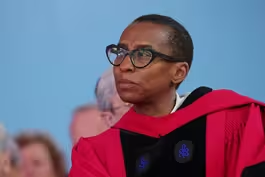
Harvard embroiled in controversy after president resigns
Video has Closed Captions
Clip: 1/4/2024 | 9m 48s | Harvard remains embroiled in controversy after its president is forced out (9m 48s)
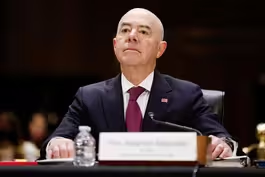
Mayorkas on immigration system strains, border negotiations
Video has Closed Captions
Clip: 1/4/2024 | 9m 3s | DHS Secretary Mayorkas on immigration system strains and border security negotiations (9m 3s)
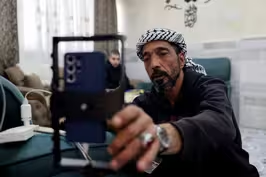
Palestinians describe harassment over social media posts
Video has Closed Captions
Clip: 1/4/2024 | 9m 12s | Palestinians describe harassment from Israeli forces over social media posts during war (9m 12s)

Remembering the art and energy of tap legend Maurice Hines
Video has Closed Captions
Clip: 1/4/2024 | 2m 35s | Remembering the art and energy of tap dance legend Maurice Hines (2m 35s)

Russia steps up aerial attacks on Ukraine
Video has Closed Captions
Clip: 1/4/2024 | 2m 58s | Russia attacks Ukraine with ballistic missiles provided by North Korea, U.S. says (2m 58s)

Trump businesses received millions from foreign governments
Video has Closed Captions
Clip: 1/4/2024 | 4m 25s | Foreign governments spent millions at Trump businesses while he held office, Democrats say (4m 25s)
Providing Support for PBS.org
Learn Moreabout PBS online sponsorship
- News and Public Affairs

FRONTLINE is investigative journalism that questions, explains and changes our world.

- News and Public Affairs

Amanpour and Company features conversations with leaders and decision makers.











Support for PBS provided by:
Major corporate funding for the PBS News Hour is provided by BDO, BNSF, Consumer Cellular, American Cruise Lines, and Raymond James. Funding for the PBS NewsHour Weekend is provided by...