
Ken Kramer's About San Diego
Episode 103 - Seven Bridges Walk
Season 2025 Episode 103 | 26m 34sVideo has Closed Captions
We take the Seven Bridges Walk and see some San Diego history along the way.
We take the Seven Bridges Walk and see some San Diego history along the way; remember the days of Escondido's citrus industry; learn about one of the most ambitious infrastructure projects ever undertaken in our county and meet the Flag Man of Mount Helix. Plus things sent in by viewers and much more!
Problems playing video? | Closed Captioning Feedback
Problems playing video? | Closed Captioning Feedback
Ken Kramer's About San Diego is a local public television program presented by KPBS
Ken Kramer's About San Diego
Episode 103 - Seven Bridges Walk
Season 2025 Episode 103 | 26m 34sVideo has Closed Captions
We take the Seven Bridges Walk and see some San Diego history along the way; remember the days of Escondido's citrus industry; learn about one of the most ambitious infrastructure projects ever undertaken in our county and meet the Flag Man of Mount Helix. Plus things sent in by viewers and much more!
Problems playing video? | Closed Captioning Feedback
Where to Watch Ken Kramer's About San Diego
Ken Kramer's About San Diego is available to stream on pbs.org and the PBS app.
Providing Support for PBS.org
Learn Moreabout PBS online sponsorshipone, and this one, seven in all that together make for a tour that is something unique about San Diego.
And this trestle, and this one for cars, trains?
No, for water for drinking, one of the most impressive construction projects in San Diego history.
We'll show it to you and more stories too, all of them true about San Diego.
announcer: Ken Kramer's "About San Diego," the history and people of the area we call home.
Here's Ken Kramer.
Ken: Hello from Oceanside to El Centro and Canto to Imperial Beach, hope things are good for you and thank you for joining us here for some stories about San Diego.
And we're gonna start with an activity that you can do.
It's an urban hike.
You can do all of it, you can do part of it.
You can stop at coffee shops along the way and also along the way you walk, really do walk more than hike, I'd say through Hillcrest, North Park, and Bankers Hill as you cross seven bridges, and that's what it's called: The Seven Bridges Walk, and it is, I tell you, something perfectly about San Diego.
How about we go east to west, okay?
Beginning on the east side of Park Boulevard, we walk through The Desert Garden established a half century ago, a couple of acres of succulents and drought-resistant plants from all over the world, with a pathway leading us right to the entrance to the first bridge.
Ken: So let's get started.
The Park Boulevard Bridge is number one, right over Park Boulevard, right into the park.
Ken: And what a way to arrive.
I mean, on this springlike day, the perfumed air and the blossoming trees created a gorgeous canopy of welcome.
There's the B. Evenson Fountain.
It was dedicated in May of 1981, and it pays tribute to Beatrice Barker Evenson, who led the effort to preserve buildings in the park.
Really, our city's crown jewel would look nothing like it does today without her and the committee of 100 that she formed to save them.
Continuing west, we walk past the Museum of Us, and there in the courtyard of what's called the California Quadrangle is this plaque that most people never see.
It honors DC Collier, who carried the honorary title of Colonel, so he was Colonel Collier, and he organized and directed the Panama California Exposition of 1915.
If you walk under the arch and look back toward that quadrangle, this was the grand entrance to that event, the way many attendees came in after crossing the Cabrillo Bridge, number two on our Seven Bridges Walk.
♪♪♪ ♪♪♪ Ken: Certainly the best known of them, the Cabrillo Bridge was built to be the main pedestrian entrance into the park for the exposition.
Construction began at the end of 1912.
On the bridge itself is a plaque honoring it as a San Diego historic civil engineering landmark.
Building it involved about a million board feet of mostly redwood.
You could see that when, in 2012, we went inside while the bridge was being upgraded and seismically retrofitted.
♪♪♪ Ken: By the way, under the bridge where the 163 is now used to be a lake.
Did you know that?
Known as Laguna de Puente.
Some people just called it the Cabrillo Pond.
It was full of lilies.
From atop Cabrillo Bridge, you can see park trails and the highway leading into and out of downtown, just like it was designed to be.
There's something very satisfying as you walk along it.
Ken: On down here about 3/4 of a mile to the First Avenue Bridge.
♪♪♪ ♪♪♪ Ken: West on Laurel Street you walk through part of Bankers Hill.
Its name was meant to appeal to bankers and attract other wealthy residents.
Turning right you're on First Avenue, which used to be known as First Street until the time of that big exposition in the park when the city changed it.
It had to be Avenue, you know?
Avenue is much more elegant.
♪♪♪ Ken: Come to First and Nutmeg, and there you are, number three, the First Avenue Bridge.
Ken: Four hundred and sixty-three feet long, a hundred and four feet high, built by the property owners in this area under the Improvement Act of 1911.
And you know what else?
Take a look right here.
Ken: Standard Iron Works in San Diego made everything from plumbing to metal casings to parts of this bridge which used to look like this and then was rebuilt in 1931, a way for folks in uptown to get downtown by going right over Maple Canyon below.
♪♪♪ Ken: Okay, so what's the next stop?
Just keep walking on First, turn right on Quince, and you'll come right to it.
Ken: The Quince Street Bridge, built for pedestrians in 1905.
This one here, this Quince Street Bridge, is the oldest bridge in San Diego, and it meant that people who lived on this side could get over to the other side where the streetcar ran and the Fourth Avenue Station was.
Two hundred and thirty-six feet long, it was originally built at a cost of $805.
Ken: Super-interesting bridge, but you know what?
There's one that's maybe even a little better known just 3/10 of a mile down this road.
♪♪♪ Ken: Walk on back to First, turn right until you get to Spruce, then left, and ah ha ha, there's the Spruce Street footbridge.
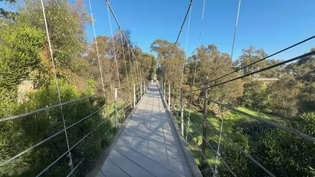
So here we go, and I'm going to say if you're a little unsettled by heights, for decades this one has had a nickname.
They call it the Wiggily Bridge.
Ken: And it's really true.
You walk out here and you can feel the bridge wavering, kind of moving back and forth.
It is a suspension bridge and it's been sort of moving people for more than a century now.
Ken: Built in 1912, it connected neighborhoods together and connected people with the streetcar, which was a big plus when developers were advertising it.
It crosses over what today we call Kate Sessions Canyon, named for the woman who more than a century ago planted hundreds of trees in Balboa Park and neighborhoods all over San Diego.
The Spruce Street Suspension Bridge is a treasure.
On our way to number six involves some walking back up to First, then to University and a chance to enjoy Hillcrest, stop, grab a snack.
♪♪♪ Ken: And then we're gonna make our way east on University to Vermont, a left turn there, and behold the Vermont Street Bridge.
Here was once a wooden bridge dating back to the 19-teens, but in 1994 it was reconstructed as a link into University Heights.
And what's so interesting about this bridge and why it's worth the time to stop and notice it is the public art in metal and acrylic.
There are bits of philosophy and definitions, and words taken from a Navajo chant, and so many little delights that are discovered and savored, in this case in the fading light and lengthening shadows of late afternoon.
♪♪♪ ♪♪♪ Ken: And finally we chose to go back to University and then east to Georgia Street where there is the Georgia Street Bridge.
♪♪♪ Ken: Built in 1914 as another civic improvement timed with the exposition, used to be up until the late 1940s, the San Diego Electric Railway, the first trolley, ran under here on its way to East San Diego.
A few years ago, the long-buried rails were taken up.
It was seismically reinforced.
The street was lowered so that taller trucks could get through.
Pedestrian and bicycle improvements were added.
It remembers what we were and celebrates what we are, and we are at the end of our Seven Bridges Walk.
Five and a half miles all told, but you can do part of it, you can just see two or three at a time.
♪♪♪ Ken: There are online maps and guides if you want to search the Seven Bridges Walk.
It's a great way to bridge distance and time and see some truly historic things about San Diego.
Ken: There's lots of information out there about the Seven Bridges Walk.
Easy to find online or go to our web page.
We will link you to it.
Why not try it?
Ken: There used to be an old saying about the water in San Diego that you first had to boil it and then you filtered it and then you boiled it again and then you drank something else.
Back in the 1880s, our water really wasn't very good and San Diego was growing and what did they do about it?
Well, they built a flume.
One of the most amazing structures ever built in San Diego, made of 9 million board feet of redwood, it was a 33-mile-long open tray of flowing water.
I think you had to see it to believe it, but at least there are pictures.
See, it used to be in San Diego that most of the water we drank and used for irrigation came from wells, and it was salty, sometimes nauseating, not good water really.
But in 1889 this flume changed everything, and it was just an enormous project to bring good mountain water from the mountains to the eastern part of La Mesa and on to San Diego.
First of all, there had to be a dam built way up on the San Diego River at Boulder Creek.
That's where the water was captured to be put in the flume, and the flume itself, just imagine what it was like: 6 feet wide, 18 inches deep, full of water, running all those miles, and it had to be all downhill, of course, so the water would keep flowing.
There were tunnels.
Here's the Los Coches Tunnel being built, and more than 300 trestles, including this one, the Los Coches Trestle, 1774 feet long, 65 feet high.
Nobody had ever seen anything like that in San Diego.
So amazing was this thing that on opening day, 22nd of February, 1889, public officials and dignitaries took a ride in wooden boats down a good part of the flume.
Sitting right there in the front, that's the governor of California whose name, interestingly, was Robert W. Waterman.
So the flume was built, but then it had to be maintained.
It was wood after all, and sometimes it leaked, so you had flume walkers who saw trouble spots and made repairs, inspectors continuously patrolling for problems, and houses were built along the route, so those workers and their families had a place to live.
Looking back, there were lots of issues with the San Diego flume.
For one thing, in the hot summer months, all that water in a fairly shallow container moving along, too much of that water evaporated.
In 1919, a wind storm blew over the Sweetwater trestle that had been weakened by leaks and deterioration of the wood.
But in its time and for its purpose, it did its job, the water eventually ending up in La Mesa Reservoir, piped from there into San Diego.
La Mesa Reservoir, which would later be built up into what would become Lake Murray.
And some of the water too went to a rancher's pond, sometimes known as Duck Pond.
If you've ever been to Anthony's Fish Grotto, you know the Duck Pond is still there, even though the flume is gone.
No, it just didn't age well.
By the late 1920s, customers were demanding repairs, and the state of the art in water delivery and storage had changed.
In time, dams were built, the lower Otay and Morena.
And pipes, siphons, and concrete tunnels replaced the flume, but what a thing it was.
Here's old Highway 80 and the flume, now the Lake Jennings Park Road off-ramp from Interstate 8, where just up the road at the RM Levy water treatment plant, the Helix Water District has kept just a few bits of the flume that visitors can see: an old wagon that rolled down the flume during its construction.
There's some of the redwood pipe that replaced it.
And then a section, just a section, of what was once an engineering marvel that delivered good sweet water from the mountains and became a remarkable part of history about San Diego.
Ken: Hikers know that there is also an historic Flume Trail that tracks along above the El Monte Valley there in Lakeside.
There are informational markers and traces of the Flume's route can still be seen along that trail, the eastern end of which is located in El Monte County Park.
♪♪♪ ♪♪♪ ♪♪♪ Ken: To Escondido now and back in time to when that city was known for citrus, and rightly so.
Ken: There's an old barn at Escondido's Grape Day Park, and if you go inside, there's a truck that may be even older, and in the back of that, look, there are wooden crates that once carried lemons and oranges.
You go back 65 years, and if Escondido wasn't the citrus capital of the country, it was certainly close.
There was a building where they processed and packed oranges that was the size of a college gym and the largest lemon packing house in the world-- the world!
One of the biggest streets in town just happened to be named Lime, and the boxes themselves, they had such colorful labels, works of art from our own North County shipped all over the country.
Names like Hiddendale.
In Spanish, Escondido means hidden.
There was Freedom Brand, America Brand, the combination of snow-capped mountains and golden oranges, wow.
In 1945 and '46, 1,159,000 boxes of citrus were processed.
Ken: Fifty-three million pounds just in that one season alone.
So how did it all end?
What happened?
Ken: Avocados happened.
You could get more money with many fewer trees.
Development happened, more profit from building on the land than growing on it.
By the 1960s and '70s, Escondido was changing.
Today, the sidewalk still says Lime Street, but its name is now Broadway.
Just a coincidence, but oddly nostalgic, for in its citrus sunny past, Escondido, the hidden dale, must have seemed like an agricultural heaven where even the lemons grew sweet and all the artwork told such a beautiful story about San Diego.
Ken: Still to come, one man's hobby, his collection of things that fly high and proud, and I don't know of anybody who so revels in the benefits of a breezy day.
But first, shall we see what you've sent in now?
We get a lot of mail for which I am very grateful, and especially so when you include something or lead us to something we can show here.
You email us photos of old family businesses that your relatives may have had, or you're tearing down a wall, you know, and as part of a remodel, you find an empty bag of cookies or a soda bottle from a century ago.
Well, we'd love to see that and share it like this.
Ken: 1913, let's go flying.
Linda Lee Carroll-Whatley's family had a seaplane that flew over Mission Bay for the daring of the day.
They also built the Kendall Street Pier with wood that washed down to the beach after a flood.
1975, a viewer sent photos of young aviators here having fun in helicopters at Mission Beach, Belmont Park.
Denny Seipoldt's dad worked for Crown Air at Montgomery Field.
He got to fly The Monkees here from Burbank for a promotional visit in 1966, a great photo opportunity.
♪♪♪ Ken: Ah, Pacific Southwest Airlines, PSA, was San Diego's home-based airline and an iconic presence in California for almost 40 years up until 1988.
Back in the '70s, Cheryl Holt Lenvey worked for PSA.
She sent these memories of her back in the days of smiling skies.
To the airwaves, Diane Kaplan Wiscott sent this picture of a Channel 8 broadcast TV truck and, see, it says "Jack Gross Television"?
Jack Gross was her great-uncle and started the station in 1949.
She included a photo from the first night on the air.
Among the celebrities, there's Jack Gross and San Diego Mayor Harley Knox.
And from Barbara Nielsen and with thanks to CBS 8, a KFMB radio DJ at the beach in September of 1959.
Notice, the station was at 540 on the A.M.
dial back then.
Here's "Dance Time" on Channel 8 TV.
All the latest and greatest sounds on record.
And Bob Dale.
Remember Bob Dale doing the "Payday Movie" and "Zoorama" from the San Diego Zoo?
announcer: Zoorama!
Bob Dale: Can you make him kiss Robert, this little boy?
male: You wanna give him a kiss, Porky?
Give him a kiss.
Give him a kiss.
Ken: And here's San Diego TV kids show host Monty Hall saying, "Hi, y'all."
And from the random miscellaneous file, thank you for sending in, downtown shot, probably around Horton Plaza, 1975, and another viewer just a couple of blocks away, here's the Salvation Army band outside the Western Union office.
From Nancy Lindsay, longtime family business in Ocean Beach in 1946.
"We please most of the people most of the time," it says.
Call them, Belmont 9797 or at home, Belmont 4843.
That's fine.
And finally, kind of an aviation theme this time, I guess.
Chris Youngman says a trainer fighter plane was put on the Fletcher Hills Elementary School playground so the kids could play on it.
His brothers told him when students were in trouble, one of the punishments was to make them go out and paint the plane.
It was removed during the Cold War, but for those kids, a lasting memory indeed about San Diego.
And one thing more, a personal note if I may.
A few weeks back, we had our 100th episode celebration on the air here.
One hundred episodes since returning to KPBS after having done the show commercially on radio and TV, and it was a night.
We had so many emails and letters and social media posts from viewers and it was very special, and I'm very grateful.
And I wanted to share with you what happened a couple of weeks thereafter.
There was a celebratory get-together at the Music Box on India Street in Little Italy, and more than a couple of hundred people came by, and my co-producer and photographer and editor Suzanne Bartole and I got to meet so many of you, and we answered questions from Maya Trabosi and the audience, and the people who came to that evening included friends and colleagues who have supported this show and me since the start.
And for me, it was a night of nostalgia too.
Seeing Tom Carlow there, for example, you know him as the former general manager of KPBS.
His being there brought my mind back to how many years, decades, we've worked together.
male: Let's bring Tom Carlow over here too.
Ken: And how, as maybe the show's biggest fan at KPBS, he helped forge the deal with NBC 7 and Phyllis Schwartz that brought the show back home to public broadcasting right around 2009 and 2010.
So it's been a long road, sir, since we were student assistants together just getting started in San Diego.
On that night, I felt you could have been up on that stage with us, and just to everybody who came that night and to all who watched our 100th and any of the 99 episodes that preceded it, may I say thank you for all the very nice things you've had to say about "About San Diego."
Ken: And finally this time, I admit I have a special fondness for collectors of things.
I don't know why, but when we hear that someone gets it in their mind that they just wanna have a particular kind of thing and then they get more and more of them, and pretty soon they have a lot of them and it's just a thing, well, I want to go and knock on their door and do one of our people stories.
So here we go.
Ken: Over at Mr.
Franks's house, a little wind is a welcome thing.
Andrew Franks: We get a really good prevailing breeze from the ocean that goes out towards the mountains unless the Santa Anas are coming in and then it, you know, it turns around and goes the other way.
Ken: Andrew Franks likes to fly flags, you see?
American flags?
Yes, he's got quite a few.
Andrew: And then we get into a Betsy Ross.
This is another one for early flag.
So all these are early Revolutionary War mostly.
Ken: And then there are his other flags, of which he has, I guess you could say, many.
Andrew: Somewhere around 515 at this point.
Ken: If he started January 1st, he could fly a different flag every day of the year and all the way to June the 1st of the next year and by then he'd probably have some more because he just loves collecting and displaying flags from everywhere.
Andrew: So this flag is the centennial celebration of Essex Fells, New Jersey.
Ken: Of course, we wanted to see, did he have a couple of flags from San Diego?
Andrew: I gotta get to the Ss.
Hold on.
Oh, there's Pink Floyd.
I love that one.
Pirates as well.
Earth, we'll get to San Diego here eventually.
Ken: Getting there, before SAN is SAL.
Andrew: All right, so this is the Salton Sea.
Some guy worked out some way that that represents the latitude and longitude coordinates of Salton Sea.
Ken: On to sports teams and moments in San Diego history.
Andrew: And the next one is the San Diego Wave, and I really, really like that San Diego Zoo one from the 100-year anniversary.
Ken: Seems like he's got a flag to fit almost any occasion.
Might be holiday, birthday.
Andrew: Other days, it just varies on sometimes what's going on in the news, although I try not to get too political.
Ken: Oh, and one more thing, just every once in a while, look at this.
On some occasions random and I must say greatly appreciated among Mr.
Andrew Franks's many flags about cities and about rock bands and about sports teams.
Andrew: I'm glad I was able to get one of those.
Ken: Dancing in the wind is this flag, "About San Diego."
Ken: Yay, and that's it for this time and this episode of "About San Diego."
A real pleasure for me to do these episodes, to meet San Diegans, to see our county in different ways from week to week, from Webster and Shelltown to Paway and Ocean Beach, and to tell these stories.
If you have things to share, video, photos, or flags, if you want to see these stories again or contact us or learn more about the things you do see here, just go to our website.
It's KenKramerTV.com.
Until next time and as always I am Ken Kramer.
Thank you for watching and for caring about San Diego.
♪♪♪ ♪♪♪ ♪♪♪ Ken: Is this legal?
announcer: Support for this program comes from the KPBS Explore Local Content Fund, supporting new ideas and programs for San Diego.
Video has Closed Captions
Preview: S2025 Ep103 | 30s | 5/21 - we take the Seven Bridges Walk and see some San Diego history along the way.v (30s)
Providing Support for PBS.org
Learn Moreabout PBS online sponsorship










Support for PBS provided by:
Ken Kramer's About San Diego is a local public television program presented by KPBS