Ken Kramer's About San Diego
Episode 102 - An Iconic North Park Eatery
Season 2025 Episode 102 | 26m 46sVideo has Closed Captions
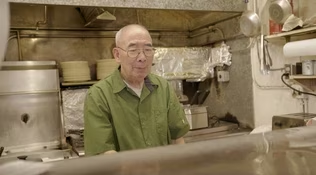
We remember an iconic North Park eatery and its owner who became a legend in the community.
We remember an iconic North Park eatery and its owner who became a legend in the community; visit the Pumpkin Patch, a strange geologic phenomenon near Ocotillo Wells; investigate a ghost story in Encinitas; consider life in a fire lookout tower near the border; see things sent in by viewers, and more!
Problems playing video? | Closed Captioning Feedback
Problems playing video? | Closed Captioning Feedback
Ken Kramer's About San Diego is a local public television program presented by KPBS
Ken Kramer's About San Diego
Episode 102 - An Iconic North Park Eatery
Season 2025 Episode 102 | 26m 46sVideo has Closed Captions
We remember an iconic North Park eatery and its owner who became a legend in the community; visit the Pumpkin Patch, a strange geologic phenomenon near Ocotillo Wells; investigate a ghost story in Encinitas; consider life in a fire lookout tower near the border; see things sent in by viewers, and more!
Problems playing video? | Closed Captioning Feedback
How to Watch Ken Kramer's About San Diego
Ken Kramer's About San Diego is available to stream on pbs.org and the free PBS App, available on iPhone, Apple TV, Android TV, Android smartphones, Amazon Fire TV, Amazon Fire Tablet, Roku, Samsung Smart TV, and Vizio.
Providing Support for PBS.org
Learn Moreabout PBS online sponsorshipKen Kramer: Can you imagine wandering the desert?
I'm in out here east of San Diego, not far from the Salton Sea, and you see what must be a mirage, right?
Look, it looks like pumpkins.
That's strange.
Pat Abbott: And it's definitely worth seeing.
It's really cool.
Ken: We talk about history.
This is geologic history.
These things have been here for a very, very long time, but how'd they get here?
And suppose I told you there were more on the way.
We recall a man who watched out for us every day in a truly unique way.
Norm Mitchell: I just--I scan and I scan the ridge tops.
Ken: Remembering Norm Mitchell, who spent a lot of his life up here alone.
Could you do it?
And in Encinitas, there used to be an Italian restaurant-- isn't there anymore--but one of the regulars in this restaurant in the 2010s used to be a guy named Al.
Big Al the Barber, they called him.
And when you saw Big Al there, I guess you could say it was a little bit odd because he'd been dead for 70 years.
Gomer Pyle: And part it on the side and make a little rabbit ridge up here in front.
Then you'd comb it wet, okay?
Ken: Remember the "Gomer Pyle" TV show?
TV shows made here, and old movies too.
I mean very old.
And your 8-millimeter footage from here and there shows us a thing or two and more stories, too, about San Diego.
male announcer: "Ken Kramer's About San Diego," the history and people of the area we call home.
Here's Ken Kramer.
Ken: How are you doing?
Welcome to the show we call "About San Diego," little stories about people and places and local history, and it is so much fun to do this.
I think you'll like what we have on tap.
We have a desert mystery this time, a maybe ghost story, see what you think, and an always so much fun part of the show where you send in things for us all to see, parades and old movies made here.
A lot to get to, so let's start with one of those people's stories about San Diego.
Ken: Here we are in North Park, corner of Grim Avenue and North Park Way.
Used to be a little Chinese restaurant was here.
June Wong: Oh, yes, I grew up here.
My parents made me work here growing up.
Ken: Well, June Wong's dad owned the place, and he went by the name of Lucky.
Everybody knew him as Lucky.
Liked to play the horses, you see.
Kind of had a knack for that.
June: For the most part, he was lucky.
Ken: Came from China to San Diego with his granddad, went to school here, and was very determined.
June: Because you don't have time--as an immigrant, you don't--you have to survive.
You can't be involved in your hangups.
Ken: So 1975 on this corner, Lucky Wong opens a little Chinese restaurant, but what it eventually became was a place for an affordable breakfast.
And I mean for years maybe $3 or $5.
June: Oh, it's a full meal.
You get your full breakfast: eggs, bacon, hash browns, and toast.
Ken: And something more, something that wasn't on the menu, a genuine goodness.
You came in here one time or 100, Lucky cared about you.
Matthew Lyons remembers that.
Matthew Lyons: I saw multiple people who didn't know that it was cash only and left without paying the bill, just kind of on the honor system.
You know, I definitely know that there were people who knew that this was the place where they could come get a bite to eat even though they never intended to pay the bill, and that it was okay and that they were still welcome back.
Ken: He was the cook.
He was the server.
He took your breakfast order.
He went in the back and prepared it, brought it to you, brought you the bill, which might be a few dollars, never more than ten.
Finally raised it to $9.98, but $10 was a line he would not cross, June says.
June: Because he was very generous, he was very giving, and he knew so many people that he was able to help make connections and network.
Ken: And that's the other thing about Lucky Wong.
Over a half century in this no frills breakfast place, his very open, very genuine, very human interest in everybody, no matter who you were, made him a North Park icon.
Matthew: June said that cooking wasn't Lucky's passion.
I think it was taking care of people was, so this--for-- cooking was his metaphor for how he could take care of people.
Ken: He became known to the city's movers and shakers, a tireless champion for North Park, and a friend and confidant to soon to be neighborhood business owners like Matthew Lyons, who became a regular at the diner and ended up opening Tribute Pizza in the old post office right across the street.
When 90-year-old Lucky Wong died in 2024, Matthew knew the connection and affection he felt for him was for sure felt by other people too.
Matthew: So we started, you know, a petition on Change.org and got more than 4,000 signatures in pretty short order.
Ken: All to help create the lasting tribute unveiled on June 28th of 2025.
Matthew: It was unbelievable.
There were like--I don't know.
A thousand people showed up?
Ken: Gathering on that day on that North Park Street corner to remember the good man who made an unforgettable impression.
So there it is today at the corner of North Park Way and Grim Avenue, one block of which now and forever will carry the honorary name of Lucky Lane.
Lucky's daughter, June, knows people seeing it will think about the restaurant.
June: And his legacy--for me, his legacy wasn't about the diner.
It's the impact he made on people.
Ken: And one more thing.
Along with that petition, there was money raised to pay for the sign on the street designation, more than enough to also create a scholarship for students who need support in studying the culinary arts.
June says her dad believed that if you do good, it will come back to you.
Well, Lucky did, and it has, for he is now-- June: You know, being loved, being honored, being remembered.
Ken: As someone who truly cared about people and about San Diego.
Ken: All right.
Now how about a little road trip?
We're gonna go see something that if you live in San Diego or Imperial County, you may know about because one of these natural features of the landscape is hard to miss.
Now, the other one is less well known and very odd at first glance, so bring snacks and lots of water.
Here we go.
Ken: Let's go way out east on Interstate 8, okay?
We're heading down into the desert east of Jacumba, and you see scattered across the landscape in clusters and crumbles miles of what look like rocks split by some unseen brute force.
Ever notice that?
You're not alone.
Pat Abbott is a geologist.
Pat: You know, of all the questions I get from the public, number one is, "When's the next big one for the earthquake?"
And the second biggest one wants to know how those rocks came to be.
Ken: Oh, you'd think must have been ground up and broken by earthquakes over countless millennia, right?
But no, that's not it.
Pat: They're overwhelming.
I even had a call once from somebody in London, said he was losing sleep at night.
He'd driven down there and trying to find out the origin of how something like this could form.
Ken: Professor Emeritus Pat Abbott, Department of Geology at San Diego State, has lectured and written many books on why our county's rockscape looks the way it does.
Out here, what's happened?
"Think of hot magma thousands of feet down," he says, "rising like it would for a volcano but not reaching the surface."
Meantime, up above, water seeping through cracks in the earth picks up minerals.
As the magma cools and becomes rock, that water eats away at it, making them look split and exotic.
Pat: Then, as they near the ground surface and erosion strips away the eroded material, here you have these elegantly shaped sculptures from Mother Nature.
Ken: Really pretty.
Okay, now let's go out here, miles and miles and miles from any population center.
The desert can play tricks on your brain, right?
And you might think that if in the quiet of a hot, dry desert afternoon you happen to come upon the pumpkin patch.
And that's really what it looks like, a pumpkin patch, but they're rocks, not placed here, not moved here.
Naturally occurring right where you see them, these round rocks are in the Ocotillo Wells State Vehicular Recreation Area.
Pat: This is a different state park than the Anza-Borrego State Park, even though they're basically both right next to each other.
Ken: So how does something like this happen?
First thing Pat Abbott says is the Colorado River used to dump its sand all along here.
Older sands were buried by younger sands, building up to thousands of feet thick.
Then...rainwater soaks into the ground, creating very slow-moving groundwater moving around little grains of sand, water that has a lot of dissolved minerals.
Now imagine a single grain of sand.
Nobody can say why it's any one particular grain, but it's hundreds, maybe thousands of feet under here.
Pat: Kind of like the faucet in your kitchen.
You get some whitish crystals that precipitate there.
Same thing goes on underground.
Ken: That tiny crystal attracts more of the same kind of crystal growth.
Pat: And then they end up encircling it and growing and growing into what we call a concretion.
Ken: So how do they get up to the surface like this?
They're heavy, and over thousands of years, while everything else just washes away, they don't.
So they end up appearing like this, looking like pumpkins.
Pat: And there's more below our feet.
As erosion goes on, the pumpkin patch will grow.
Ken: Uh-huh, just like those rocks along Interstate 8, something old, remarkable, and lasting about San Diego.
♪♪♪ Ken: The past couple of weeks, we've been going back into the archives doing stories in the category of things that aren't here anymore with a nod to Ralph Story, who first used that title.
Times and places change.
Now, a little background.
A few weeks ago, I went to Encinitas and to a particular location there where, a few years ago, there used to be a restaurant which isn't there anymore.
There's another business there now, but anyway, I went in and I said, "Have you seen Big Al lately?
Big Al."
And they looked at me with puzzlement because they did not know this story about San Diego.
Ken: This is a story about Mr.
Johnston.
Right here he is.
You can see him in a picture taken some time after 1920.
Grant Ulysses Johnston was his name.
Stephanie Cashin: He's my great-great-grandfather.
Ken: Came to Encinitas and ended up becoming the town barber, even though he wasn't trained as a barber, Stephanie Cashin says.
Stephanie: Never cut hair, didn't know anything about it.
He was a gambler was the truth.
Ken: Loved to play poker, they say.
Always up for a game.
Sure, let's play.
Ken: And, actually, he played cards at a place called If I'da--if I'da bet this or if I'da bet that.
That was the name of the card shop.
But in a card game, he actually won the barbershop.
Ken: That's right.
Won it, lock, stock, and razor strop.
He was now Big Al, proprietor of Al's Barber Shop.
Stephanie: So in literally one hand of cards, he became the town barber.
Ken: Big Al was by all accounts a terrific guy, and in the Encinitas of the '20s, '30s, and '40s, he was a compassionate, generous, really nice man.
Stephanie: During the Depression, during times when there was a lot of poverty in Encinitas, he would see people dri--walk by with--and he would give them--he would say, "Give them a haircut they'd be proud of."
Ken: Now, if you wonder, "Where was Al's Barber Shop back then?"
it was right where this newly built restaurant is today called Via Italia, 500 block of Pacific Coast Highway.
And you know something Stephanie Cashin says?
Stephanie: They definitely feel that my great-grandfather is still there at that restaurant.
Ken: He's still around.
Maybe Big Al, dead and gone for decades, just might be a ghost now, who in this restaurant plays tricks every once in a while.
Just ask the owner, Paolo Pedrazzani.
Paolo Pedrazzani: Like in this area, if that light, I replace it on Tuesday, the other two lights went off on Wednesday.
Then I replace that light again, and the other light went off.
And I said, "Jeez, brand-new building.
How can it be possible?"
Ken: Okay, lights go out.
Things like that happen.
Paolo didn't think it was anything otherworldly until a customer came in here one day, sat down, and started saying things like, "Yes, he's happy now.
He likes the way you've recently painted the place."
Paolo said, "Excuse me?"
Paolo: I said, "I'm sorry, what are you talking about?"
I said.
"Oh, you don't know?
There is a ghost that lives here."
I said, "Ghost?
Are you joking?"
"No, no, he spend most of his time in this corner, and he really likes the color."
Ken: This corner right here, just about exactly where Big Al's Barber Shop used to be.
"Well," Paolo thought, "if he likes my new paint job, I'm not changing anything."
Paolo: And I have to be honest, since that time, those lights, they never burn out, never.
Ken: Meantime, at the San Dieguito Heritage Museum on Quail Gardens Drive, they've got Big Al's original barber chair, the very one he cut hair in for decades, and some barber items from the period.
Oh, and one more thing about Al.
He was a thrifty guy.
Remember I said his name was Grant Ulysses Johnston?
Where'd this "Al" come from?
Al's Barber Shop?
Big Al?
Well, see, when he won that shop in that poker game, it was from a man named Al, and he figured it cost too much to change the sign, so he changed his name instead.
Thus, Al has become a legend in Encinitas after all these years and perhaps a continuing presence down at Via Italia?
Stephanie: And the rumor has it is that he's still kind of hanging around back in that one area.
Ken: If so, Paolo says he's fine with it.
Paolo: And Big Al is a nice, good guy so far.
Ken: And a nice, good story, too, about San Diego.
Ken: Again, since Via Italia closed and another business occupies that space, no recent evidence of Big Al has been reported, but if that changes, you will hear about it right here.
All right, we're going to remember another personality here now, a man who late in his life had one of those jobs you think about and you wonder, "Could I do that?
Could I live that kind of life?"
It's isolation.
You focus on your job because that's pretty much all there is.
It's just you alone.
Ken: Mr.
Norm Mitchell is going to work.
And in all of San Diego County, I don't imagine there are many who have a job that can compare with what he does because, you see, every day that he's up here, all day what he does is watch things.
Norm: I'm an observer, and I always have been.
I just--I scan and I scan the ridge tops.
Ken: From up here, all alone in a fire lookout tower at 4,508 feet at the top of Los Pinos Mountain.
If you thought that these lonely fire lookouts were a thing of the past, they're still around.
He's still the most immediate eyes constantly watching San Diego's backcountry for the first tiny, little sign of smoke.
Norm: All of our calls are small, wispy, thin.
It's never large.
If it is, it's well into Mexico, or it's well to the north.
Ken: Up here by himself, norm seems like he has the perfect temperament for solitude.
He's never been a restless person, he says.
He won't say for how many years he's been up here, says he's not much into time.
Norm: For eight years, I hiked in and I hiked out 12 miles in, 12 miles out.
I brought my own food in.
Ken: Now it's more accessible.
There are occasional visitors, off-roaders and hikers, not every day but some days.
Norm: I put the flagpole up to show presence, and people saw that.
And they started to come and realized that it was okay to come in and talk, sit around, look through the binoculars.
Ken: By no means luxurious, it's comfortable enough, I guess.
He has a stove for cooking and a place to sleep.
He's got a radio link to the world.
When he sees something, he locates it on this instrument called an Osborne Firefighter and quick calls it in.
Norm: More than likely, they would--if the area is a high-threat area, they would launch air attack, and whatever the call was for that day, they'd start a full response.
Ken: But by nature, he is not a man who's in a hurry about life.
You can tell just by the way he talks, thinks before he speaks.
And no, working out here at this remote outpost deliberately built in the middle of nowhere doesn't bother him.
Norm: I was raised in an environment that's not too much different than this, you know, in southwestern Pennsylvania.
You know, grew up with an outhouse, you know?
I remember when electricity came to the house.
Ken: When this job was advertised, they were looking for someone who could work alone without supervision.
Oh, yes, and not panic.
There are big storms up here.
Norm: It's high winds, rain, lightning, thunder.
Yeah.
The lookout's cool.
It can handle it.
Ken: He alternates with another observer up here, but what about the hours, hours and hours of being alone?
He does some writing, preferring not to say what he writes about, but finds inspiration all around.
Norm: It feels like home.
Ken: On a windswept backcountry peak where Norm Mitchell has kept watch for more years now than he's willing to say, it's a living and a calling, a content isolation in a crowded urban world, a rare story indeed about San Diego.
Ken: Norm Mitchell passed away in 2017 after 27 years working as a fire lookout.
Those towers are still around in California, Oregon, and Washington, and throughout the west.
Particularly in an era of satellite monitoring, there's something about having somebody like Norm watching.
♪♪♪ ♪♪♪ ♪♪♪ ♪♪♪ ♪♪♪ Ken: Finally, this time, we turn to you for film, video, images you have to share, things that you've come across that you'd like for everybody to see.
This is your window on history, and through it, we all learn something about San Diego.
Ken: From Jim Steringer, let's all go see the moving pictures in 1911.
And look, man gets a letter in the mail, says he will inherit $3 million.
Three million, think of that.
Only condition is that his daughter has to be married off, and that's a problem.
Okay, let's back up.
If you're less than, I don't know, 110 years old, you might wonder, "What is he talking about 'moving pictures'?"
It's just an old name for movies back when San Diego County was kind of like a movie-making mini-Hollywood.
There was a studio right on the main street in La Mesa, the American Film Manufacturing Company.
Flying A, they called it.
Filmmakers came here for a variety of financial and labor reasons but also because the rocks and trails around Lakeside and Grossmont in La Mesa were perfect for shooting low-budget westerns like "The Rancher's Nerve."
Who will be brave enough to stand up to the outlaw?
Flying A was only here for less than a year, but in that time made 150 movies.
That's like about one every other day.
announcer: "Gomer Pyle: USMC," starring Jim Nabors as Gomer Pyle.
Also starring Frank Sutton as Sgt.
Carter.
Ken: Filming of the "Gomer Pylele" TV series in 1964, some of which took place at Marine Corps Recruit Depot in San Diego.
Lynn Hochmuth Congemi's father was commanding general there.
She sent this picture with the stars of the series, possibly the producer or director to the far right.
And just to her right, that's General Hochmuth, her dad.
September 3, 1970, at the Hotel del Coronado, an official state dinner away from the White House.
That was a rarity.
Richard Nixon and President Gustavo Diaz Ordaz of Mexico and a parade and motorcade right through the city.
Chris Casey was just 5 years old.
He doesn't remember the parade, but his dad and mom shot film of it.
The street decorated with banners, floats going by, horses, marching bands.
And then riding by in an open car were the presidents of the United States and Mexico.
1955 parade here along El Cajon Boulevard, homecoming San Diego State College featured celebrities and a float calling for peace in Korea from P. Hicks's collection dating back to that year, thank you.
1969 Lemon Grove Days parade featured the Lemon Grove Junior High School band, part of the city's celebration that was so much fun, big enough to be impressive and small enough to have a lot of local charm.
Here, an unidentified canine joined the town banner being carried down the street.
There was an official mascot named Mr.
Lem N Grove and an unofficial one named Timmy.
Well, the parade was a tradition in Lemon Grove until 2004. male: What's your name?
Gomer: Gomer Pyle, sir.
Ken: "Gomer Pyle: USMC" lasted another five seasons, was never out of the top ten rated series, second only to "Rowan & Martin's Laugh-In."
And did that dad get his $3 million?
Did his daughter agree to marriage?
Well, he offered some cowboys money if they'd find a man.
And they had to kidnap the girl too, but they didn't know that the handsome man kind of fancied the girl, and maybe she liked him too.
I don't know, but neither knew that the other was tied up.
So while the cowboys were off drinking or something, the handsome man got himself untied and then untied her.
And it was like, "Oh, you're that handsome man," and, "Oh, I like you.
You're that girl, and isn't this a happy happenstance?"
And the handsome man says, "Tell you what, I've got an idea."
Well, see, the captive couple knew that since the cowboys, as soon as they got done drinking, were gonna deliver them for marriage anyway, so they re-tied themselves, which I don't imagine was an easy thing to do.
The justice of the peace declared them married.
Now the couple that had secretly liked each other were together.
The cowboys were none the wiser.
Everybody was richer, and it was a happy ending to the story of the $3 million, which, since it was filmed here in 1911, was also, in a way, a story about San Diego.
Ken: By the way, you know who directed that La Mesa History Center silent film called "The Three Million Dollars"?
The director of that movie and of the Flying Ace studio here in 1911 was a man named Allan Dwan, and Allan Dwan went on to a pretty impressive career directing Shirley Temple in "Heidi" and "Rebecca of Sunnybrook Farm" and John Wayne in the "Sands of Iwo Jima."
And that's it for this time and this episode of "About San Diego."
If you wanna see these stories again, if you wanna send us something for everybody to see or learn more about the places and people on the show, just go to our web page.
It's KenKramerTV.com.
KenKramerTV.com.
We will see you next time.
Until then, and as always, I am Ken Kramer.
Thank you for watching and for caring about San Diego.
Bye-bye.
♪♪♪ ♪♪♪ ♪♪♪ ♪♪♪ ♪♪♪ ♪♪♪ ♪♪♪ female announcer: Support for this program comes from the KPBS Explore Local Content Fund, supporting new ideas and programs for San Diego.
An Iconic North Park Eatery Episode Preview
Video has Closed Captions
Preview: S2025 Ep102 | 30s | On 4/16 - We remember an iconic North Park eatery and its owner who became a legend in the community (30s)
Providing Support for PBS.org
Learn Moreabout PBS online sponsorship












Support for PBS provided by:
Ken Kramer's About San Diego is a local public television program presented by KPBS