
December 25, 2025 - PBS News Hour full episode
12/25/2025 | 57m 46sVideo has Closed Captions
December 25, 2025 - PBS News Hour full episode
December 25, 2025 - PBS News Hour full episode
Problems playing video? | Closed Captioning Feedback
Problems playing video? | Closed Captioning Feedback
Major corporate funding for the PBS News Hour is provided by BDO, BNSF, Consumer Cellular, American Cruise Lines, and Raymond James. Funding for the PBS NewsHour Weekend is provided by...
December 25, 2025 - PBS News Hour full episode
12/25/2025 | 57m 46sVideo has Closed Captions
December 25, 2025 - PBS News Hour full episode
Problems playing video? | Closed Captioning Feedback
How to Watch PBS News Hour
PBS News Hour is available to stream on pbs.org and the free PBS App, available on iPhone, Apple TV, Android TV, Android smartphones, Amazon Fire TV, Amazon Fire Tablet, Roku, Samsung Smart TV, and Vizio.
Providing Support for PBS.org
Learn Moreabout PBS online sponsorshipWILLIAM BRANGHAM: Good evening.
I'm William Brangham.
Geoff Bennett and Amna Nawaz are away.
On the "News Hour" tonight: Torrential rains inundate California, causing destructive floods and mudslides.
Author Irin Carmon on her new book on how women are navigating post-Roe America.
And as children open gifts from the North Pole, we look at how Santa Claus has evolved over the centuries.
GERRY BOWLER, Author, "Santa Claus: A Biography": Saint Nicholas is this embodiment of generosity, of unmerited favor, to which you add a fantasy, a midnight gift-bringer from someplace enormously exotic.
(BREAK) WILLIAM BRANGHAM: Welcome to the "News Hour."
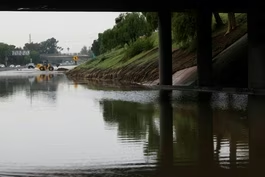
A powerful storm battered California, triggering mudslides, severe flooding and multiple evacuations.
At least three people were killed, including a sheriff's deputy.
It's a record-setting Christmas Day for rain in the Golden State, and more is coming tomorrow.
Officials are warning travelers to reconsider holiday travel plans as dangerous conditions may only get worse.
As floodwaters engulf a home in San Bernardino County, a rescue helicopter lands to evacuate the family that's stranded up on the roof.
Tim Needham filmed this incredible scene.
TIM NEEDHAM, San Bernardino Resident: We saw there were a bunch of emergency lights down at the end of the road, and we walked as far as we could without getting swept up in the water, and saw that there were people, that my neighbors were on top of the roof, three people on top of the roof, just sitting there and waiting.
WILLIAM BRANGHAM: Similar scenes played out across Southern California today and yesterday, roads turning treacherous with mud and debris forcing the shutdown of major highways.
On hillsides badly burned by the massive fires earlier this year, a deluge like this can loosen the soil even faster, making conditions even more dangerous.
SHANNON WIDOR, Orange County, California, Public Works: In the canyon areas here, we have very steep terrain, and we have the creek here behind us.
So the burn scar, it doesn't give water the chance to saturate into the ground.
WILLIAM BRANGHAM: Northern parts of the state were also slammed with heavy rains and wind that triggered mudslides in multiple communities, and, in the mountains, huge amounts of snow blanketing the Sierra Nevadas.
In Wrightwood, a ski resort town in the San Bernardino Mountains, officials issued a shelter-in-place warning for residents who didn't evacuate and now must watch as muddy waters course through their town.
WOMAN: There's a little low bridge there.
That's the one that's completely covered, had a car in it, and that's gone now.
WILLIAM BRANGHAM: This colossal downpour triggered by a storm known as an atmospheric river also knocked out power earlier today for nearly 150,000 people.
These conditions prompted California Governor Democrat Gavin Newsom to declare a state of emergency in multiple counties with the National Guard on standby.
As this humid subtropical air from California blows across the country, much of the U.S.
was unseasonably warm on this holiday, with temperatures in some parts of the Midwest and South 15 to 30 degrees warmer than normal, making Christmas for millions feel more like spring.
In the day's other headlines: Ukraine's President Volodymyr Zelenskyy said he had a very good conversation with top U.S.
negotiators about ending the war with Russia.
Zelenskyy's call with special envoy Steve Witkoff and President Trump's son-in-law Jared Kushner comes days after he said he was open to withdrawing troops and creating a demilitarized zone in his country's east.
It's not clear whether Russia will agree to that proposal, which must also go to Ukrainian voters in a referendum.
Turning to the Vatican on this Christmas, Pope Leo during his first Christmas Day sermon as pontiff condemned the treatment of Palestinians in Gaza and called for an end to all wars around the world.
POPE LEO XIV, Leader of Catholic Church (through translator): Fragile is the flesh of defenseless populations tried by so many wars ongoing or concluded, leaving behind rubble and open wounds.
WILLIAM BRANGHAM: Leo led mass inside St.
Peter's Basilica and then addressed a rain-soaked crowd from the loggia overlooking the square.
He called on leaders to find peace through dialogue and he offered a variety of blessings.
POPE LEO XIV: Merry Christmas.
May the peace of Christ reign in your hearts and in your families.
WILLIAM BRANGHAM: Unlike his predecessor, Leo, who is the first us pope, offered Christmas greetings in multiple languages, including in English.
Around the world, there were more Christmas celebrations, some full of unique holiday cheer, others coming amid challenge and hardship.
(SIRENS BLARING) WILLIAM BRANGHAM: Air sirens briefly interrupted the bells and songs of carolers in Ukraine's capital, Kyiv, as a Russian drone flew overhead.
The celebration, with traditional costumes and Christmas stars, went on undeterred.
(SINGING) WILLIAM BRANGHAM: And, in Bethlehem, where Christians believe Jesus was born, Christmas mass and festivities were held for the first time in more than two years since the war in Gaza began.
Back here at home, it was also the final Christmas mass for Cardinal Timothy Dolan at New York City's St.
Patrick's Cathedral.
And one very lucky Powerball player in Arkansas is having a very merry Christmas indeed, having won the $1.8 billion jackpot.
WOMAN: Get those tickets out.
Let's play.
That first number up... WILLIAM BRANGHAM: The grand prize win last night ended a nearly four-month streak without one.
All that time without a winner drove the jackpot to near record levels.
This was the second largest U.S.
lottery jackpot ever.
If the winner opts for the one-time lump sum cash payout, that would earn them, before taxes, about $835 million.
Still to come on the "News Hour": a new generation of smaller plug-in solar panels grows in popularity in the U.S.
; a new fellowship honors the work of aging lifetime jazz musicians with financial support; photographers Dereck and Beverly Joubert describe their 40 years of capturing dazzling images of wildlife in Africa.
We turn now to our video podcast, "Settle In."
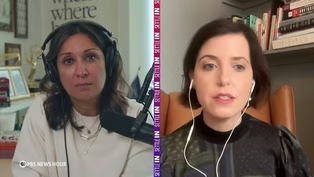
Amna Nawaz recently spoke with Irin Carmon, the journalist behind the book "The Notorious RBG," as well as a new book about pregnancy called "Unbearable."
It tells the stories of five women in New York and Alabama as they navigate a new post-Roe landscape.
Here's an excerpt of that conversation.
IRIN CARMON, Author, "Unbearable: Five Women and the Perils of Pregnancy in America": The women in my book, most of them -- some of them are pregnant more than once throughout the course of the book.
Most of them actually are not looking to end their pregnancies.
They want to keep their pregnancies.
They want to raise their children.
But as I report on in the book and as I tell their stories, which unspool over the course of before, during and after pregnancy, the way that American medicine and law has been set up has profoundly limited and harmed and cruelly treated too many people who find themselves in these situations, whether that's needing miscarriage care, whether that's having respectful and safe birth care, or whether that's seeking to end a pregnancy.
AMNA NAWAZ: The fascinating thing about the stories as you share them is that, even when you expect things to unfold in a certain way because of someone's socioeconomic status or because of where they live, some of these same things and same challenges and same treatments ring true even there.
And I want -- I'm going to unpack all of that.
I want to talk to you about some of those silos you mentioned there too.
But I have to put to you this one line when you were talking about why you wanted to write this book in the very first few pages, because this stuck with me.
You said: "What's clear to me from my years of reporting and my own experiences is how incomplete our story of American reproduction has been and how much has been unexpressed, hidden or taken for granted."
The incomplete part stuck with me.
What did you mean by that?
IRIN CARMON: Well, first of all, we can't have too many stories about what this profoundly life-changing experience can do.
I think, for me, when I -- the real inspiration for writing this book, the actual moment, even though in some ways I was leading up to it in my entire career of reporting, was being pregnant.
I was six months pregnant for the second time when Roe v. Wade was overturned with the Dobbs decision and I was eight months pregnant when the decision was finalized.
And for me, one of the stories that I wanted to tell -- I was covering the decision as a reporter at "New York Magazine."
I was writing about all the implications for policy and for law and the dynamics of the decision and the holding.
But I was also feeling in my bones what it would mean for this profound change in American law and life, how it would actually affect people.
And I did not need an abortion.
I did not seek an abortion.
I was really excited to be pregnant.
But I also found myself thinking, why hasn't anybody talked about how what an enormous physical and grave undertaking pregnancy can be in the context of even when you want to and what it might mean to force this on someone?
I don't think nobody talks about it, but for me it was something that I felt in my bones.
I felt it in my blood.
I could feel like in the extra heart that was beating inside of me, that there was a profound erasure from that opinion in particular and from the way Alito wrote about it of the seriousness of pregnancy, regardless of the circumstances you find yourself in.
So one of the parts that I thought was incomplete and inexpressed is that you might think of yourself -- unexpressed - - is that you might think of yourself as never needing this kind of care, right?
And there are women in the book who I write about who never thought they would be in this situation... AMNA NAWAZ: Right.
IRIN CARMON: ... and find themselves seeking a kind of care that is stigmatized, that is illegal, that is secret, or that they will be punished for one way or another.
And so it felt like the best way to tell that story was to -- I started a little bit by weaving in my own personal story, even though in many ways it's not an extraordinary one, but I think the very fact that for me as a married, white, upper-middle-class, privileged woman who literally reports on this for a living, the feelings that I had of being made to feel smaller or less than a fully adult human in control of my own decisions during my pregnancy were so instructive for me.
Because I thought, like, what chance does anybody who doesn't have all this going for them have in this system that says that the moment you become pregnant you have fewer constitutional rights, you have fewer rights of autonomy in medicine, you will be treated like, to quote one of the women in my book, a child animal?
And that's not to diminish the fact that my pregnancies and many other people's pregnancies were deeply joyful and I was excited about them, but that's not a reason to diminish the individual pregnant person's humanity.
WILLIAM BRANGHAM: For that full conversation and more episodes, check out our video podcast "Settle In" or on YouTube or wherever you get your podcasts.
For years, solar power at home was mostly limited to people who owned their rooftops and could afford the up-front cost of putting panels up there.
But that's changing as a new generation of small plug-in systems are making clean energy more accessible.
Our report, which first aired on "PBS News Weekend," comes from Laura Klivans of PBS station KQED in San Francisco.
LAURA KLIVANS: Agnes Chan is a retired teacher in Berkeley, California.
She wanted to install solar panels on her home construction, but was limited by her fixed income budget.
AGNES CHAN, Plug-in Solar User: I've lived for a long time and even consulted my roofer, but there's no way that I can afford that.
LAURA KLIVANS: So she found a cheaper work-around and is one of the newest adopters of plug-in solar.
She hopes to rein in bills that run into the hundreds, even with a thermostat set to 60.
AGNES CHAN: It's a great house that I have lived in for over 35 years, but there's no way to insulate it.
So I'm shivering in my own house.
LAURA KLIVANS: Instead of tens of thousands of dollars for rooftop solar, Jan's setup costs $400 and took less than an hour to install.
AGNES CHAN: This is the app which will show me how much the panel is generating.
LAURA KLIVANS: And rather than taking a decade or so to pay it back, it will likely take her two to three years.
CORA STRYKER, Co-Founder, Bright Saver: We are systematically removing the barriers.
LAURA KLIVANS: Cora Stryker Co leads the nonprofit that provided Chan with her panels.
They bring plug in solar to renters, plus people in multifamily housing and other Americans shut out of rooftop systems.
CORA STRYKER: These things are modular.
They're tiny.
You can put them just about anywhere.
You can add on as time goes on so it's less big.
Up-front investment all at once.
WOMAN: Introducing Gizmo Power's patented mobile electricity generator.
LAURA KLIVANS: From plug in carports to balconies, entrepreneurs are investing in this emerging market.
MAN: Now that you've seen the possibilities for installations in various scenarios.
LAURA KLIVANS: But there's a major hurdle to widespread adoption.
In most of the U.S.
it's not legal to just set up these systems and plug them in as envisioned.
MAN: Our next topic on the agenda so called plug in Solar.
LAURA KLIVANS: At a recent online forum hosted by California's utility regulator, Eamon Hoffman, who works for the state's largest utility, PG&E, said customers must comply with regulations and pay fees as if they were setting up a rooftop system.
Utilities say that helps them manage energy supply and demand.
But plug in solar advocates say their systems should have a simpler registration process.
BILL BROOKS, Brooks Engineering: This is the world headquarters of Brooks Engineering.
LAURA KLIVANS: We asked an independent expert to weigh in.
BILL BROOKS: These panels were from early 1980s.
LAURA KLIVANS: Bill Brooks is an electrical engineer who specialized in Solar for 37 years.
He helped write California's code that governs how solar connects to the grid.
BILL BROOKS: There are 78 solar panels.
I call it my solar garden.
LAURA KLIVANS: He says there are risks to plug in solar.
BILL BROOKS: If the product didn't have the proper certifications, then there would be the possibility that somebody could energize a downed power line that could injure linemen.
LAURA KLIVANS: But Brooks says the barriers can be overcome by updating existing tools.
BILL BROOKS: This is a microinverter used in things like plug in Solar and it has a certification and we have the National Electrical Code.
LAURA KLIVANS: When these safeguards are in place, Brooks doesn't see a need for a lengthy or costly registration.
And he says independent organizations are working on a safety standard for the technology.
MAN: We drop-ship this to our customers, but.
LAURA KLIVANS: Plug in solar companies and their customers aren't waiting for regulators.
MAN: Here's the instructions.
LAURA KLIVANS: Bay Area resident Joe Tenenbaum considered rooftop solar when his electricity bills started rising.
JOE TENENBAUM, Plug-in Solar User: A good amount of sun even from the morning on, and then it's going to move.
LAURA KLIVANS: But it would require replacing the roof too.
And costs quickly ballooned.
JOE TENENBAUM: And we don't own this house.
This is my parents' home.
My wife and kids and I moved in with them when my mom got sick.
It's not feasible for them to make $100,000 investment in a rooftop system and it isn't either for us.
LAURA KLIVANS: Tenenbaum liked the idea that they'd be able to take their panels with them if they moved.
For $1,600, he bought an 800 watt DIY kit from Craftstrom.
JOE TENENBAUM: All right, should we build it?
MAN: Yes.
LAURA KLIVANS: He liked how they built safety measures into their technology.
The company also advises customers to register their systems.
The panels won't power the whole house, but will keep Tenenbaum's refrigerator humming and small appliances charged.
He expects to save five to on his monthly utility bill.
MAN: So it can grow with your energy.
LAURA KLIVANS: Craftstrom co-founders and brothers Michael and Steven Scherer say demand for plug-in solar is growing.
MICHAEL SCHERER, COO, Craftstrom: Especially here in California.
People are telling us about the time of use rates that double as they come home and actually use power.
STEPHAN SCHERER, CEO, Craftstrom: And then the second motivation is becoming part of the Green Revolution.
WOMAN: House Bill 340 -- LAURA KLIVANS: Legislators across the country are taking note.
STATE.
REP.
RAYMOND WARD (R-UT): We know there are safe just because they've been doing this for three or four years now and it's worked out well in Europe.
LAURA KLIVANS: Earlier this year, Utah passed the first legislation nationwide that will allow plug-in solar with no registration when certain safety standards and codes are set.
Similar legislation is in the works in several other states, including New York, New Hampshire, Pennsylvania and Vermont.
AGNES CHAN: My panel is producing 645 watts per hour.
LAURA KLIVANS: As for Agnes Chan in California, she's hoping to stay warmer this winter.
AGNES CHAN: I expect to be comfortable instead of shivering in my own house wearing a down jacket and a blanket to watch TV.
LAURA KLIVANS: Even if everyone in the U.S.
had these panels, plug-in solar could only cover a slice of national energy demand.
But experts say every bit of renewable energy counts.
JOE TENENBAUM: Big moment here.
I'm very excited about this new system.
Just unboxing it felt like opening up a gift.
We have solar.
MICHAEL SCHERER: That's all there is to it.
LAURA KLIVANS: For "PBS News Weekend," I'm Laura Klivans in Northern California.
WILLIAM BRANGHAM: So, for this next story, we need to warn you.
If you have small kids in the room, you may want to mute this and come back a bit later, because we're talking about that visitor from the North Pole, OK?
This Christmas Day, many good boys and girls welcomed that familiar visitor last night, the jolly man in the red suit with a sleigh full of gifts.
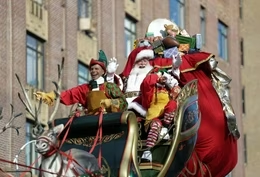
But that white bearded figure that we all recognize as Santa Claus, he is a relatively modern creation shaped over centuries.
Stephanie Sy recently talked with an author who unwraps the surprising history of Old Saint Nick.
STEPHANIE SY: That author is Gerry Bowler.
And his book "Santa Claus: A Biography" traces how the legend of our favorite bearded gift-giver evolved over centuries.
Gerry, it's such a pleasure to have you on the "News Hour."
So I want to hop right into it.
Is Santa Claus -- and I quote from the book -- a figure of mythology or a creature of literature or a tool of a clever capitalist?
GERRY BOWLER, Author, "Santa Claus: A Biography": He is a wonderful myth, about 1,700 years old, American in renovation and largely a conspiracy by families.
So it changes over time.
STEPHANIE SY: Saint Nicholas was an actual fourth century bishop.
What was he most known for?
GERRY BOWLER: At the time of his life, he was known for generosity.
But when he died, a cult grew up around him inside Christianity that made him the most influential, popular male saint on the Christian calendar.
He was the patron saint of so many things, but probably his most famous miracle in the Middle Ages was his resurrection of three murdered boys who had been chopped up and put in a pickle barrel.
He discovered this and put them all together again.
So he becomes the patron saint of children.
And thus around maybe the 12th century, he was someone who parents and the church said came on December 6 to bring presents for good little girls and boys to leave something in their shoe.
STEPHANIE SY: So, Gerry, it sounds like there's this darker side of the Santa Claus legend to talk about here that a lot of people are unaware of.
GERRY BOWLER: Well, in the 1500s, when Protestants abolished the cult of saints, parents had to have some kind of magical gift bringer.
They still wanted that aspect.
In many places, they turned to the Christ child.
In French, you call it Le petit Jesus.
In German, it'd be Das Christkind.
The Christ child is certainly a great Christian symbol, but he lacked two things that Saint Nicholas had had.
One, the baby is obviously not going to carry a big sack.
And, two, he's not scary.
And Saint Nicholas could scare kids into good behavior.
So what happened in Germany and in Northern Europe was that the Christ child started becoming accompanied by scary helpers.
They carried a whip or switches or a chain.
In Austria, of course, we have Krampus, which looks exactly like the devil.
So he's one of those scary helpers.
STEPHANIE SY: So this goes back to your first answer, which is there was this conspiracy of families.
Are they basically at the root of the Santa Claus that we know today?
GERRY BOWLER: Well, a number of New York poets and thinkers and rich landowners wanted to make Saint Nicholas the bearer of good things and also a bit of a threat to bad kids.
The first poem that takes Saint Nicholas out of his Catholic bishop's uniform and puts him in a fur-trimmed red robe is called "A Children's Friend" in the 1820s.
It's a poem that describes this Christmas Eve midnight gift-bringer who comes equipped with a reindeer-powered sleigh.
The next year, Clement Clarke Moore that sleigh, multiplies the reindeer, and writes a poem for his family.
STEPHANIE SY: And the poem you're referring to there is "'Twas the night before Christmas."
GERRY BOWLER: "'Twas the night before Christmas, a Visit From Saint Nicholas."
And it goes viral, as it were.
It's adopted by families first in the Northeastern United States.
Then it spreads to Canada and throughout the rest of America.
STEPHANIE SY: So, in other words, there's sort of this amalgamation of traditions that are folded in and layered on.
GERRY BOWLER: That's the nature of Christmas.
Christmas is very adaptive.
By 1900, Santa is pretty much set, though, except with the addition of Rudolph in 1939.
(SINGING) GERRY BOWLER: And despite all kinds of efforts by Hollywood and commerce to make him in their image, he's remained pretty stable since then.
STEPHANIE SY: Why do you think the legend of Santa Claus has endured for centuries?
GERRY BOWLER: Because it is so valuable to families.
Saint Nicholas is this embodiment of generosity, of unmerited favor, to which you add a fantasy, a midnight gift-bringer from some place enormously exotic, powered by reindeer, for crying out loud.
It serves to give kids an idea of fantasy, of generosity.
So, as long as families continue to love Santa Claus, it doesn't matter what Wall Street or any particular denomination happens to be for or against him.
STEPHANIE SY: That is Gerry Bowler, the author of "Santa Claus: A Biography."
Thank you so much for joining us.
Happy holidays.
GERRY BOWLER: My pleasure, and merry Christmas.
WILLIAM BRANGHAM: Unless you're a real jazz aficionado, you might only know a handful of the greats, Louis Armstrong or Duke Ellington, Coltrane or Miles.
But there is a legion of players who've worked their entire lives playing this music, many of them doing so with very little fanfare.
While they have earned the respect and gratitude of their peers, many have struggled to earn a living.
A new fellowship honors them and helps lend support in their later years.
Jeffrey Brown reprises this story for our arts and culture series, Canvas.
JEFFREY BROWN: At 68 years young, New Orleans-born-and-raised jazz drummer Herlin Riley is ready to bring a smile with his tambourine and back a band on stage, from childhood to today, practicing, performing, teaching.
He's worked hard to make a life in jazz, including playing with the likes of giants such as Wynton Marsalis and Ahmad Jamal.
HERLIN RILEY: It takes commitment.
It takes commitment and also to be -- to recognize where you stand of the people who are around you, your peers.
Am I good enough that I can make a living?
Am I good enough to be accepted?
Am I good enough that I can -- I will be getting the phone calls to make a living?
And... JEFFREY BROWN: Because you don't always know.
HERLIN RILEY: You don't always know.
But I tell my students all the time that, if you're going into music for any other thing other than the passion and the love of it, you should do something else.
JEFFREY BROWN: At a recent concert at New York City Winery, Riley performed as part of the inaugural class of the Jazz Legacies Fellowship, 20 musicians, all 62 and older.
The fellowship comes with $100,000 to use as the musicians want for creative projects they always hope to take on, or for housing, medical and other personal needs.
The four-year program is funded by the Mellon Foundation, for the record, also an underwriter of PBS News, in partnership with the Jazz Foundation of America, and honors seasoned jazz musicians who may not have achieved huge popular success, but have continued to work and contribute to the art form they love.
Another jazz legacy fellow, 90-year-old pianist Valerie Capers.
VALERIE CAPERS, Musician: Ninety years old, that's ridiculous.
JEFFREY BROWN: It's ridiculous, but you're still doing all these things.
So you're not stopping anything.
VALERIE CAPERS: Oh, no.
JEFFREY BROWN: Still at it, but remembering well the early days.
VALERIE CAPERS: My challenges in jazz are to -- as you say, to move into it and to be able to maintain myself for this work, you're right, quite a period of time.
JEFFREY BROWN: Yes.
(LAUGHTER) JEFFREY BROWN: Blind since age 6, Capers studied classical music at the New York Institute for the Education of the Blind.
But she also fell in love with jazz.
Her father was a friend of Fats Waller.
And she recalls having to hide her new passion from her piano teacher.
VALERIE CAPERS: She had no use for dealing with anything that would be jazz or that would be anything like that.
JEFFREY BROWN: Anything but classical music.
VALERIE CAPERS: That's right.
That's right, none whatsoever.
JEFFREY BROWN: Capers ended up taking Saturday classes at Juilliard to get her jazz fill.
VALERIE CAPERS: It was exciting just to be around who were playing this music that I just loved and enjoyed so much.
The music brought smiles and laughter and energy when you would play the music.
They would just enjoy it.
JEFFREY BROWN: Capers went on to a long career, including leading a trio, playing with the likes of Dizzy Gillespie, and decades of teaching.
Another veteran pianist and newly minted fellow, 80-year-old George Cables.
The native New Yorker grew up seeing Thelonious Monk, Charles Mingus, and John Coltrane and was hooked.
GEORGE CABLES, Musician: Hearing the music is one thing.
Seeing it and being there while it's being made and watching an iconic figure like Thelonious Monk is something else.
JEFFREY BROWN: Through the years, Cables has played with jazz legends including Sonny Rollins and Dexter Gordon.
But his career hasn't been without obstacles, not only keeping up a working routine, but dealing with serious health problems, including a liver-kidney transplant and the amputation of a leg.
GEORGE CABLES: They were there, things that I had to go through in order to do the things that I want to do.
This kind of thing, the music is a wonderful thing to be involved with this music with jazz especially, because it's a living music.
It's always changing.
But the business is kind of difficult.
So it's good to know that there may be fewer things to worry about or to be as concerned about as I may have been.
MELANIE CHARLES, Musician: I feel like the music industry can be a bit ageist.
We have heard time and time again important jazz musicians who shifted the sound, who passed away poor, struggling, had to do a GoFundMe to put them to rest in a proper way.
And that always breaks my heart.
JEFFREY BROWN: Melanie Charles is a jazz singer, flutist, composer and producer.
At 37, she's a generation or two younger than the 20 fellows.
But she says she was honored to be on the selection committee of professional musicians and scholars that picked the first group.
MELANIE CHARLES: If you don't have a cult following, people, you will go to Russia and people will know all your albums, but you're going to go home and you just might struggle financially.
You might not be able to pay your rent or your mortgage, or you might have an album that you want to finish, your life's work, that you have never been able to have the budget to make it happen.
JEFFREY BROWN: A protege of 87-year-old jazz bassist Reggie Workman, who was her teacher in college and one of the 20 musicians selected, Charles says a common thread among the fellows is their commitment to the next generations.
MELANIE CHARLES: A lot of the jazz masters, you find that in the career, they're always hiring younger musicians.
Why is that?
It's because they understand that that fresh sound is so important to pushing the music forward and it keeps them bright and fresh.
JEFFREY BROWN: In fact, several of the band members playing with Valerie Capers at this performance were musicians she's taught.
VALERIE CAPERS: Oh, I get tremendous satisfaction because it's almost like a parenthood in a sense, because you are passing on to others that are close to you who have spent time with you.
JEFFREY BROWN: George Cables says this fellowship has energized him.
He's writing new music, collecting and organizing older works into one volume.
So you're 80 years old, you're still writing music and you're still performing music.
GEORGE CABLES: That's what I do.
That's my life, and that -- actually, that makes -- that gives me breath, that gives me life, that gives me energy.
That makes life worthwhile and meaningful.
JEFFREY BROWN: As for drummer and tambourine man Herlin Riley, he too intends to play on.
(MUSIC) (APPLAUSE) JEFFREY BROWN: Thank you so much.
HERLIN RILEY: Thank you so much, Jeff.
Thanks for having me.
JEFFREY BROWN: For the "PBS News Hour," I'm Jeffrey Brown in New York.
WILLIAM BRANGHAM: For more than 40 years, Beverly and Dereck Joubert have lived with, photographed and filmed African wildlife.
Their work documents not just the majesty of the African continent, but also the host of threats, often manmade, confronting the animals and the wilderness.
Their new book is "Wild Eye: A Life in Photographs."
In a story that aired first on television, on "PBS News Weekend," John Yang spoke with the Jouberts, photographer and conservationist Beverly and filmmaker Dereck.
He asked them why they chose to publish a retrospective now.
BEVERLY JOUBERT, Award-winning Photographer and Filmmaker: It's really important to be able to look back and see what life was for us then and for, you know, all the animals and where we are today.
And, of course, we are losing at an alarming rate everything from the cats to elephants and landscape.
So we thought if we could bring a piece together that truly is celebrating these animals and hope that everybody will want to try and protect them.
DERECK JOUBERT, Award-winning Photographer and Filmmaker: I think that's true.
You know, I think that it's a time now for us to all reflect on what was and then determine what's going to be.
JOHN YANG: What are the threats that you see?
DERECK JOUBERT: Well, we've seen quite a lot of poaching threat.
We've seen over hunting in a lot of places.
It seems like Africa more and more is becoming this forgotten place that people are so involved in their lives in the rest of the world that the future of wildlife is off the agenda.
JOHN YANG: How did you decide?
How did you pick which images went into the book?
BEVERLY JOUBERT: That was a challenge.
I can tell you, going through 40 years of photography, the image really needed to tell a story.
Some of the images are a little harder to look at, but they are telling a powerful story.
And so that's how, you know, we selected.
Not every image will go on a wall, but they're important to be able to tell the story of Africa's wildlife.
DERECK JOUBERT: I also think that some of the storytelling that was chosen through these images spoke more about moments before the image was taken and what's going to happen after the image was taken.
So these are not just snapshots in town.
These are indicators or reflections of a story that's going on there, and so draw the audience of the viewer in.
JOHN YANG: Let's talk a little bit about that by looking at some of the pictures.
First, there's a leopard in a baobab tree.
And in the book, in the caption, you've given this leopard a name.
Do you often do that with the animals you photograph?
BEVERLY JOUBERT: When we're out there, you know, we'll spend two to three years with the animals that we're filming.
So, yes, we do if we get to know animal.
This particular leopard we got to know very well because it was the mother to a little leopard that we stayed with for four years.
And the little leopard we stayed with for four years is the front cover of the book "Wild Eye."
DERECK JOUBERT: And I think there are a couple of more functions of actually naming these things.
We give them characters, or rather we reveal their characters.
If it's just, you know, leopard number F125, there's no characterization there.
But these are real personalities, and I think that we do them a disservice by not at least giving them a fair shot at winning your heart.
BEVERLY JOUBERT: One of the important about her up in that baobab tree is more than 2,000 years old.
So it's not only about protecting her as one of the cat species, but it's by protecting the land so you can protect everything else, all the biodiversity and the fauna and flora.
JOHN YANG: The next photo is of a lion cub, and it really is sort of almost a star photo.
You've got that rainbow perfectly placed behind this cub.
Talk about that, about how you get the right image, you want frame it and also just that, getting it from the right perspective.
BEVERLY JOUBERT: It's always a challenge to get the right image.
I mean, I take thousands of images that would never be perfect in my eyes or in Dereck's eyes, but this particular one line was observing the rest of the pride.
And so it meant that we could move around, and as we moved around with our vehicle, we could position the rainbow exactly behind this little one.
DERECK JOUBERT: Of course, there's some tension within this image because while the rainbow is perfectly positioned for Beverly's lens position, perfectly for mine.
And so there's dialogue in the vehicle is, can you go forward about two feet?
I'm going, no, why would I do that?
JOHN YANG: You're the filmmaker there.
DERECK JOUBERT: Exactly.
And so we've always got to weigh that up and balance that and our lives.
BEVERLY JOUBERT: Yes.
JOHN YANG: Then the next photo is of lions in trees.
And you say it's unusual to find lions in trees.
BEVERLY JOUBERT: It is.
Some areas the lions have started adapting and going up trees.
But the problem is not like a leopard.
They can't go straight up a tree trunk.
They can't lock their ankles like a leopard can.
So it's a challenge for them.
So this was a beautiful reclining tree, so it was easy for them to get up.
JOHN YANG: I've heard both of you say that you're big cat people.
Talk about that.
DERECK JOUBERT: Well, Beverly has a wild side to her.
No, we -- when we came out of university, our very first assignment out there, even though were researchers then, was studying lions and so that got into our DNA and we studied lions for 35 years.
Somewhere along the line we found cameras and we started photographing and filming them as well.
And we just keep coming back because that's where we feel most imbalance, I guess.
BEVERLY JOUBERT: Yes.
And over a 60-year period, they've declined by 95 percent And that's all the big cats.
And so leopards have this beautiful skin and we need to speak out for them because everybody know would like to acquire one of their skins.
And with so few left in Africa, we feel like we need to be the ambassadors.
JOHN YANG: And, of course, you don't just photograph big cats, you also photograph other animals.
We've got these zebras in the book.
You say these zebras are actually going someplace.
BEVERLY JOUBERT: These zebras, I mean, it's quite an unusual situation.
So when the rains come, they go to one of the harshest places, which is a salt pan called the Makgadikgadi Pans.
And they're going there because they need minerals.
So as the rains come and all the pans fill up, they go there, they spend a couple of months there, they build their bodies with all the minerals and then they come back.
So they are migrating in that image.
DERECK JOUBERT: And I think an image like this is exactly what I was talking about earlier on, John.
It talks about who.
So these zebras are in or what and in what landscape?
So the stalks of the reeds in the perfect habitat for them because it matches and speaks to architecturally what a zebra is.
And then what next?
Why would they be wading through the water to go to water?
And I think the best photographs end with a question mark.
JOHN YANG: Not just the beauty, but also some of the violence of life in Africa.
A photograph of a lion battle with an elephant and then you also capture the kill.
And you said that this kill took days because the elephant is so large.
I mean, I find this image difficult to look at.
But what was it to watch that, to be there while that was going on?
BEVERLY JOUBERT: So the first image, that is a female cow.
And that happened at 2:00 in the morning.
So that is a challenge, you know, on its own.
I remember shouting out to Dereck, he had to wake up and start filming.
And I start, you know, taking the photographs.
And she was about 21 years old.
Nine lions in the pride.
And it was opportunistic.
They were the first to ever capture lions trying to bring down an elephant.
And this particular image was a story of hope for us because she fought for her life for at least a half an hour and she did get away.
DERECK JOUBERT: So these two images together play light and dark.
They play hope and desperation and despair.
And so the female that Beverly's talking about did actually get up and run off.
She had a will to live.
And this older bull in this image gave up hope.
And that was a long, grueling couple of days for us to sit and film and photograph through.
But the way that we get through that is we fortify ourselves with the knowledge that we didn't play a role in this.
We're silent observers within this.
And this is going on up and down through Africa behind us one way or the other.
We can't intervene.
We can't change that destiny for these animals.
But what we can do is use our tools, our cameras, to bring that to audiences so there's a better understanding of the facets and nuances of nature.
Otherwise we go down self-generating sense that everything out there is Disneyland.
And I think it's good for people to know that there's a harsh side to Africa as well.
JOHN YANG: You've been at this 40 years, hundreds of photographs in this book.
Is there an image you're still chasing, an image you want to capture that you haven't yet?
BEVERLY JOUBERT: There's always an image I'm still chasing.
I don't quite know what it is because I need to be open to, you know, whatever comes our way.
But the images definitely need to be preserving and protecting wildlife in Africa.
DERECK JOUBERT: And I think that's the journey, isn't it?
Is not necessarily caring about where you're going to end up, but being open to the steps along the journey as they present themselves to you.
BEVERLY JOUBERT: Yes.
JOHN YANG: Dereck and Beverly Joubert, thank you very much.
Just amazing pictures.
Thank you very, very much.
BEVERLY JOUBERT: Thank you, John.
DERECK JOUBERT: Thank you.
BEVERLY JOUBERT: Really appreciate.
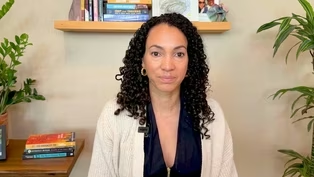
WILLIAM BRANGHAM: At the start of this year, the community of Altadena, California, was among those devastated by wildfire.
Gina Clayton-Johnson is the founder of Essie Justice Group.
And she lost her home and countless family treasures.
In this Brief But Spectacular from earlier this year, she shares her reflections on loss, resilience, and rebuilding.
GINA CLAYTON-JOHNSON, Founder and Executive Director, Essie Justice Group: I always felt like Altadena was my little secret, because whenever I would tell anyone where I was from, no one knew where I was talking about.
Altadena was a place where traditionally a lot of Black folks could go and find that they could buy land because of redlining and other realities.
My parents actually bought a home there in the early 1980s.
It was a wonderful place to be from.
The Altadena Eaton Fire burned down my home, my parents' home, my kids' school, and something like 9,500 structures or more in Altadena.
And it's devastating.
The day that the fire started was a really windy day.
We got a call from the school around 3:00 saying that the power had gone out and to come pick up the kids.
At 11:00 p.m.
that night, we drove away because we decided we wanted to be somewhere with power in the morning.
We were not evacuated.
We did not receive a warning, a text message, a call.
So we went to our friend's house, and then came the news that our house had burned down.
I called my aunt and I said: "Is there any way that we can come stay with you?"
She lives in Atlanta.
During other hard moments of my life, my first phone call was my parents, but they had just lost their home.
They're in their 70s.
I have always been curious about who I come from and why I'm where I am.
Memory happens because it can attach itself to pictures and to things that we use to tell those stories.
I had my great-grandmother's plates.
Her mother's name was Cassie White (ph), and that sharecropping farm where my great-grandmother grew up, that was where Cassie White lived and worked her days.
She liked to knit.
And this was like her art.
And I had them hanging with her picture on our wall.
And that's gone.
To zoom out and to understand that this is a Black community with multiple generations of history, of artifact, the fact that that's gone is something I'm still processing.
My 5-year-old daughter said: "You know, Momma, I know how to not be sad.
If you just think about something else for a little bit, you won't be sad anymore."
My son, who is masterful at destroying everything, he said: "Momma, I'm going to fix our house."
It meant something.
Askia (ph), my daughter, she wanted -- for Christmas, she wanted this mermaid castle.
So she was fully in love with this thing.
She said: "Oh, my -- the mermaid castle is burned.
I know what I will do.
Next year, I'm going to ask Santa for another one."
It's stuff like that where I'm just like, OK, like, yes, let's go.
We can do this.
We will ask Santa for another one.
It's harder in certain ways to do all of this with these little kids.
But, in other ways, it's such a gift, because they're teaching us something.
It's burned, and also -- there's an end to that sentence that doesn't have to feel -- that can feel full of possibility.
My name is Gina Clayton-Johnson, and this is my Brief But Spectacular take on putting the pieces back together.
WILLIAM BRANGHAM: You can watch more Brief But Spectacular videos online at PBS.org/NewsHour/Brief.
The Rockettes are one of the most iconic dance groups in the country, and they're celebrating a big anniversary this year.
The "News Hour"s Julia Griffin explains.
JULIA GRIFFIN: In New York City this time of year, holiday cheer and twinkling lights are easy to spot.
But of all that shimmers, perhaps nothing sparkles more than 36 rhinestone Rockettes high-kicking their way through the "Radio City Christmas Spectacular."
The longest-running precision dance company in America, the Rockettes are not only celebrating the holiday season this year, but also 100 years on stage.
Founded in St.
Louis in 1925, the troupe was originally known as the Missouri Rockets.
But, by 1933 they'd moved to New York, settled into their Radio City Music Hall home, and launched the annual "Christmas Spectacular," changing their name to the now famous Rockettes along the way.
A mainstay of American entertainment, the Rockettes have performed at presidential inaugurations, Super Bowls, and countless lightings of the Rockefeller Center Christmas Tree.
Today, the company is 84 members' strong; 36 dancers grace the stage each show, kicking some 200 times each before the curtain closes.
Some members dance with the group for more than a decade.
JULIE BRANAM, Director and Choreographer, "Radio City Christmas Spectacular": It's just really a magical thing being a Rockette.
JULIA GRIFFIN: "Radio City Christmas Spectacular" director and choreographer Julie Branam was a Rockette herself for 13 years and knows what it takes to grace the Radio City stage.
JULIE BRANAM: I think it takes incredible dancing, number one, and a willingness to work harder than you have probably ever worked at any other job in your life, because you have to really want to look like everybody else and put in the time and effort to do the precision work.
JULIA GRIFFIN: That precision work, a sharp, synchronized mixture of jazz, tap, and ballet, is a style almost unique unto itself and one that binds Rockettes, past and present, in a unique sisterhood.
AUDREY MCDONALD, Rockette Dancer: Joining this legacy that's been inspiring audiences for generations is just so special and it's such an honor.
JULIA GRIFFIN: Current Rockettes Audrey McDonald and Courtney Crain grew up in Louisiana together.
COURTNEY CRAIN, Rockette Dancer: This is my fifth season, but experiencing it now through her eyes and her first season, it's really magical for me and special for me.
JULIA GRIFFIN: For 11-year veteran Megan Kelley-Crocco, a core memory was learning one of the numbers that has been in the show since 1933.
MEGAN KELLEY-CROCCO, Rockette Dancer: When I first learned "Parade of the Wooden Soldiers" 11 years ago, I had - - that was my moment of, oh, my gosh, I'm a Rockette.
So many women have done this number before me and now I get to do it and I get to share this with the people I love and inspire more generations of future Rockettes out there.
JULIA GRIFFIN: And over the years, the Rockettes have shared secrets on how to keep the friendship strong.
WOMAN: For the Rockette hookup, our right hand is high on the woman next to us and then our left hand is low.
And we never touch.
That's the last thing you want to be doing is hitting your neighbor while we're doing these kicks.
WOMAN: That's a good way to lose friends.
WOMAN: Yes.
(LAUGHTER) JULIA GRIFFIN: This year, to mark the group's centennial, the Sixth Avenue street sign outside Radio City Music Hall was renamed Rockettes Way.
And... WOMAN: Once a Rockette, always a Rockette.
(CHEERING) JULIA GRIFFIN: ... more than 500 past and present Rockettes from all 50 states and several countries celebrated the troupe's legacy on opening night.
SUSAN DUSTIN, Former Rockette: Radio City has a unique ability of really honoring the women that came before us and paying tribute to the past, while incorporating all of the modern-day things.
And we remain today to be the world's most famous dance troupe.
And so it's just extraordinary.
JULIA GRIFFIN: For PBS News, wishing you a high-kicking happy new year, I'm Julia Griffin.
WILLIAM BRANGHAM: Finally tonight, we continue our tradition of holiday music brought to us by members of the U.S.
military.
From our "News Hour" holiday archives, enjoy this rendition of the Christmas classic "Jingle Bells."
(MUSIC) WILLIAM BRANGHAM: And that is the "News Hour" for tonight.
I'm William Brangham.
On behalf of the whole "News Hour" team, thank you so much for joining us.
We hope you have had a merry Christmas.
Good night.
A Brief But Spectacular take on resilience and rebuilding
Video has Closed Captions
Clip: 12/25/2025 | 4m 9s | A Brief But Spectacular take on putting the pieces back together (4m 9s)
How the traditions of Santa Claus evolved over centuries
Video has Closed Captions
Clip: 12/25/2025 | 5m 44s | How the character and traditions of Santa Claus evolved over centuries (5m 44s)
Irin Carmon joins Amna Nawaz for our 'Settle In' podcast
Video has Closed Captions
Clip: 12/25/2025 | 5m 6s | Irin Carmon joins Amna Nawaz for our 'Settle In' podcast (5m 6s)

News Wrap: Zelenskyy speaks with U.S. peace negotiators
Video has Closed Captions
Clip: 12/25/2025 | 3m 36s | News Wrap: Zelenskyy says he had 'good conversation' with U.S. negotiators on peace plan (3m 36s)
Rain drenches Southern California with more storms coming
Video has Closed Captions
Clip: 12/25/2025 | 2m 39s | Torrential rains drench Southern California with more storms on the way (2m 39s)

The Rockettes celebrate a century of dance
Video has Closed Captions
Clip: 12/25/2025 | 3m 46s | The Rockettes celebrate 100 years as a holiday season favorite (3m 46s)
Providing Support for PBS.org
Learn Moreabout PBS online sponsorship
- News and Public Affairs

FRONTLINE is investigative journalism that questions, explains and changes our world.

- News and Public Affairs

Today's top journalists discuss Washington's current political events and public affairs.












Support for PBS provided by:
Major corporate funding for the PBS News Hour is provided by BDO, BNSF, Consumer Cellular, American Cruise Lines, and Raymond James. Funding for the PBS NewsHour Weekend is provided by...