
Becoming America with Bonnie Boswell: Life, Liberty and the Pursuit of Happiness
Special | 26m 41sVideo has Closed Captions
Bonnie Boswell goes in search of people breathing life into American ideals.
How do we pursue happiness in a world filled with divisiveness? Bonnie Boswell travels across the country to talk with people sharing and reflecting on the American ideals of “Life, Liberty and the Pursuit of Happiness.”
Problems playing video? | Closed Captioning Feedback
Problems playing video? | Closed Captioning Feedback
Bonnie Boswell Reports is a local public television program presented by PBS SoCal
Becoming America with Bonnie Boswell: Life, Liberty and the Pursuit of Happiness
Special | 26m 41sVideo has Closed Captions
How do we pursue happiness in a world filled with divisiveness? Bonnie Boswell travels across the country to talk with people sharing and reflecting on the American ideals of “Life, Liberty and the Pursuit of Happiness.”
Problems playing video? | Closed Captioning Feedback
How to Watch Bonnie Boswell Reports
Bonnie Boswell Reports is available to stream on pbs.org and the free PBS App, available on iPhone, Apple TV, Android TV, Android smartphones, Amazon Fire TV, Amazon Fire Tablet, Roku, Samsung Smart TV, and Vizio.
Providing Support for PBS.org
Learn Moreabout PBS online sponsorshipBonnie Boswell: Like many Americans today, I worry a lot.
Our differences have become magnified.
Life feels more challenging.
As a young couple, with help, my husband and I could buy a home.
Now, it's harder for my adult children and their friends to do the same.
Policies and politics have failed to produce a common vision that allows everyone to win, but there are signs of hope, so join me as I set out on a journey of discovery to meet people across the country facing today's challenges with fresh ideas and optimism.
Welcome to "Becoming America."
Singer: ♪ America I reach out and talk to you If we could see each other I want to know, want to know Want to know ♪ Where you're coming from ♪ Announcer: The funding of this program is made possible by the Ford Foundation, the California Wellness Foundation, and Woodcock Foundation.
Boswell: Now, many people associate America with the ideals of freedom, equality, and opportunity, but the fact is those goals have been and still are works in progress, and that's because people are themselves works in progress.
Well, the point is, if our values are worthy to never give up on our goals.
I turn to the words of my friend and colleague, the late Pastor James Lawson.
Martin Luther King called Jim the leading nonviolent theorist in the world.
I was the producer and co-host of his national live talk show for over a decade.
Jim described our national dilemma this way.
Lawson: The spiritual poisons that hurt us today--racism, sexism, violence, and plantation capitalism.
Boswell: Jim believed in the power of nonviolence, dialogue, and personal transformation to overcome these poisons.
He said we should turn to the preamble to the Declaration of Independence for inspiration.
Lawson: "We hold these truths to be self-evident."
We don't have a national program that emphasizes that period, and you can't get it without some major forms of teaching and conversation.
You can get it in the poetry of the human race, in the literature, in the scriptures.
It's there, but that has to be translated into every contemporary generation.
♪ Boswell: With that in mind, I decided to go to Philadelphia.
I saw Independence Hall, where the Declaration of Independence and the Constitution were debated and adopted.
I also interviewed participants attending the second Young People's Continental Congress, or YPCC.
Students and teachers from around the country were brought together by 3 organizations, National History Day, Carpenters' Hall, and Generation Citizen.
The goal--teaching young people how to put the founding ideals into action.
Student: Long-term budget plan that allows this program to exist for as long as it needs to.
Student: Getting people involved about learning in civics because the more people learn about civics, the more likely they are to be active in our society.
♪ Boswell: I met Andrew Wilkes, the civic voice and policy officer for Generation Citizen at the National Constitution Center.
So you say this is a real hands-on activity.
It's not just memorizing things, but it's, like, active.
Wilkes: They have conversations based on focus issues that they care about.
They create classroom constitutions that are modeled after an understanding of how the U.S.
Constitution is set up, and then after they have their classroom charters, if you will, they pick their focus issues.
They then conduct community interviews.
We call it community-based civics because the goal is to learn about how decisions are made on issues that affect students' lives.
Boswell: So how did the participants feel about the program?
I asked 3 of them.
Tell me about yourself and what you're learning.
Nitya: It combines these 3 different factors--the civic education, history, and leadership.
Boswell: Nitya, what's it been like for you meeting people from different backgrounds?
Nitya: It's truly, like, inspiring because I get to learn about their experiences and their love for history, too.
I've already made a friend.
Her name is Ella.
She's from Montana, and she was telling me how, like, she lives in a town with only one stoplight, and I was like, "That's amazing!"
Coming from Columbia, which is more like 150,000 population.
Meeting people from such diverse backgrounds has truly been really cool, and then also on top of that, um, like that we're all truly interested in history and civic education, as well, and just civic engagement within our communities.
Boswell: Well, some of the magic of an immersive program is that students and teachers are able to walk around buildings where disagreements between the founders were hammered out to create a new nation.
Like other visitors, they learned it wasn't an easy process.
The First Continental Congress was held here at Carpenters' Hall in 1774.
I went there to talk with executive Director Michael Norris.
So tell me a little bit about those early days.
Norris: Here, they argued about, um, should colonies have one vote per colony, or should those votes be proportioned according to the population of that colony, right?
Sound familiar?
What was significant about the First Continental Congress was the coming together.
That was a moment where people put aside what they thought--or what differences they had so they could focus on a shared challenge, you know, that that needed to be addressed collectively.
So for us today, that's a really telling moment to remind folks, like, this can be done, right?
We can surmount polarization to solve problems.
Boswell: Garrett, you've learned a lot here that surprised you, I know.
What are you gonna take back to your hometown?
Garrett: I've learned a lot about just how... how diverse our nation's beginnings have been.
It was really segregated, and it was not connected.
Everyone had different ideals.
Everyone was arguing different things, especially in the Continental Congress, and I thought that was really interesting that people didn't agree a lot back then, and when they did agree, we got things like the Revolution.
Seeing people's perspectives on things, things that I haven't thought about myself, in these experiences, in our classrooms, and our environments, like analyzing primary sources.
When other people would point something out that I didn't see, I thought that was really nice because then then that gives me a deeper--a deeper context as to what I'm learning about.
For when people did agree, important things happened.
Boswell: What have you found are the challenges of getting civics actually in the schools?
Wilkes: Over the past 3 decades, we've seen the crowding out of social studies in school curriculum, and a part of what explains that trend is that science, technology, engineering, and math have been seen as essential subjects, and civics has often been seen as a nice to have.
We have disinvested in civics at the federal level.
Boswell: It turns out that for every $50 going to a STEM program, civics only gets $0.05.
Wilkes: And a part of what Generation Citizen is arguing and part of what gives me so much passion, Bonnie, is the idea that civics is actually a must have.
Teacher: Take a couple of minutes to reflect on that based on the activity that we just completed.
Dale: You know, as a teacher, I feel like I see examples in my classroom every day of young people disagreeing, but being able to come together and have a conversation and whether it comes to solutions or it comes to some sort of relationship and commitment to being in ongoing conversations, it feels so satisfying to be in a room where that happens.
Young people, you all really model for the rest of us, like, how to be in conversation and commitment to, you know, the founding ideals of liberty and fairness and justice.
[Drum playing] Boswell: At the end of the second Young People's Continental Congress, students work with teachers to create their own Declaration of Aspirations, affirming by its title that our core values are goals we can work towards together.
Student: We the delegates... Student: of the 2025 Young People's... Student: Continental Congress... Student: do hereby declare... Student: the following aspirations... Student: for our peers and our country.
Student: We commit to building a future grounded in fairness, respect... Student: compassion, and universal human dignity... Student: so that all young people share the freedoms necessary to lead and thrive.
Student: That we and our government guarantee that economic opportunities... Student: are accessible to all communities across every region... Student: that we expand access to high-quality and well-funded education... Nitya: free of government censorship at all levels... Student: so that every American can live up to their fullest potential.
Garrett: We seek to build a community in which the technology... Student: knowledge, and information necessary for... Student: informed civic engagement... Student: are available to all.
Boswell: In Philadelphia, YPCC students learned that, yes, the Founders had differences, but when they put aside their disagreements, they were able to get things done.
Students also learned listening to others was an opportunity to gain new insights, but what if one person's idea of liberty is another person's idea of control?
Take the hotly contested issues surrounding guns.
Pastor Lawson said we've become too attached to violence.
Lawson: The human race has fell--has fallen in love with violence... Boswell: Mm-hmm.
Lawson: but the powers of violence are all negative so far as the human species is concerned.
It destroys in order to manage, control, dominate because very often after it destroys it takes a generation to restore.
The presidents and the prime ministers are not the major casualties.
Power is character.
Power is the capacity to care about your own life and care about all the neighbors and care about the human race.
Boswell: I'd heard of a new program in Denver, Colorado, making progress helping both sides of the gun issue find common ground.
Well, I needed to know more, so I went to Denver.
♪ At the University of Colorado Medical School, I met Amanda Wilcox.
Amanda is an advisor to the Firearm Injury Prevention Initiative, or FIPI.
Her 19-year-old daughter Laura was shot and killed by a mentally disturbed man when the family lived in rural Northern California.
Wilcox: So she's the oldest of my 3 kids.
She had incredible, um, organization skills, discipline, and energy.
She also had, I would say, beyond her years, a sense of respect and justice and kindness.
Boswell: At the time of the shooting, Laura was working as a receptionist with the county Department of Behavioral Health during a school break.
Wilcox: A client came in for an appointment and pulled out a gun and opened fire, and he shot her 4 times at point-blank range.
We lived on 20 acres outside of town, and I didn't have the radio on or anything, and a friend of Laura's called me about 2:00 that afternoon, said, "Did you hear about the shooting in Nevada County?"
I said, "What shooting?"
And I thought, "Well, that's where--isn't that where the health department is?
That's where Laura's working."
So I spent the afternoon calling every 20 minutes, and every time, they told me they didn't have information.
My husband came home, and by this point, I--I felt I wanted to know.
I yelled out, "What happened to Laura?
What happened to Laura?"
And my husband lifted his head from the phone and said Laura was killed.
I felt like I was underwater, and I--my knees kind of buckled, and I walked over to our big easy chair in the living room and sat down, and my two tall teenage sons got into my lap.
We were all stunned, and life as we knew it was over.
Boswell: Well, Amanda turned her grief into activism.
She and her husband helped pass 80 firearm injury prevention laws.
This included a red flag law, giving family members and officers permission to ask that a gun be removed from the home of a person in danger of causing harm to themself or others.
Amanda's heartbreaking story is in sharp contrast to her fellow FIPI adviser Edgar Antillon.
He is the CEO of an organization called Guns for Everyone.
Antillon: My parents immigrated here from Mexico illegally back in the eighties, so it's the stereotypical Mexican upbringing.
Guns were actually not a part of our family.
The gun ownership came later in my life.
Boswell: And what prompted it later in life?
Antillon: That's when I found that this this very basic tool represents freedom.
It keeps me free from the bad guy.
It keeps my autonomy from the government on the extreme side, right?
You think back 1776, and it represents that freedom and us being a sovereign nation.
Boswell: Tell me about how you see this in terms of your overall mission.
Antillon: We want to provide a place for all people to get training.
That's it.
Self-Defense training should be for everyone.
Everybody has the natural right to defend themselves, so we provide a space for humans to just get training and information about responsible gun ownership.
One of the most controversial things about us--there's plenty of controversy with us, but one of the most controversial things about us is our name, Guns for Everyone.
Boswell: Oh, Yeah.
Antillon: Yeah.
Our name stems from this idea that the government shouldn't decide who gets a gun.
That doesn't mean we actually believe literally everyone should own a gun.
There's been plenty of students who I've told "You are more dangerous with the gun than without the gun."
There's a lot of humans who are not healed yet and have a lot of trauma from their past that are way too emotional to carry a firearm.
Boswell: Edgar and Amanda were brought together by Dr.
Emmy Betz.
She is an ER doctor at the medical school and the founding director of the Firearm Injury Prevention Initiative.
Betz: I've lost family members myself to firearm suicide, and so I started to realize the connection between firearm access and suicide risk and realized in the ER that was something I could really help people with if I could figure out how to talk with my patients in a respectful, effective way to help them make their homes a little bit safer.
Boswell: How does America compare to other highly industrialized countries with firearms?
Betz: We know firearms are the leading cause of death in kids and teens in the United States right now, and that's been true for a few years, so I think firearm-involved injury and death, whether it's from homicide, from suicide, from mass shootings, um, it's a huge problem in this country.
When we first set up our work, we really wanted an advisory committee, really to help us see our blind spots and think about things from different ways and think about how we could be most impactful, and so through our own networks and asking friends, we started to kind of make a list of people who we felt like could represent different buckets.
Boswell: Dr.
Betz says having people like Amanda and Edgar on the advisory committee is critical.
Betz: We really wanted an advisory committee bringing together diverse perspectives to help us think about the work we were doing, how we could do it better, and potentially into the future to think about new directions.
Boswell: Edgar and Amanda, you've been working together for a while.
What was the most challenging part of it for you?
Wilcox: Well, to be honest, I was quite uncomfortable probably for the first year, not because of the goals of the group so much, but just because I was new to Colorado.
I had not been here long.
Sort of the politics, the culture, the intensity around the issue is different here, and I felt almost like an outsider.
I think the first couple of meetings we had I was taken aback a little bit by, um, the stridency--is that a word--how strident some of the members were.
I just--I just feel--there's so many different forms of gun violence, and I think from FIPI that's become even clearer to me, and a person who lives in suburbia who buys a gun because they are worried about a home invasion and just feel they need to protect their family, and hopefully they've been trained by Edgar.
[Laughter] That's an important piece of it is being a responsible, safe gun owner versus what is going on in urban settings.
Antillon: When Amanda said gun violence--because I'm thinking she's gonna get attacked because she said had gun violence, but if you ask any gun person, they'll get fixated on that phrase, and I only know this because I see it all the time.
We don't call it knife violence.
We just say violence.
Wilcox: Should I be saying, "Violence with a gun"?
Antillon: I think-- Wilcox: So--because violence as a whole, that is very broad in all the ways we deal with it.
Antillon: I know Amanda, and I know what she means.
I'm a human who's had to use his gun in self-defense twice.
I would rather hang out with Amanda and share the message of reducing negative outcomes with firearms.
Even though we don't agree from a policy standpoint, we agree on how to look at stuff from a different perspective, and this is why it's important to talk to people you don't agree with.
Boswell: Well, Amanda and Edgar say fear, whether real or imagined, can be a driver of gun ownership.
Antillon: A lot of people come to the classes thinking, "I've seen the 5:00 news, and it seems like Denver's getting more dangerous or the world's getting more dangerous or what have you, so now I need a gun," until you break down the reality of you being attacked is actually pretty minimal, and once you understand it and you can break it down and get to the root cause of it, then we understand why you're afraid.
Because we do see a lot of people come to the classes and don't end up buying a gun.
Wilcox: I know statistics aren't persuasive, but I know that suicide's gonna be more likely by someone in my home if there's a firearm in it, and in general, you know, gun--when you add guns to a domestic violence situation, there's more likely gonna be a fatality, and school shooters get their gun from the home, so in my mind, um, you know, there's such a risk versus a perceived benefit that many people have, and I've asked myself, "Well, if someone comes to my home, you know, would I be willing to shoot someone?"
If someone wants to steal my TV, I wouldn't be willing to shoot someone over a television.
You know, if someone's coming to hurt me, that seems unlikely in my situation.
I don't believe I have enemies, and so to me, it's such a small risk that I wouldn't want the risk of a gun in the home.
That's where I land on it... Boswell: Yeah.
Wilcox: but I know people with a lot of fear, where they have a gun in every room.
Antillon: I'm a human who's had to use his gun in self-defense twice, so for, like, for me, that's very real, and I need to understand humans like Amanda, where they're coming from, who say, "I don't ever think I'll ever need a gun."
Like, that's what I thought, too.
I don't think--I never thought I'd ever use my firearm, and then whammo, twice, which is rare, which is very rare.
Like, if anybody should have this paranoia, fear about getting attacked, like, I've needed to use it twice in my life.
Just because I agree with you on guns and gun politics doesn't necessarily mean I share the same message with you.
Boswell: So, Amanda, when you've been out in the world among your friends and whatnot, have you been able to share this kind of maybe new insights that you've had because of being a part of this organization?
Wilcox: So a lot of the conversations I had in my rural county where I lived with gun owners who thought they disagreed with me and friends and people I respected, I came away from that in some ways the bigger difference wasn't about policy or specific law.
It was the role of fear that we had in our lives.
Boswell: When you look at the landscape of what's happening in America currently, how do you feel about what's going on?
Betz: The past probably 5 to 10 years have seen really remarkable growth in this sort of collaborative approach of really doing firearm injury prevention with the firearms community, with firearm owners, with the industry, with businesses.
It took time to build that trust, and there's really exciting work happening now.
There's not one law that's gonna fix things.
How we prevent suicide is sometimes different from how we prevent gang-related community violence or mass shootings or unintentional accidents at home.
It's gonna take nuanced, different approaches for each of those, and that's OK.
Boswell: For their part, Amanda and Edgar say while they may not always agree they both want to understand each other better, and that willingness to understand is the beginning.
Well, now, there was one thing I was curious about.
How are the people I'd interviewed in Philadelphia able to take home the lessons they'd learned?
So I decided to set up a Zoom call and ask each one.
Nitya: It was this life-changing experience.
It made civics feel more real, and not only was it the buildings, but it was also the people, meeting all of these diverse people around me.
Through that program, we created the Declaration of Aspirations, and it was a document for aspirations for our future, and I was able to bring that back here in South Carolina, attending high school in different clubs that I am in right now.
Garrett: It was pretty much like on the local news, and so it was crazy because all my friends were like, "OK.
I need to see pictures."
I think a lot of what took place is going to, like, help kind of shape the curriculum.
It definitely has opened my eyes to always looking at things in more than one perspective, to try to take the best scenario and move forward with that.
Boswell: So as a teacher, this must have been really important to you.
Dale: I mean, it's had so many tremendous impacts.
I think the experience itself, seeing my student and other young people engage in the history of the founding of our country, whether it was a letter from George Washington to one of his lieutenants or an initial draft of the Constitution, it was wonderful and inspiring to see, like, them tangibly hold on to those documents they probably only ever heard of, that probably sounded almost, like, imaginary, and just as a teacher, I came away with that with, like, lots of ideas around how can I bring in those types of documents or those types, like, of hands-on, real-world experiences into my classroom to get my students back in Kansas City just as excited?
Boswell: Well, my experience with people in Philadelphia and Denver having courageous conversations reminded me of Pastor Lawson's words.
Lawson: The nation as a whole must always know that there's a growing group of human beings that are using the power of life, love to help our country come closer to the justice and the community that we crave.
Boswell: Well, after returning home, I began to think about how holding honest dialogue really expands our own humanity, and then I picked up a book, "The Origin of Man's Ethical Behavior" by a scientist Ernest Everett Just, who was also a distant relative of mine.
I wondered, could his ideas about ethics and life be another key to becoming America?
Join us on our next edition.
I'm Bonnie Boswell.
♪ Singer: ♪ I want to know, Want to know, want to know ♪ Where you coming from ♪ ♪ Announcer: The funding of this program is made possible by the Ford Foundation, the California Wellness Foundation, and Woodcock Foundation.
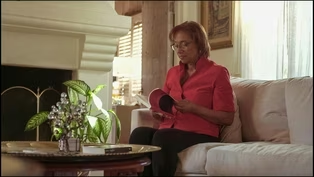
Becoming America with Bonnie Boswell: Life, Liberty and the Pursuit of Happiness
Preview: Special | 30s | Bonnie Boswell goes in search of people breathing life into American ideals. (30s)
Providing Support for PBS.org
Learn Moreabout PBS online sponsorship












Support for PBS provided by:
Bonnie Boswell Reports is a local public television program presented by PBS SoCal