
August 27, 2023 - PBS News Weekend full episode
8/27/2023 | 26m 44sVideo has Closed Captions
August 27, 2023 - PBS News Weekend full episode
Saturday on PBS News Weekend, the latest after a gunman killed three Black people in a racially motivated attack in Jacksonville, Florida. New research reveals a genetic variation that increases the risk of Parkinson’s disease in people of African descent. We look at how climate change is disrupting the global food supply. Plus, how American sunscreen stacks up against the rest of the world.
Problems playing video? | Closed Captioning Feedback
Problems playing video? | Closed Captioning Feedback
Major corporate funding for the PBS News Hour is provided by BDO, BNSF, Consumer Cellular, American Cruise Lines, and Raymond James. Funding for the PBS NewsHour Weekend is provided by...
Support provided by:

August 27, 2023 - PBS News Weekend full episode
8/27/2023 | 26m 44sVideo has Closed Captions
Saturday on PBS News Weekend, the latest after a gunman killed three Black people in a racially motivated attack in Jacksonville, Florida. New research reveals a genetic variation that increases the risk of Parkinson’s disease in people of African descent. We look at how climate change is disrupting the global food supply. Plus, how American sunscreen stacks up against the rest of the world.
Problems playing video? | Closed Captioning Feedback
How to Watch PBS News Hour
PBS News Hour is available to stream on pbs.org and the free PBS App, available on iPhone, Apple TV, Android TV, Android smartphones, Amazon Fire TV, Amazon Fire Tablet, Roku, Samsung Smart TV, and Vizio.
Providing Support for PBS.org
Learn Moreabout PBS online sponsorshipJOHN YANG: Tonight on PBS News Weekend, the latest from Jacksonville, Florida where a gunman killed three black people in a racially motivated attack.
Then, new research reveals a genetic variation that increases the risk of Parkinson's disease in people of African descent.
And there's a rice shortage since prices soaring a look at the effects of climate change on the global food supply.
MAN: Climate change isn't just a negative blanket of adverse impacts, but there will be winners and losers.
(BREAK) JOHN YANG: Good evening.
I'm John Yang.
As Americans mark the 60th anniversary of Martin Luther King Junior's I Have a Dream speech, yesterday's fatal shooting of three black people by a white gunman in Jacksonville, Florida is a brutal reminder that race based hate is still among us.
Authorities say the shooter who turned one of his guns on himself left behind writings detailing his ideology of hate and the FBI says it's investigating the rampage as a hate crime.
Late today, President Biden said in his statement, hate must have no safe harbor.
Silence is complicity and we must not remain silent.
Our report is from Ali Rogin and we should warn you some of the images may be disturbing.
ALI ROGIN: In the New Town area of Jacksonville, neighbors gathered to lift each other up and grieve.
JU'COBY PITTMAN, Jacksonville City Council: Our community is sick and tired of being sick and tired.
ALI ROGIN: Authorities today named the gunman as Ryan Christopher Palmeter.
The shooting began Saturday afternoon at Dollar General Store.
The gunman killed two men and one woman all of whom were black.
After his killing spree, the shooter texted his father telling him to check his computer where he had left multiple racist manifestos, a suicide note and a will.
Police then entered the store and heard a single shot.
The shooter was later confirmed to have killed himself.
T.K.
WATERS, Sheriff, Jacksonville: I urge us all not to look for sense and a senseless act of violence.
There's no reason or explanation that will ever account for the shooters decisions and actions.
His sickening ideology is not representative of the values of this Jacksonville community that we all love so much.
ALI ROGIN: Florida Governor Ron DeSantis condemned the shooter.
GOV.
RON DESANTIS (R) FLORIDA: Perpetrating violence of this kind is unacceptable and targeting people due to their race has no place in the state of Florida.
ALI ROGIN: The Jacksonville Sheriff's Office released disturbing photos of the guns the shooter used a handgun and an AR style rifle with swastikas on it.
The latest federal statistics show reported hate crimes on the rise.
Racism against black people accounts for half of all racially motivated hate crimes.
Saturday shooting was the latest in a series of racist attacks.
Last year a gunman targeting black people left 10 dead at a supermarket in Buffalo, New York.
In 2021, a shooter killed eight people, including six Asian American women in Atlanta.
For PBS News Weekend, I'm Ali Rogin.
JOHN YANG: More tragedy this time in the military.
The crash of a U.S. Marine Corps aircraft in Australia this morning has left three Marines dead.
The Osprey with 23 Marines aboard went down on Melville Island off the coast, the northern coast during a multinational training exercise.
Everyone on board was injured at least five of them critically.
The cause of the crash is unknown and the military exercise has been put on hold.
A new tropical storm system Idalia is formed in the waters off Mexico's Yucatan Peninsula.
Right now it's more or less stationary but forecasters expect that on Monday it will start heading toward Florida.
It could deliver heavy rain and winds to the Tampa area by Tuesday and make landfall as a category one hurricane by Wednesday.
Florida Governor Ron DeSantis has declared a state of emergency for more than 30 counties.
Russia's intelligence services has confirmed that as suspected Yevgeny Prigozhin died in Wednesday's plane crash north of Moscow.
U.S. intelligence officials say his plane was likely brought down intentionally though not by a missile, the Kremlin has denied any involvement.
Prigozhin led a brief mutiny against Vladimir Putin in late June.
And hundreds of Monster Hunters converged on Scotland's Loch Ness this weekend in search of signs of the mythical Loch Ness monster.
It's the biggest hunt for Nessie in more than 50 years.
Volunteers and researchers were armed with thermal imaging drones, infrared cameras and underwater microphones.
Nessie enthusiast who couldn't make it could watch live streams from the team's webcams.
Still to come on PBS News weekend, the ways climate change is disrupting the global food supply and how American sunscreen stacks up against the rest of the world.
(BREAK) JOHN YANG: One million Americans are living with Parkinson's disease a progressive condition that causes problems with body movement.
And every year about 90,000 Americans are newly diagnosed.
But studies show that black patients are far less likely than others to be diagnosed and when they are diagnosed it's an average of four years later than white patients.
New research by a group of Nigerian, British and U.S. doctors has identified a genetic variant that increases the risk of Parkinson's in people of African descent.
And that variant is not seen in those of European ancestry.
Ekemini Riley is the managing director of Aligning Science Across Parkinson's, which coordinated the project's researchers.
Dr. Riley, from your perspective, what is the significance of this research, not only for our understanding of Parkinson's, but also for these underserved communities like people in America with of African descent?
DR. EKEMINI RILEY, MANAGING DIRECTOR, ALIGNING SCIENCE ACROSS PARKINSON'S: I think that it showcases the importance of inclusion, and this real, intentional inclusion of people that are traditionally underrepresented in research here in the U.S., and also abroad.
And I think what we've done through ASAP, the Aligning Science Across Parkinson's, as you mentioned up top, and the program under our umbrella that has really moved this forward, the Global Parkinson's Genetics Program, what they have really done is been inclusive through and through by creating a global coalition of investigators to really be able to enable this work.
JOHN YANG: And I know that the mechanism what how this variant works, is not known, but it's a marker, could this someday lead to targeted treatments targeted therapies for people of African descent?
EKEMINI RILEY: That is the hope.
So there are Parkinson's therapies that are already in human testing that target GBA1, which is the gene in which a new variant was identified.
And this gene has already been known to increase the risk for developing Parkinson's disease and people of other ancestries.
And with this discovery, and more like it, and being that we are already headed into an era of more targeted treatment, it really is the hope that it will widen the aperture and include more variants, and therefore more people who may be affected.
I think one major corollary here is the cancer field where, you know, if you have a cancer, and you get it genotypes, there can be a particular treatment that is specific to what your cancer expresses.
And a physician may be able to prescribe that for the patient, that is really the hope that we can get there to that place with Parkinson's disease.
And I would say, you know, really, we are there about a few other risk factors in Parkinson's disease for which clinical trials are being run and targeting those risk factors.
And so now, knowing about this particular risk factor, we can really start to feel more research into this area, and you know, again, has the potential to revolutionize treatment options for underserved populations.
JOHN YANG: And you talked about earlier, you talked about the importance of inclusion.
Is this an issue just for Parkinson's research, or is this an issue for medical research overall?
EKEMINI RILEY: This is an issue for medical research overall.
I think there needs to be far more emphasis placed in making sure that the research that's being done is reflective of the communities that we are in.
It's not special.
It's not specific to Parkinson's disease, or any other particular disease area, but I think we're really moving in that direction.
There are other studies that are being supported by the NIH.
So key example is the All of Us initiative that's really trying to count more and more people within the U.S. that are of diverse ancestries and backgrounds.
So we need more types of studies like that.
And for existing studies, to really go out into the communities that they're serving.
JOHN YANG: Why is it that so much of medical research is about people of European descent?
EKEMINI RILEY: There's a history of racism, scientific distrust within this country.
There's also that type of history abroad as well.
And I think as we are moving forward to think about how we want to understand disease and how we want to target disease, more and more, we're going to see what I hope we'll see, as more and more efforts really opening up and thinking about how to include populations of other ethnicities, other ancestries, and really coming together to give a more global picture of disease.
Like I've mentioned, their compound issues here, I think far more than we can get into in this particular segment.
But I do think that it's time now to sort of shift our focus, and really think about how we're going to dismantle what has existed before, again, that being a history of racism, which has been, you know, fostered scientific distrust and the like, to really build now more and do better, and include people who are traditionally underrepresented here in the U.S. and abroad.
JOHN YANG: I have to say that this study this - - you're finding was sort of almost accidental, you didn't set out to look for this.
EKEMINI RILEY: Right.
That is correct.
Originally, we set up this project and the leadership of GB2, you know, again, they are really walking the walk and thinking about how they're going to build capacity within the countries that they're working with, and then also be a discovery engine.
And so they set up a practice project for trainees in Nigeria, and in Britain, and it just so happened that, you know, doing this training exercise and using real data, we actually led to uncovering a real finding.
JOHN YANG: So that must have been very exciting for the people who are in the training.
EKEMINI RILEY: Very exciting for us.
Yes.
JOHN YANG: Ekemini Riley of Aligning Science Across Parkinson's, thank you very much.
EKEMINI RILEY: Thank you.
JOHN YANG: This summer, the effects of climate change have been hard to miss across North America and Europe, record heat, wildfires and warming oceans.
There are other less obvious consequences.
Rising greenhouse gases, warmer weather and changes in precipitation all affect both the quantity and quality of food crops.
Earlier I spoke with Jonas Jagermeyr, a climate change scientist at Columbia University and the NASA Goddard Institute for Space Studies.
I asked him to explain the relationship between climate change and the global food supply.
JONAS JAGERMEYR, Columbia University: If you're asking for the main drivers factors that really affect crop growth in the field, then it's mainly three aspects it's temperature, precipitation, and then something that's much less known is carbon dioxide, Co2 in the air, you know, and temperature precipitation, they create extreme events such as droughts, heat waves, and then hail and flooding is it is a big problem in agriculture too.
But the Co2 effect, it creates climate change of the will, at the same time crops love it, the plan growth is stimulated by Co2, at the same time it creates adverse effects through all these cascading effects of climate change.
JOHN YANG: Does this affect all crops the same?
JONAS JAGERMEYR: That's a very good question.
Some crops are very sensitive to that Co2 effect.
Other crops are not.
So then, for example, corn, maize, is doesn't really benefit from higher Co2 levels.
So the full run of temperature and shifting precipitation patterns are felt in maize growing.
So globally aggregated, corn is really seeing the largest negative impact.
JOHN YANG: So it sounds like there are winners and losers in terms of crops and in terms of regions.
JONAS JAGERMEYR: I think that's a message that we need to get comfortable with coming, that climate change isn't just a negative blanket of adverse impacts.
But we want to be really careful because potential positive or potential gains are difficult to realize.
And what's important is think of the regions where they could happen.
So low latitudes, generally we're speaking of lower income countries, multiple they're affirming that have much less capacity to adapt.
So larger negative impacts will directly impact livelihoods and the food system in general, whereas in you know, developed breadbasket regions in the Global North, there is more adaptation capacity that can buffer some of these negative impact.
JOHN YANG: And this can also affect the nutrient, so the nutritional value of crops, is that right?
JONAS JAGERMEYR: Correct.
When I say Co2 is beneficial for plant growth and development.
At the same time, it dilutes the nutritional content of crops.
So, it moderates any gains you may see from higher Co2 levels and the nutritional quality.
The protein content, micro micronutrients such as zinc and vitamins and an iron, these components aren't taken up, aren't produced by the crop at the same pace they're growing.
So it's a dilution effect.
And it lowers the nutritional quality of the crop, which raises concern for global nutrition.
JOHN YANG: Put this all together for us and tell us the practical effects of all of what you've just explained in terms of people's diets in terms of food insecurity and in nations in places that are already experiencing food insecurity, what are the practical effects of all this?
JONAS JAGERMEYR: We have to get comfortable with the idea that agriculture is facing a new climatic realities and has to undergo a fundamental transformation.
There will be winners and losers.
Some regions may potentially benefit from moderate warming and higher Co2 levels.
Vast majority of global best bread baskets will see adverse impact.
And there needs to be a proactive and long planned adaptation, implementation, that the key to making Global Food Systems sustainable and climate resilient.
JOHN YANG: Adaptation, what needs to be adapted?
JONAS JAGERMEYR: To farming feel, first of all can do intuitive things, such as shifting your planting dates, right?
If it's warmer, you just go out earlier.
And that's already happening, we see that you have to think of new varieties, new cultivars, that -- and that's a challenge for breeders, to develop these new varieties that are adapted to these new climate realities that are late maturing, they exploiting a warmer environment.
But it's unclear at the forefront of research, how far they can go.
And then, you know, later you can switch to two new crop all together in regions where besides it's not viable to grow corn anymore, we as consumers play a big role.
And first of all, with the choice what we're eating, we can make a whole contribution to the global sustainability of the food system by requesting more sustainable foods.
For example, this is a sticky topic but the animal based contribution to your diet makes a big contribution to our food break.
JOHN YANG: Climate scientists Jonas Jagermeyr from Columbia University and NASA.
Thank you very much.
JONAS JAGERMEYR: Thank you.
Thanks for having me.
JOHN YANG: The Skin Cancer Foundation says that to lower the risk of skin cancer everybody older than six months should use sunscreen every day, not just when lying on a beach or jogging in the midday sun.
But Ali Rogin is back to tell us that today's sunblock in America is full of ingredients that are decades old and increasingly obsolete.
ALI ROGIN: The last time the Food and Drug Administration approved any new active ingredients for sunscreen that helped to block our skin from ultraviolet rays was 1999.
In the past few years, some new laws have sought to expedite the regulatory process for sunscreen but many consumers, industry leaders and dermatologists are frustrated by the slow pace.
On social media skincare influencers and everyday users are spotlighting just how far behind they feel American sunscreens are.
It's even got the attention of New York Congresswoman Alexandria Ocasio-Cortez.
REP. ALEXANDRIA OCASIO-CORTEZ (D) New York: Sunscreens are far behind the rest of the world.
I was in South Korea earlier this year and it is so clear how far advanced the rest of the world is on sunscreen.
ALI ROGIN: Here to discuss the state of Americans sunscreen is Dr. Rita Linkner a board certified dermatologist.
Dr. Linkner, thank you so much for joining us.
We just heard Alexandria Ocasio-Cortez talking about how far superior brands in South Korea but also, of course, in Europe and other parts of the developed world, why is it that American sunscreens are so far behind.
DR. RITA LINKNER, Board-Certified Dermatologist: So you hit the nail on the head, it's been since 1999, that a new UV filters been approved here in the United States.
And to back up a little bit, what is a UV filter, so it's actually the chemical ingredient in the sunscreen, which is protecting our skin from UV light.
And just to look at the sheer numbers globally, they're just much larger pool of options that manufacturers can draw from, which helps the consumer because they're just more products out there, they're protecting a wider range of UV light.
In Europe, there are 29 approved UV filters.
Here in the United States, we have 16.
And to break it down even further looking at specifically UVA light, which is what ages our skin.
In Europe, there are nine UV filters for UVA light.
Here in the United States, we only have four.
ALI ROGIN: So how does that translate to actual protection when we talk about if you're putting on sunscreen that you bought in America versus putting it on in other parts of the world.
RITA LINKNER: So in the United States, sunscreen is regulated as an over the counter drug.
And that's been happening since 1978.
When you look at Europe, sunscreens are regulated as cosmetics there.
They do not require human clinical data in order to get approved.
However, their standards for UVA filter approval is more robust than what we have here in the United States.
There is a suggestion that the FDA is going to change the UVA approval standards here in the United States, which will bring up the parody level to be equivalent as to what is now, you know, normal process in Europe.
So we're all kind of holding our breath, waiting for the FDA to make these types of changes.
ALI ROGIN: And I think to the average person, when you hear extensive regulation to make sure that these substances that we're putting on our skin are safe, you think that's a good thing.
But why is it that it seems like from what you're saying, these other markets have found a better balance between safe ingredients, and the best products for skin protection.
RITA LINKNER: So it's interesting, Europe does not require human data in order for their filters to be approved.
But in the studies that have come out since their filters have hit the market, there's very little data to suggest that it's in any type of way endangering the consumer there.
There's very little dermal absorption, skin allergy reactions, irritants, reactions, so the less regulation there in Europe has given them more options.
But again, it hasn't come with any significant data to suggest that that's putting the consumer there and any type of harm.
There's an exciting European filter, it's called TriAsorb that covers into visible light, specifically blue light, we're learning more and more every day about how blue light ages the skin affects melasma rosacea, other dermatologic issues.
So yes, it'll protect you against you know, skin cancer and all of that.
But these bells and whistles, the new technology, the savvy are filters that are coming out in Europe.
I'd love to see those church now come to fruition, American manufacturing side as well.
ALI ROGIN: Bottom line, if you're putting on American sunscreen, what is your risk compared to somebody who's putting on sunscreen from a different market?
And also, what should people who only have access to the American sunscreen market be doing to help protect themselves to their fault -- to the fullest extent?
RITA LINKNER: Let's be clear, you're safe in using American products.
It's not as though your skin is added any additional risk.
I just want to be very clear about that.
Everyone should be using sunscreen 365 days a year, you want to make sure that you're applying it on everything that's exposed, you want to make sure you're reapplying it every two hours.
Ideally, you're using an SPF level that's between a 30 and a 50.
Try to avoid high intensity sun exposure between 10:00 a.m. and 2:00 pm.
Wearing a wide brimmed hat and clothing with UPS protection that covers exposed areas.
These are all additional modifiable behaviors we can all take on.
Skin cancer is the most common type of cancer here in the United States.
You want to be making all of these good choices when you're outdoors as we come from summer and go into the fall as well.
ALI ROGIN: Dr. Rita Linkner, board-certified dermatologist, thank you so much for breaking this down for us.
RITA LINKER: Thank you so much for having me, Ali.
JOHN YANG: Now online to look at what we know about the 18 people indicted in Georgia along with former President Donald Trump.
All that and more is on our website pbs.org/newshour.
And that is PBS News Weekend for this Sunday.
On Monday, Lonnie Bunch, the head of the Smithsonian and NAACP Legal Defense Fund President Jeanine Nelson discuss the 60th anniversary of the March on Washington.
I'm John Yang.
For all of my colleagues, thanks for joining us.
Have a good week.

Florida shooting is latest attack amid rise in hate crimes
Video has Closed Captions
Clip: 8/27/2023 | 2m 20s | Deadly Jacksonville shooting is latest racist attack amid rise in hate crimes (2m 20s)
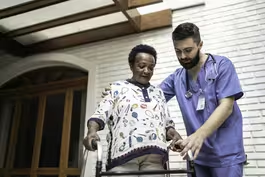
Gene study links Africans to higher risk of Parkinson’s
Video has Closed Captions
Clip: 8/27/2023 | 6m 12s | Gene variant found linking people of African descent to higher Parkinson’s risk (6m 12s)

How climate change is disrupting the global food supply
Video has Closed Captions
Clip: 8/27/2023 | 6m 12s | How climate change is disrupting the global food supply (6m 12s)

Why sunscreen in the U.S. is behind the rest of the world
Video has Closed Captions
Clip: 8/27/2023 | 6m 8s | Why sunscreen in the United States is behind the rest of the world (6m 8s)
Providing Support for PBS.org
Learn Moreabout PBS online sponsorship
- News and Public Affairs

FRONTLINE is investigative journalism that questions, explains and changes our world.

- News and Public Affairs

Amanpour and Company features conversations with leaders and decision makers.












Support for PBS provided by:
Major corporate funding for the PBS News Hour is provided by BDO, BNSF, Consumer Cellular, American Cruise Lines, and Raymond James. Funding for the PBS NewsHour Weekend is provided by...