
August 20, 2023 - PBS News Weekend full episode
8/20/2023 | 24m 8sVideo has Closed Captions
August 20, 2023 - PBS News Weekend full episode
Sunday on PBS News Weekend, a Ukrainian non-profit is helping the growing number of amputees injured in the war get fitted for artificial limbs. Then, with Spain's historic win in the Women's World Cup, we look at the progress and remaining challenges for women's soccer. Plus, travel writer Rick Steves shares his advice on navigating post-pandemic travel.
Problems playing video? | Closed Captioning Feedback
Problems playing video? | Closed Captioning Feedback
Major corporate funding for the PBS News Hour is provided by BDO, BNSF, Consumer Cellular, American Cruise Lines, and Raymond James. Funding for the PBS NewsHour Weekend is provided by...
Support provided by:

August 20, 2023 - PBS News Weekend full episode
8/20/2023 | 24m 8sVideo has Closed Captions
Sunday on PBS News Weekend, a Ukrainian non-profit is helping the growing number of amputees injured in the war get fitted for artificial limbs. Then, with Spain's historic win in the Women's World Cup, we look at the progress and remaining challenges for women's soccer. Plus, travel writer Rick Steves shares his advice on navigating post-pandemic travel.
Problems playing video? | Closed Captioning Feedback
How to Watch PBS News Hour
PBS News Hour is available to stream on pbs.org and the free PBS App, available on iPhone, Apple TV, Android TV, Android smartphones, Amazon Fire TV, Amazon Fire Tablet, Roku, Samsung Smart TV, and Vizio.
Providing Support for PBS.org
Learn Moreabout PBS online sponsorshipJOHN YANG: Tonight on PBS News Weekend, as the war in Ukraine leaves a growing number of people with amputations, a nonprofit is helping them get fitted with artificial limbs.
MAN: More than 30,000 people are waiting for prosthetics right now that means they have lost at least one limb.
So the situation is getting really bad day after day.
JOHN YANG: Then with Spain's historic victory in the Women's World Cup, we'll look at both the progress and the remaining challenges for women's soccer.
And as Americans head overseas and record numbers, Rick Steves advice on navigating post pandemic travel.
(BREAK) JOHN YANG: Good evening, I'm John Yang.
Tropical Storm Hilary made landfall this afternoon along Mexico's Baja Peninsula.
It may have lost its hurricane status, but forecasters warn it will still deliver potentially historic rainfall across the Southwest which could trigger life threatening flash floods.
By tomorrow morning, the fast moving storm is expected to be well inland over Nevada as a tropical depression.
But on its way there, forecasters say the storm could dump up to six inches of rain on parts of California, Nevada and Arizona and that could lead to mudslides and power outages.
Officials say the worst conditions are expected in the mountains east of Los Angeles.
KRISTIN CROWLEY, Chief, Los Angeles Fire Department: Rain is forecast to begin earlier than expected.
As you can see if you look outside, it's here.
The Antelope Valley in San Gabriel mountain areas outside of the city of Los Angeles are expected to see the largest impacts with three to seven inches of rain.
JOHN YANG: Los Angeles Mayor Karen Bass says the city has been reaching out to people without homes living in encampments along the city's river beds and other flood prone areas.
She says city shelters are available for residents without a home.
To the north in Washington State, another kind of climate disaster, three wildfires in the eastern part of the state have claimed a life and destroyed some 185 structures.
Officials say the largest of the blazes called the gray fire has charred about 10,000 acres west of Spokane and is totally uncontained.
Spokane County is under a state of emergency and thousands have been forced to evacuate.
The Netherlands and Denmark said today they'll supply us made F-16 fighter jets to Ukraine, United States that earlier approved the transfer.
Ukrainian president Volodymyr Zelenskyy has been asking for F-16s as he seeks an edge in the war with Russia.
The planes won't have an immediate effect.
Official said pilot training would begin this month and take at least six months to complete.
And Spain's women's soccer team won its first World Cup Championship today defeated England one to nothing.
A packed crowd in Sydney, Australia watch Spanish left back Olga Carmona score the game's only goal about midway through the first half.
This year's World Cup tournament set records for both attendance and TV viewers.
Still to come on PBS News Weekend, a look at the progress made in women's soccer and the challenges the sport still faces on the global stage.
And Rick Steves gives his well-traveled advice on being a post pandemic tourist.
(BREAK) JOHN YANG: The war in Ukraine has reached a grim milestone as many as 120,000 Ukrainians have been wounded and close to 70,000 killed.
As the conflict rages on, a critical need as emerge for some of those wounded on the front lines access to artificial limbs.
Nick Schifrin reports on a Ukrainian nonprofit that helps survivors move forward after a life changing injuries.
NICK SCHIFRIN: It is the largest land war the world has seen in 80 years and Russia has built an 800 mile long defensive line that includes massive fields of mines, some 20,000 to 50,000 Ukrainians have been seriously hurt and forced to amputate one or more limbs since the Russian full scale invasion last February.
That numbers surpasses levels not seen since World War I.
The Ukrainian group superhuman center is trying to answer the massive need for medical attention, offering reconstructive surgery and physical and psychological support to those who have lost limbs.
Andrey Stavnitser is the co-founder and joins me now.
How massive is this challenge and has it increased in the last few months as Ukraine has gone on the counter offensive through those Russian minefields.
ANDREY STAVNITSER, Co-Founder Superhumans Center: So just for your understanding, we have approximately the size of Austria, land plot size of Austria is filled with mines right now in Ukraine.
So even if the war stops today, it's going to take many months, if not years to demine it.
And we see civilians and military personnel stepping on those mines every day and about 30,000, more than 30,000 people are waiting for prosthetics right now, that means they have lost at least one limb.
So the situation is getting really bad day after day.
NICK SCHIFRIN: And you mentioned it's both civilians and soldiers for those soldiers.
Are you seeing a dramatic increase because of the nature of how the Russian defenses have been built?
And the fact that Ukrainian soldiers simply have to go through the minefield in order to get to the Russian forces that have occupied your land?
ANDREY STAVNITSER: Exactly.
So we are in the middle of the counter offensive.
And we're losing a lot of great guys.
And we're really, really waiting for the F-60s to back us up from the skies, and that hopefully is going to change the course of the war.
But meanwhile, what Superhumans is doing is we're trying to save as many victims of war so we don't distinguish between civilians or military or kids does matter for us.
And we try to provide them with the best prosthetic solutions there are.
We do it totally free of charge, thanks to our donors from all over the world, and especially from the US.
NICK SCHIFRIN: Russia has systematically targeted the Ukrainian health care system.
The organization Physicians for Human Rights now says 1,000 facilities have been targeted.
What are the barriers?
What are the challenges within the system already, that these victims who are losing limbs face.
ANDREY STAVNITSER: So the biggest issue was to create the ecosystem to bring the expertise into the country, the expertise of, you know, prosthetics, and it's not only prosthetics, it's also, you know, psychological, physiological rehabilitation, its production of prosthetics, installation and maintenance has to come as a package because, you know, these people they need complex, holistic solutions.
Our main goal is to put them back to work to make them able to perform in the office or whatever they would be doing before.
For example, we have a patient who is ice skating instructor.
So, we have produced and ice skating prosthetics so that he can go back to training kids, you know, we're doing figure skating.
NICK SCHIFRIN: Does that mean that every person who comes to you at least needs a tailor made prosthetic and how difficult is that?
ANDREY STAVNITSER: It is quite difficult, your prosthesis is point of contact for the rest of your life.
Because whenever you lose a little bit of weight, or you gain a bit of weight, or something happened to you, you have to come and adjust your prosthetic slightly starts causing trouble, it starts causing pain.
So you have to make sure that it's always fitting you in the best possible way.
So you can be verticalized and you can do sports, and you can be active, et cetera.
So it's a complex thing, and Ukraine never had it.
So we had to bring all this expertise.
We had to teach our doctors abroad and bring them in where to find us, U.K., German doctors, bring them into Ukraine so that they could train as many doctors in Ukraine who could then go and work across the country.
NICK SCHIFRIN: You currently have one facility in Lviv, the largest city in western Ukraine.
You're hoping to open five facilities in the next two years.
Are you concerned that the need for what you do is only going to increase as this war continues?
ANDREY STAVNITSER: We're trying to be ready for that.
And you know, I was -- before the war started I thought million dollars is a lot of money but right now I can see that a million dollars is only 50 patients for Superhumans.
Our biggest bottleneck right now is that we need more financing in order to bring help to more people.
We're obviously blessed with donors.
But this is not enough.
The amount of people that need help is much bigger than any of our current donors.
NICK SCHIFRIN: Andrey Stavnitser is the co-founder of the Superhuman Center.
Thank you very much.
ANDREY STAVNITSER: Thank you, Nick.
JOHN YANG: Five years ago, Spain's national women's soccer team didn't have jerseys designed for women, didn't have high quality training facilities and didn't have enough physical trainers.
Their rapid rise to today's World Cup championship and what the team went through to achieve it symbolizes both the sports worldwide progress and the challenges it still faces.
Meg Linehan is a senior writer for The Athletic.
She covers the U.S. Women's National Team, and the U.S.
Pro Women's Soccer League.
Meg, this is a team coming into the World Cup, we heard stories about the Spanish team, team members were talking to each other.
They weren't talking to the coach.
This is a team that had never won a knockout round game before in any official tournament.
Talk a little bit about what they achieved here what they did today.
MEG LINEHAN, The Athletic: Yeah, first time World Cup winners, right.
I mean you dethronging the U.S., Germany, all of these massive teams and to go through this tournament in Australia, New Zealand also to survive a for nothing defeat at the hands of Spain in the group stage.
So massive accomplishment for Spain, and they've had success too on the youth level as well.
So we're seeing this kind of growth across the game in Spain, but obviously to win the Women's World Cup, a massive accomplishment to win it against a team like England who had just won last summer Euro competition as well, again, just like a major, major win for this program moving forward and something for them to use as just a massive platform of growth moving forward as well.
JOHN YANG: Talk about what this coming out of the World Cup, what the future current state and the future of women's soccer around the world looks like not just at the national team level, but also sort of going down the ladder.
MEG LINEHAN: You know, we've seen this World Cup has shown how investment immediately make the difference in just the not the growth of the game, but just the level of play.
Vlatko Andonovski, who essentially lost his job because of the US's performance of this World Cup said multiple times, the rankings don't matter of this World Cup.
We saw just an incredible level of play an incredible level of competition, where debutantes were hanging with major teams.
So we've talked for so long about the gap between the U.S. and some of other top programs and the teams coming up and building still and the gap is basically closed at this point.
But what I think is interesting is that this has shown that having a strong domestic league is a key to international success, that having the investment in grassroots levels in the youth levels, especially we've seen a team like Spain, but also England, right, both of these teams reaching the final.
They have seen such success at the youth national team levels in Youth World Cup, and we're seeing it pay off at the senior national tournament.
JOHN YANG: These were also two teams today that have struggled off the field for equity with the men's, men's players in their in their countries.
And this is obviously something that the U.S. team has been pushing for a long time.
In a way is that a legacy of the U.S. team as they exited early, and they're no longer the dominant player.
But have they helped this issue?
MEG LINEHAN: Yeah, I think we saw that, you know, Sweden knocks U.S. out and then immediately turns around and says that you have to put some respect on this team for what they have done not just on the field right and the respect that we have for them as players but for everything that they've fought for.
But it's the same thing, you know, this fight I think it's boiled down in very simple kind of online friendly terms of equal pay, but it goes so much more beyond the payment the salaries, even equal prize money for a World Cup.
It goes into equal working conditions, it goes into how our bonuses structure, it goes into do you have enough physical trainers, medical staff, are you actually equipped to play at the highest level the way that a men's national team is?
We saw this with Canada too.
They don't start really thinking about this until Janine Becky goes to cover the men's world up and sees what their men's national team has comes back to the Canada Women's National Team and says why don't we have these things?
So it is, it's a much bigger fight than just this equal pay fight.
But the U.S. women's national team really did I think set the stage in terms of saying yes equal pay obviously has to be on the table, equal prize money.
But it is all of these working conditions, travel conditions, hotels, physios, all of these things, hugely, hugely make a difference to our performance as a team and what we can accomplish.
JOHN YANG: On this question of equity at the end of last week, the FIFA president Gianni Infantino, first of all he called equal pay a slogan that he said that really doesn't matter, according to him.
And he also told the women players pick the right battles.
You have the power to convince us men what we have to do.
What do you make of that?
MEG LINEHAN: I mean, it is pure Gianni Infantino.
He has said multiple things along these lines of just keep acts as if the doors are open for female footballers in this space.
And what we have seen from this World Cup is that so many teams are fighting their federations.
So many teams are worried that payments that FIFA has promised for these players are not actually going to reach these pockets.
So there is no just magical opening of a door unlike what he is promising.
There are still multiple systemic battles that have to happen in order for this game to be respected.
But what we're seeing is that even when teams are fighting their federations they can win a World Cup.
Even when teams are fighting their federations they can accomplish things.
And even when every single systemic barrier is put into place, the women's game explodes in popularity and investment.
So, it's happening with or without him, but hopefully he gets on the right side of thing.
JOHN YANG: Meg Linehan, senior writer of The Athletic.
Thank you very much.
MEG LINEHAN: Thank you.
JOHN YANG: A lot of pent up wanderlust is being released after three years of pandemic restrictions.
Americans are crossing the Atlantic in record numbers, jamming hotels and popular tourist sites.
A lot of them no doubt are armed with a Rick Steves guidebook or advice from one of Steve's columns, newsletters, or long running series on Public Radio, and PBS.
Rick Steves.
Thanks so much for joining us.
I understand you just got back from Iceland and Poland.
With any differences pre pandemic and post pandemic?
RICK STEVES, Travel Guide: You know, I've spent a couple of months in Europe so far this year, ranging from Spain to Estonia to Iceland.
And the big issue is the crowds.
This sort of a feeling of revenge travel, they're calling it, everybody wants to get back there and do the trips that were canceled.
And Europe has learned how to moderate the crowds by having people book admissions to museums.
Europe did not waste time during the pandemic.
There's a lot of impressive new infrastructure, new museums, new libraries, new creative restaurants, it's pretty exciting time to be there.
JOHN YANG: I know your guides urge people to get off the beaten path to do things that not many tourists do, but do things that the locals do.
Are you still finding new things as you after all these years?
RICK STEVES: My whole idea is to go over there and hit and miss and miss and hit and miss and bring home the hits, to make mistakes and learn from my mistakes.
Take careful notes so people can learn from my mistakes rather than your own and travel more smoothly.
I've done in the last couple of years venerable long distance trails in the Alps.
I've done barge tours in Burgundy.
I've learned the joy of second cities in Europe, everybody goes to the first cities why not try Leone or Marseille after Paris?
Why not go to Porto instead of Lisbon?
You're going to go to Edinburgh, be sure to check out Glasgow.
Yes, go to Dublin.
But don't miss Belfast.
It's these Rust Belt industrial cities that used to be ignored that are now edgy, and I think really rewarding and they get you away from all the crowds.
JOHN YANG: How do you approach a new place when you first encountered it?
RICK STEVES: I tried to be as confused as a typical tourist would be.
I've been going there all my life first timers not going to know what ends up.
And then I realized that, you know, your time - - your money is a limited resource, but so is your time.
And that means remembering a taxi ride can be a good economic choice considering what you and your travel partner's time is worth.
That means do a smart itinerary recognizing that you know, you don't want to have redundancy.
You don't want to see Oxford and Cambridge do one or other of the great university towns and make time for something entirely different like the castles in northern Wales.
I think it's really, really constructive for us to get out there.
Get to know the world find out that there's more than one right way to do things and the world is filled with beautiful people and a lot of love and a lot of joy.
And you come home them with I think the most beautiful souvenir and that's a broader perspective.
JOHN YANG: During the pandemic there was a lot have that sort of tunnel vision focusing on things right in front of us.
How has that changed Americans attitude toward travel?
RICK STEVES: The challenge for us these days is to get away from our screen.
You know, I was filming in Venice, recently, and we were trying to find two levers on a gondola going under the bridges size, there is no lovers going under the bridges size, they're all taken selfies, you know.
And as a tour guide, I have to really remind my travelers be in the moment.
That's a big challenge for us.
And another big challenge is, don't be sheep going where everybody's going.
I mean, these days, it's crowd sourced, you know, you got a lot of people who've never been to Paris telling you where the best hot chocolate is, you know, you can let that design your itinerary.
But really, it's important for us not to have that Instagram mentality where you got to stand on the same pier and get the same frame.
So you can prove to your friends that you're having a great time, go over there and carve your own path.
If you've got Irish heritage, that's where you should go.
If you love Wagner, and opera music, you can go to the Wagner festival.
If you love Italian food, you can go to Italy, if you love World War II history, you can go to Normandy.
It's just for me, so exciting to be able to go over there and sort through all the options cut through all the superlatives and find out ways that we can travel smartly.
JOHN YANG: And you mentioned Instagram, there's so many people talking about travel on Instagram, on YouTube channels influencers, who may be getting a lot of freebies from the things they're talking about.
How has that changed how people learn about travel?
How has that changed what you do?
RICK STEVES: In the future, I think there's going to be two kinds of travelers, those who consume information smartly and those who take information that comes at you for with an agenda.
You got to know how to travel like a temporary local, you got to know when you walk down the main street, the damn rack in Amsterdam, you're going to see a place that looks like a tourist information center, but it's actually a box office selling commercial ventures.
There's no and Frank, there's no Dutch East India Company, there is no Rembrandt in that box office.
There's just a bunch of gimmicks that want your time and your money on your vacation.
You know, what you need to do is equip yourself with good information, expect your toast itself to travel smart, and you will.
A good example is lines, the green thoughtless, unprepared traveler spends a lot of time needlessly in lines.
And for me, that's a big agenda.
If I encounter a line when I'm researching for my guidebooks, I find a way around that line.
I find a way to coach my travelers to be able to enjoy that site without wasting two hours trying to get into it.
JOHN YANG: Rick Steves helping people travel smart.
Thank you very much.
RICK STEVES: Hey, thank you, John, and happy travels.
JOHN YANG: And that is PBS News Weekend for this Sunday.
On Monday, a controversial new California law that allows courts to enforce care plans on people with mental illness.
I'm John Yang.
For all of my colleagues, thanks for joining us.
Have a good week.

Travel writer Rick Steves' advice on post-pandemic travel
Video has Closed Captions
Travel writer Rick Steves shares advice on navigating post-pandemic travel (5m 52s)
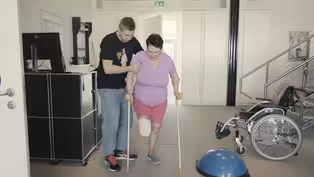
Ukrainian nonprofit helps amputees get artificial limbs
Video has Closed Captions
Ukrainian nonprofit helps amputees get artificial limbs (5m 38s)

What Spain’s win means for the future of women’s soccer
Video has Closed Captions
With Spain’s historic win, a look at the progress and challenges facing women’s soccer (6m 21s)
Providing Support for PBS.org
Learn Moreabout PBS online sponsorship
- News and Public Affairs

FRONTLINE is investigative journalism that questions, explains and changes our world.

- News and Public Affairs

Amanpour and Company features conversations with leaders and decision makers.












Support for PBS provided by:
Major corporate funding for the PBS News Hour is provided by BDO, BNSF, Consumer Cellular, American Cruise Lines, and Raymond James. Funding for the PBS NewsHour Weekend is provided by...