
April 23, 2026 - PBS News Hour full episode
4/23/2026 | 57m 46sVideo has Closed Captions
April 23, 2026 - PBS News Hour full episode
Thursday on the News Hour, tensions rise in the Strait of Hormuz as Iran seizes ships and President Trump orders attacks on vessels laying mines. The federal government reclassifies marijuana, changing the way it's regulated and researched. Plus, we report from Uganda on the Trump administration's conditions for foreign aid and the potentially drastic impacts on disease prevention.
Problems playing video? | Closed Captioning Feedback
Problems playing video? | Closed Captioning Feedback
Major corporate funding for the PBS News Hour is provided by BDO, BNSF, Consumer Cellular, American Cruise Lines, and Raymond James. Funding for the PBS NewsHour Weekend is provided by...
April 23, 2026 - PBS News Hour full episode
4/23/2026 | 57m 46sVideo has Closed Captions
Thursday on the News Hour, tensions rise in the Strait of Hormuz as Iran seizes ships and President Trump orders attacks on vessels laying mines. The federal government reclassifies marijuana, changing the way it's regulated and researched. Plus, we report from Uganda on the Trump administration's conditions for foreign aid and the potentially drastic impacts on disease prevention.
Problems playing video? | Closed Captioning Feedback
How to Watch PBS News Hour
PBS News Hour is available to stream on pbs.org and the free PBS App, available on iPhone, Apple TV, Android TV, Android smartphones, Amazon Fire TV, Amazon Fire Tablet, Roku, Samsung Smart TV, LG TV, and Vizio.
Providing Support for PBS.org
Learn Moreabout PBS online sponsorshipGEOFF BENNETT: Good evening.
I'm Geoff Bennett.
AMNA NAWAZ: And I'm Amna Nawaz.
On the "NewsHour" tonight: Tensions rise in the Strait of Hormuz, as Iran seizes ships and President Trump threatens to attack vessels laying mines.
GEOFF BENNETT: The federal government reclassifies marijuana as a less dangerous drug, changing the way it's regulated and researched.
AMNA NAWAZ: And we report from Uganda on the Trump administration's conditions for foreign aid and the potential impacts on disease prevention.
DR.
ELIZABETH BUKUSI, Kenya Medical Research Institute: It's about protecting them from HIV, protecting them from unplanned or unwanted pregnancies, but also other sexually transmitted infections.
(BREAK) AMNA NAWAZ: Welcome to the "News Hour."
President Trump announced late today that the cease-fire between Israel and Lebanon will be extended by three weeks.
GEOFF BENNETT: That cease-fire covers fighting between Israel and Hezbollah, the Iran-backed militant group based in Lebanon.
Separately, Mr.
Trump told reporters earlier he was in no rush to reach a deal with Iran after his latest cease-fire extension.
Our Stephanie Sy begins our coverage.
STEPHANIE SY: Just two days after President Trump extended his two week cease-fire with Iran, the prospect of talks is giving way to more tensions and brinksmanship from both sides at sea.
Iranian state TV broadcast this highly produced video complete with drone footage and a soundtrack purportedly showing the country's Revolutionary Guard taking control of two vessels yesterday in the Strait of Hormuz.
MAN: Motor vessel Majestic X, we intend to conduct the boarding of your vessel.
STEPHANIE SY: The Pentagon released its own footage of U.S.
forces on the deck of an oil tanker today in the Indian Ocean, a ship accused of smuggling Iranian oil.
And President Trump posted to social media that he had ordered the United States Navy to shoot and kill any boat that threatens the strait by laying underwater mines or otherwise without hesitation.
Speaking to reporters today, the president said he's in no rush to set a deadline on his latest cease-fire extension.
He said that was to allow Iran time to sort out what he characterized as its fractured leadership.
DONALD TRUMP, President of the United States: They're not doing well economically, financially.
They're not doing any business because of the blockade.
They want to make a deal.
We have been speaking to them, but they don't even know who's leading the country.
They're in turmoil.
They're in turmoil.
So we thought we'd give them a little chance to get some of their turmoil resolved.
STEPHANIE SY: When asked, the president also backed off any threat to use a nuclear weapon against Iran.
DONALD TRUMP: Why would I use a nuclear weapon when we have totally, in a very conventional way, decimated them without it?
No, I wouldn't use it.
A nuclear weapon should never be allowed to be used by anybody.
STEPHANIE SY: The escalating standoff in the street has led to another uptick in gas prices, and crude oil is back over a $100 a barrel.
DONALD TRUMP: And I'm told this is a rather historic meeting.
STEPHANIE SY: Meanwhile, a second round of high-stakes talks between Israeli and Lebanese diplomats took place at the White House today.
President Trump insisted on meeting them personally.
He then announced a three week extension of the cease-fire.
But Israel and Iran-backed Hezbollah have already accused the other of breaking the truce up to this point.
In Southern Lebanon today, thousands of mourners marched in the streets alongside the coffin of journalist Amal Khalil, her press helmet placed on top.
"Death for Israel," her pallbearers shouted.
Lebanese officials and the paper she worked for said an Israeli airstrike yesterday killed her as she took cover inside a house.
Israel's military says they will review the incident.
Thousands of miles away, in Pakistan's capital, Islamabad, banners still flutter in the breeze, teasing another round of talks between Washington and Tehran that have lately shown no signs of moving forward.
For the "PBS News Hour," I'm Stephanie Sy.
GEOFF BENNETT: The Israeli military said it intercepted rocket fire that crossed into Northern Israel from Lebanon today.
Hezbollah said the attack was in retaliation for Israel violating the 10-day cease-fire that took effect last week, an extension to which President Trump announced earlier.
Now, earlier this week, we brought you an exclusive interview with the senior Hezbollah leader, who rejected Israel's demand to disarm.
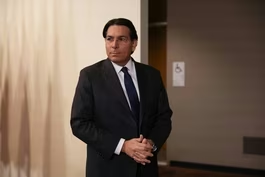
Tonight, we're joined by Israel's Ambassador to the U.N.
Danny Danon.
Mr.
Ambassador, welcome to the program.
DANNY DANON, Israeli Ambassador to the United States: Thank you for having me, Geoff.
GEOFF BENNETT: So, President Trump, as you know, a short time ago announced a three-week extension of the cease-fire between Israel and Lebanon, specifically Hezbollah.
As we sit here and speak, details are few.
What more can you tell us?
DANNY DANON: First, we welcome the direct talks between Israel and Lebanon.
We have the same goal.
We all want to get rid of Hezbollah.
We want to see sovereign Lebanon controlling the territory of Lebanon.
And, as we speak, we see that Hezbollah is trying to create chaos, attack Israeli communities in the northern part of Israel, and again try to ignite another cycle of violence.
We will continue the talks with the Lebanese.
We are grateful for the U.S.
for their involvement, but we have to acknowledge that Hezbollah should not be a part of this equation.
They shouldn't be in Southern Lebanon.
They shouldn't be part of the Lebanese government.
They are the one who's sowing chaos in the region.
GEOFF BENNETT: When the president says the U.S.
will help Lebanon protect itself from Hezbollah, what does that look like in practice beyond what's already being done?
DANNY DANON: Well, we all acknowledge the weakness of the Lebanese government.
We welcome the statements coming from Beirut about kicking out the ambassador of Iran, but he's still there, about gaining control over Southern Lebanon, but it is not the case.
Hezbollah is still there.
So there's a huge gap, Geoff, between the declarations and the abilities or the actions of the Lebanese government.
And I think the U.S.
and other country that want to help Lebanon should help them actually have control over the situation, that they can actually mobilize the military and be effective.
If they are not controlling the military, they will not be able to change much.
GEOFF BENNETT: A question about Israel's military action.
I want to play video from April 8, when Israeli forces struck more than 150 locations simultaneously across Lebanon, killing more than 300 people, wounding more than 1,000 others.
When Israel targets Hezbollah in dense urban areas, as was the case here, how does it determine what level of civilian casualties is considered acceptable?
DANNY DANON: So, first, we try to minimize civilian casualties, period, unlike Hezbollah, who did exactly the opposite.
They target communities.
We actually gave notice to many communities to evacuate Southern Lebanon, and many people left Southern Lebanon.
And we are -- we welcome that, because it allows us to attack Hezbollah without risking civilians, and we will continue to do our best to minimize civilian casualties.
But we have also to admit, Geoff, that Hezbollah is hiding behind civilians.
They are hiding behind U.N.
facilities.
They're launching rockets from those places, and we have the right to defend ourselves.
So we will continue to do that.
We will continue to fight terrorist organizations.
We saw it also in Gaza in the past with Hamas.
They're trying to use civilians as human shields, but we will do our best to minimize civilian casualties.
GEOFF BENNETT: And, to your point, we know that Hezbollah does indeed embed itself in civilian areas.
So, how many civilian deaths per Hezbollah target is acceptable?
Is it five?
Is it 10?
Is it 300?
Or is there no ceiling at all?
DANNY DANON: Well, without going into the numbers, but I will tell you that, before each attack, we have a legal team that actually looks at the intelligence we have and then reach the decision regarding the attack.
So we don't just attack.
There's a process in the IDF.
And I think we are the most moral military in the world, if you compare our actions to other militaries that engage in the past with terrorist organizations.
It's not easy for us.
And as I said earlier, we want to have peace with the Lebanese people.
We pray for that day.
When I was a child, we used to call the fence between Israel and Lebanon, we call it the good fence because they were good neighbors.
But, unfortunately, a lot changed since that day.
And, today, we have to deal with Hezbollah that is trying to hijack Lebanon.
GEOFF BENNETT: The Lebanese journalist Amal Khalil was killed yesterday in an Israeli strike.
Lebanon's prime minister responded by saying that Israel's targeting of journalists -- and this is a quote -- "is no longer isolated incidents, but has become an established approach."
The Committee to Protect Journalists has documented a pattern of journalists killed by Israeli strikes.
What military objective is served by killing reporters?
DANNY DANON: Well, I beg to differ about your question.
It's biased.
With all due respect, we are not targeting reporters, period.
Unfortunately, if you have reporters who are next to Hezbollah terrorists or Hezbollah bunkers or Hezbollah launchers, those incidents happen, and we regret that.
But to accuse Israel that we target reporters, that's a blood libel.
You know, what are we actually implying, that we gather intelligence... GEOFF BENNETT: Excuse me.
Excuse me.
I... DANNY DANON: ... that you gather intelligence... GEOFF BENNETT: I take issue.
I take issue.
I take issue with that, sir.
DANNY DANON: ... and we actually want to kill reporters, and not to kill terrorists of Hezbollah?
GEOFF BENNETT: You say that Israel does not target journalists.
Amal Khalil is dead.
CPJ has documented a growing pattern of targeted Israeli attacks in Lebanon, where 15 journalists and media workers have been killed by Israel since the October 7 attacks.
Your government continues to state that Israel does not target journalists.
But my question is simple.
At what number of dead journalists does that answer become one that the international community can no longer accept?
DANNY DANON: Geoff, it's outrageous.
When you say we target journalists, you imply that we have the intention to kill journalists, and that's a lie.
You should ask the other questions.
Where were those journalists during the time of the attack?
Where they were spending their time?
Maybe they were next to Hezbollah terrorists, and that's why they were in line of fire, unfortunately.
GEOFF BENNETT: Do you know that to be true?
Do you know that to be true?
(CROSSTALK) DANNY DANON: I will tell you one thing.
GEOFF BENNETT: Do you know that to be true, sir?
DANNY DANON: We will focus our efforts... GEOFF BENNETT: I take that as a no.
DANNY DANON: ... our abilities, our intelligence, targeting Hezbollah terrorists, period.
We are not doing it against civilians and for sure not against reporters.
GEOFF BENNETT: Danny Danon, thank you for your time this evening.
We appreciate it.
DANNY DANON: Thank you, Geoff.
AMNA NAWAZ: We start the day's other headlines in Georgia, where hundreds of people have fled their homes and more than 80 homes have now been destroyed as raging wildfires continue to threaten areas in the south of the state.
WOMAN: My house is gone.
AMNA NAWAZ: Today, distraught residents returned to their properties reduced to ash and ember.
Georgia's biggest blaze broke out over the weekend, and, at last check, it was only 10 percent contained.
Officials say that dry, windy conditions are to blame, but also fallen tree limbs still scattered from Hurricane Helene, which devastated the area more than a year-and-a-half ago.
SETH HAWKINS, Spokesperson, Georgia Forestry Commission: What we're finding out here, what's driving this somewhat is, there's just ton of old Hurricane Helene debris down in the woods, right?
It's just some of it's laying around, and it's just a tinderbox out there.
So we're definitely seeing some of those flare-ups.
AMNA NAWAZ: Hundreds of fires have also spread this week in neighboring Florida.
Officials have called it the state's worst fire season in decades.
Warner Bros.
shareholders voted today to approve the company's $81 billion sale to Paramount.
It's a major step in a deal that could dramatically reshape Hollywood and the broader media landscape.
The combined company would bring the likes of CNN, HBO Max, and Harry Potter under the same umbrella as CBS and the Paramount+ streaming service, but it still requires regulatory approval.
And critics, including some big names in Hollywood, have said the deal would lead to job losses and fewer options for filmmakers and moviegoers.
Overseas, the European Union formally approved a loan package for Ukraine today valued at more than $100 billion.
The much-needed funds were announced during a meeting in Cyprus attended by Ukrainian President Volodymyr Zelenskyy.
The loan comes as Russian oil began flowing again to Hungary and Slovakia through a pipeline in Ukraine that had been damaged during the fighting.
Hungary had previously blocked the loan.
The money will help Ukraine meet its economic and military needs for the next two years.
Without it, economists had warned the country would start running out of cash in June.
The U.S.
Senate took a pivotal first step toward funding ICE and Border Patrol and potentially finding a way to end the shutdown of the Department of Homeland Security in the coming weeks.
MAN: On this vote, the yeas are 50, the nays are 48, and the concurrent resolution, as amended, is agreed to.
AMNA NAWAZ: DHS as a whole remains unfunded, but the measure voted on early this morning would allow Republicans to get around a Democratic filibuster of ICE and Border Patrol.
It still has several more steps to go before it could take effect.
And it comes amid a push by Democrats for policy changes to the agency after two protesters were killed by federal agents earlier this year.
In the meantime, Republicans accused Democrats of wanting to defund crucial immigration operations.
SEN.
JOHN THUNE (R-SD): To prevent Democrats from deciding that they want to defund law enforcement again in September, we're going to fund these critical functions for the next three years.
AMNA NAWAZ: Republicans hold a slim majority in the House, so even a few objections within the party could derail the budget plan.
DHS has been shut since mid-February, making this the longest partial government shutdown in U.S.
history.
Round one of the NFL draft kicks off in Pittsburgh tonight, with the city expecting hundreds of thousands of visitors for the three-day event.
Officials are advising residents to use public transportation, instead of driving, to avoid the crowds, and city schools have moved to remote learning.
Authorities pledged a -- quote -- "significant law enforcement presence," both on the main draft campus and around the city.
The NFL draft has become a blockbuster event in its own right, as top prospects hope to hear their name called to join one of the NFL's 32 teams.
Meta is cutting 10 percent of its work force, or about 8,000 jobs, as the company pushes deeper into A.I.
The owner of Facebook and Instagram is just the latest tech firm to announce layoffs as part of a broader effort to embrace the possibilities of A.I.
Separately, Microsoft is reportedly planning to offer voluntary buyouts to thousands of U.S.
employees.
It's the first time the software giant has ever offered buyouts to employees as it looks to cut costs.
In the meantime, on Wall Street, stocks fell following the latest spike in oil prices.
The Dow Jones industrial average lost nearly 200 points on the day.
The Nasdaq handed back more than 200 points, or nearly 1 percent.
The S&P 500 fell back from its latest all-time high.
And conductor and composer Michael Tilson Thomas has died.
Born and raised in California, Tilson Thomas was a gifted pianist from a young age.
He later committed himself to conducting and led orchestras in Buffalo, Miami, London, and eventually San Francisco, where he stayed for 25 years.
Tilson Thomas told the "American Masters" program that a conductor's job is to -- quote -- "get 100 or so people to agree where now really is."
He was also a devoted teacher of classical music in the tradition of Leonard Bernstein.
In 2015, Tilson Thomas explained the importance of mentorship to the "News Hour"s Jeffrey Brown.
MICHAEL TILSON THOMAS, Conductor and Composer: It's essential for me, this sense of contact with a new brilliant spirit of another generation with whom I feel so much in common.
JEFFREY BROWN: But why is it essential?
MICHAEL TILSON THOMAS: Because it reminds me too of the relationship I had with mentors of mine who were 50 years older than I. My major piano teacher was a pupil of a guy called Moriz Rosenthal, who had been a pupil of Liszt, who was a pupil of Czerny, who was a pupil of Beethoven.
AMNA NAWAZ: Among his recognitions, a staggering 12 Grammy Awards, the National Medal of the Arts presented by then-President Barack Obama, and a Kennedy Center Honor in 2019.
His publicist said Tilson Thomas died at his home after years of battling an aggressive form of brain cancer.
Michael Tilson Thomas was 81 years old.
Still to come on the "News Hour": the State Department proposes sending Afghans who helped the U.S.
war effort to Congo; a DACA recipient speaks out about her deportation and return to the U.S.
; and an art exhibit shines a light on the lesser known persecution of Romani people during the Holocaust.
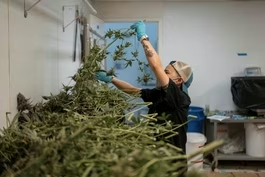
GEOFF BENNETT: The federal government is reclassifying medical marijuana, categorizing it as a drug with potential medical benefits and less potential for harm.
While this doesn't legalize marijuana nationally, it does open the door to further research into its effects.
Our William Brangham has been covering this and joins us now.
So, William, this is a move that President Trump tried to enact via executive order last year and is now being pushed by the Justice Department.
What are the practical implications of this reclassification?
WILLIAM BRANGHAM: The biggest implication is what you mentioned, Geoff, which is research into marijuana.
By moving marijuana -- and they're -- moved state-level medical marijuana from this category, Schedule I, where hard drugs were classified, down to Schedule III, which is drugs that have medical benefits like Tylenol with codeine.
That will allow greater research to be done.
In fact, acting Attorney General Todd Blanche wrote as much today.
He wrote: "These actions will enable more targeted rigorous research into marijuana's safety and efficacy, expanding patients' access to treatments, and empowering doctors to make better-informed health care decisions."
I mean, researchers had always been able to research marijuana, but there was an enormous thicket of bureaucracy to get through.
This will make it a lot easier.
This will also create quite a financial windfall for the companies that produce the recreational marijuana products that are sold all over the country.
This change in status allows them to deduct a lot of their expenses off their taxes, and so that's why some critics have called this move a giveaway to big pot.
GEOFF BENNETT: And is that who wanted this shift to happen, to have the federal government more overtly say that marijuana isn't such a dangerous drug?
WILLIAM BRANGHAM: I mean, yes, in part those companies wanted that, because, as you mentioned, this is still illegal on the federal basis, but there's 40-something states where medical marijuana and recreational marijuana is flowing out of stores all over the place.
But, also, drug policy reformers have wanted this.
As you said, they have argued for a long time that marijuana has been unfairly demonized, that it is not the same as heroin or cocaine, and we shouldn't call it that.
They argue that there was a whole generation of people who were arrested and incarcerated for simple possession, often minority communities.
And they say that this is high time that we move away from that.
GEOFF BENNETT: So, if this doesn't legalize marijuana, is it likely to change the national landscape, where different states have different systems of licensing and selling it?
WILLIAM BRANGHAM: Not really.
I mean, there will be an FDA hearing later this year to try to reclassify all marijuana, recreational and medical, but those states will still continue to operate as they are doing right now.
The hope is, is that better research will help us understand this massive rolling experiment that we are doing, which is basically all these different states are slow-rolling a legalization of marijuana across the country.
Marijuana use is up.
There were polls in recent years showing that more people are smoking marijuana than cigarettes.
And with this classification, while it says that marijuana is not as harmful, that is not to say that marijuana does not have serious problems.
People can have real substance use disorders with it.
There's increasing evidence that heavy chronic use, especially among young people, can be very detrimental to their brains and their emotional and mental development.
And so the idea is, let's study this a little bit more.
Let's make better policy decisions for this big experiment we're doing.
GEOFF BENNETT: William Brangham.
William, our thanks to you, as always.
WILLIAM BRANGHAM: Thanks, Geoff.
AMNA NAWAZ: Since the dismantling of the U.S.
Agency for International Development, or USAID, the Trump administration has been revamping aid policies, focusing on smaller, narrowly focused deals with recipient governments.
They will be required to finance part and it's hoped eventually entire programs now receiving American assistance.
In his second report, Fred de Sam Lazaro reports from Kenya and Uganda, two nations that have signed agreements under the new America First Global Health Strategy.
FRED DE SAM LAZARO: On a recent afternoon in this Nairobi public health center, Everylyn Minayo was girding herself for a dose of perhaps the most significant drug developed so far against HIV.
Minayo is considered at high risk for the virus, but on lenacapavir, she will be protected.
Lenacapavir is not the first HIV prevention drug.
There have been daily oral medications, for example, but this one is called a game changer because it's just one dose taken every six months and has been found nearly 100 percent effective in preventing HIV infection.
Lenacapavir is also the first drug made accessible in low-income countries soon after its release in rich nations.
It was approved just last June by the Food and Drug Administration in the U.S., where it is sold under the brand name Yeztugo.
The list price in America is $14,000 per dose, but under an agreement with the U.S.
government, its maker, California-based Gilead Sciences, is making lenacapavir available for two million people at -- quote -- "no profit," targeting patients in several nations that the U.S.
has approached with a new model for health care assistance.
EVERYLYN MINAYO, Lenacapavir Recipient (through translator): Sometimes, I forget to take the pills, so this gives me some reassurance that I won't get infected.
FRED DE SAM LAZARO: Everylyn Minayo, who struggles on meager earnings selling secondhand clothes, is one of the earliest beneficiaries.
EVERYLYN MINAYO: (through translator): I sometimes visit the clubs to see if I can get a client who can supplement what I earn by having sex with a man for payment.
FRED DE SAM LAZARO: The rollout here of lenacapavir is part of a new America first policy that, among other goals, aims to promote and showcase American products.
It will be added to drugs that treat HIV, which the U.S.'
PEPFAR program, aside from a brief interruption last year, has provided for years to some 20 million people worldwide.
WILLIAM RUTO, Kenyan President: I express profound gratitude to the United States.
FRED DE SAM LAZARO: Kenya's agreement signed in the presence of its president late last year will see the U.S.
provide $1.6 billion over five years.
The Kenyan government pledged to chip in $850 million.
Diseases like HIV, T.B.
and malaria are targeted particularly among young women.
And Kenya will share data, pathogens and biological samples with U.S.
experts for disease, surveillance and emergency preparedness.
WILLIAM RUTO: I assure you that every shilling and every dollar will be spent efficiently, effectively and accountably.
(APPLAUSE) FRED DE SAM LAZARO: Secretary of State Marco Rubio said the new approach works directly with governments and cuts out international agencies and nongovernment groups that contracted extensively to implement programs under USAID.
MARCO RUBIO, U.S.
Secretary of State: Bottom line is, if you want to help a country, work with that country, because that money is not just going to be spent to provide medicine and care.
It's going to be spent to improve the domestic infrastructure, health care infrastructure.
FRED DE SAM LAZARO: As part of that, Gilead Sciences has agreed to allow six generic drugmakers to make and sell lenacapavir in 120 low- and middle-income countries.
Some estimates predict a potential cost as low as $20 per dose.
However, the low-cost generics cannot be sold in several middle-income countries like Mexico, Brazil and Argentina, even though they have high HIV rates.
So this is where lenacapavir will be produced?
Ajay Kumar Pal is CEO of QCIL, a generics maker based in Uganda, which also signed an aid agreement with the U.S.
He says the deal helps not just his company, but the continent.
AJAY KUMAR PAL, CEO, Quality Chemical Industries Limited: It brings sustainability of access, because, if you look at access in the continent, it's mostly externally funded.
Africa even today imports more than 75 percent of its treatment from outside.
FRED DE SAM LAZARO: In about 3.5 years, he says, up to 11 million doses could be produced here targeting East African nations.
As for demand and pricing, he says, it's too early to predict.
AJAY KUMAR PAL: It depends upon the interest of people and how much advocacy happens about it and how the market accepts it, because, again, it's not a private product.
FRED DE SAM LAZARO: That is, governments will have to buy most of the product and promote it to generate public demand.
It's just one of several concerns that experts have for the new aid agreements.
DR.
KENNETH NGURE, Jomo Kenyatta University: If you don't get the product to people's hands or into people's bodies, then it's not helpful.
And we have seen that with a number of products.
FRED DE SAM LAZARO: Drs.
Kenneth Ngure and Elizabeth Bukusi are leading HIV scholars in Kenya.
DR.
ELIZABETH BUKUSI, Kenya Medical Research Institute: I think we have heard commitments in the past and there has been attempts to do it, but it doesn't -- the funding doesn't always follow through in the same way.
FRED DE SAM LAZARO: African governments burdened by debt and other compelling demands are often hard-pressed to fulfill commitments, she says.
And the new agreements also emphasize U.S.
priority, she adds.
And, right now, those do not include family planning services for the young women targeted for lenacapavir.
DR.
ELIZABETH BUKUSI: They fear getting pregnant even more than they fear getting HIV.
We do need to find products that do more than one thing.
It's about protecting them from HIV, protecting them from unplanned or unwanted pregnancies, but also other sexually transmitted infections.
FRED DE SAM LAZARO: In fact, Dr.
Ngure was working on a research project to combine HIV prevention drugs with contraceptives.
DR.
KENNETH NGURE: You have injectable contraceptives like Depo-Provera, and sort of work towards a mechanism where they can combine these drugs in a single injection.
FRED DE SAM LAZARO: His research into the idea ended abruptly last year, he says, along with its chief funder, USAID.
PETER WAISWA, Makerere School of Public Health: The U.S.
government has made clear America first, and I think there is no -- they have that right.
FRED DE SAM LAZARO: Dr.
Peter Waiswa is a public health scholar at Uganda's Makerere University.
Given its deep pockets, he says, America will always have the upper hand.
And he's concerned about what he calls strings attached to the U.S.
assistance.
PETER WAISWA: The only right we have is our data and the samples.
FRED DE SAM LAZARO: For example, he says African nations will be required to quickly detect outbreaks and send pathogens, data and biological samples to the United States.
PETER WAISWA: Once the samples have been exported to the U.S., who knows what is going to happen?
FRED DE SAM LAZARO: In fact, some countries have resisted, citing unfair terms, with Zambia drawing the ire of the Trump administration, which reportedly demanded a share of its mineral ores as a condition for receiving HIV assistance.
PETER WAISWA: We need to be looking at these pathogens as actually of economic potential.
FRED DE SAM LAZARO: Potential that he says could be realized if aid agreements included training to analyze data in Africa and build a biomedical industry here.
He sees a historic pattern being repeated.
Africa exports raw materials, but derives little benefit from products made from them.
PETER WAISWA: The biological samples can be a basis for making vaccines, making medicine, doing gene therapy and more.
And this is the future of science.
NARRATOR: One office visit every six months.
FRED DE SAM LAZARO: Lenacapavir is blockbuster profitable for its maker and touted as an American innovation, Waiswa says, but crucial clinical trials in its development were conducted across Africa, including here at Makerere University.
For the "PBS News Hour," I'm Fred de Sam Lazaro in Kampala, Uganda.
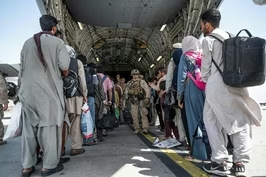
AMNA NAWAZ: Hundreds of Afghans who helped the United States' war effort in Afghanistan and who are detained now in Qatar may soon be sent back to Afghanistan or to the Democratic Republic of the Congo by the U.S.
State Department.
However, the DRC is in the midst of its own deep humanitarian crisis, with millions displaced by war and now seeking refuge outside their country.
The push to send the more than 1,000 Afghans elsewhere comes after President Trump halted the Afghan resettlement program more than a year ago.
That program offered help to Afghans who faced threats after they aided the Americans during the 20-year war.
For perspective on this and what could come next, we turn now to Shawn VanDiver, a Navy veteran and president of AfghanEvac, an organization which aids in resettlement efforts.
Shawn, welcome back to the show.
I know you briefed members of Congress on this potential plan a short while ago.
What did you say to them and what was their reaction about this plan?
SHAWN VANDIVER, Founder and President, AfghanEvac: Well, thank you so much for having me on today.
I talked to staff from -- a bipartisan, bicameral group of staff from all the relevant committees to this, and people were pretty shocked.
People are shocked, one, that folks are being sent -- or that the State Department is planning, even considering sending these folks who stood beside us and who believed in the idea of America to a war zone, to the Democratic Republic of Congo.
They were shocked that these folks are still stuck there and haven't been able to make it to the United States, in particular because the camp is 42 percent children, and there's 150-plus family members of active duty military.
And I'm happy to say that we got a lot of interest in running a bill or two that would help Afghans both here at home and abroad in Camp As Sayliyah to get to safety.
AMNA NAWAZ: Camp As Sayliyah, we should point out, is in Qatar, where they have been currently held now for many, many months.
I do want to put to you, part of what the Trump administration says here is their concern.
They say that some people in the resettlement program were not thoroughly vetted.
That's part of the reasoning for this potential plan.
What do you say to those concerns?
SHAWN VANDIVER: I would invite people within the Trump administration to go to AfghanEvac/Vetting to see how much extraordinary vetting happened.
In fact, the Biden administration didn't lessen the vetting standards.
They didn't reduce the vetting standards.
They kept President Trump's enhanced vetting, a big thing from his first administration.
And, in fact, they built on it.
They leveraged A.I.
They leveraged all sorts of classified tools.
They built out a pre-travel vetting effort to make sure that everybody who came through the Enduring Welcome pipeline, which ended up being the safest, most secure, legal immigration pathway in history, they made sure that everybody who even left Afghanistan was already vetted and medically screened before they even got to Qatar, the Philippines, Germany or Albania for even more vetting.
And I just say that they're either lying or they're poorly informed.
And I have suspicions as to which it is.
AMNA NAWAZ: The more than 1,000 people or so who are currently waiting include interpreters, folks who helped the U.S.
war effort over those 20 years, as you mentioned, their families.
Tell us about the conditions that they have been living in.
And if you're in touch with them, what are they telling you as all this plays out?
SHAWN VANDIVER: Oh, goodness.
Well, look, I'm in touch with them every day.
I'm in a big group chat with a lot of these folks and their family members and another group chat with the active duty military service members whose families are stuck there.
And to a person, one, they're pissed off that the government is even considering sending them anywhere but the United States of America.
Number two, the kids are very worried, right?
We're seeing a lot of advocacy from the youth, from the 14-to-25-year-old age range.
And we're seeing them be very powerful voices.
We're also seeing a lot of folks that have been there for a while losing hope.
People are devastated.
The people that are in the military are losing a lot of faith in their country.
But Afghans still believe in the idea of America.
They still want -- know that the American dream is real and they want to get here.
And so we're hoping that, by shining some light on this heinous plan, that we can get them here to safety, those that are able to clear.
There are a few folks at the camp who cannot clear.
And that's who the State Department should be focused on helping get somewhere else.
AMNA NAWAZ: If these families were to return to Afghanistan, what would await them there?
SHAWN VANDIVER: Well, certain death for many.
There are women who served in the military and fought the Taliban, fought our war for us.
There's a lot of people who the Taliban would like to have retribution against.
And, look, it's not as though the Taliban is sitting at the airport with a folding table and some chairs and a green visor checking resumes and exactly how long they worked for us.
No, now that they have been at this camp for years, they have a relationship with the United States, even more so than before.
So it's going to be a lot harder for them to hide.
And, frankly, it's a violation of the promise of America that is squarely on the shoulders of President Trump, Stephen Miller and Marco Rubio.
AMNA NAWAZ: Shawn, can I just ask you to take a step back here?
You yourself are a veteran.
You have made this advocacy your life's work over the last several years.
You're in close contact with a lot of these families.
If this plan ends up going through, and I should ask you if you think it is inevitable, what does that say to you about the U.S., the place it holds?
And what are the other options for these families?
SHAWN VANDIVER: Thank you for asking that.
The message that this is sending is that the U.S.'
promises are temporary and conditional and dependent on who is sitting behind the Resolute Desk.
And that just cannot be.
You're right.
I have made this my life's work.
I have given up a career.
I have given up a lot.
But, look, it is so important.
This is -- Afghanistan was not my war.
I didn't serve in it.
But this is my fight because it's a fight about the very promise and idea of America.
And we have got to make sure that, when people with flags on their shoulders are making promises downrange, that those are checks that can be cashed by the people who are believing us.
I'm irritated.
I don't think that this is going to go through.
I think that this work is going to thwart their plan.
And we're going to keep working every day to get in the way every time that they try to cause harm to vulnerable people.
And if folks want to learn more, they can go to AfghanEvac.org/donate if you want to support our efforts.
We're really grateful you're covering this.
AMNA NAWAZ: That is Shawn VanDiver, president of AfghanEvac, joining us tonight.
Shawn, thank you.
Good to speak with you.
SHAWN VANDIVER: Thank you so much.
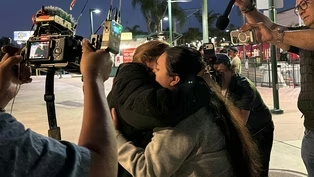
AMNA NAWAZ: Well, in addition to clamping down on the number of immigrants being let into the U.S., the Department of Homeland Security says it deported more than 675,000 people in the first year of Trump's second term.
Although the administration claims to be targeting violent criminals, others continue to be caught up in the crackdown, including some who are protected from deportation.
Liz Landers spoke recently with one woman who was detained, deported, and then allowed to come back into the United States.
LIZ LANDERS: Maria de Jesus Estrada Juarez entered the United States at 15 years old and has lived in the U.S.
for 27 years.
She was a recipient of a deferred action program established under President Obama that protects certain undocumented individuals from deportation if they came to the U.S.
as children and do not have a criminal record.
Maria was on her way to citizenship with a family petition through her U.S.
citizen daughter, but, on February 18, she was detained at her green card appointment and deported to Mexico within 24 hours.
A judge ruled her deportation was illegal and ordered her return on March 23.
She joins us now from her home in California.
Maria, thank you for joining us this afternoon.
MARIA DE JESUS ESTRADA JUAREZ, Detained and Deported by ICE: You're welcome.
Thank you for having me.
LIZ LANDERS: So, like many others, you were arrested by ICE at a normal USCIS appointment that you were at trying to get your green card through your U.S.
citizen daughter.
Can you describe what happened that day?
MARIA DE JESUS ESTRADA JUAREZ: We showed up to the appointment at USCIS at Sacramento.
We walk into the office.
We had my interview.
At the end of my interview, the agent, the interview agent asked -- told me that he needed to speak to his supervisor.
And sooner than I know, they knocked on the door and I got arrested.
And I was told that I was being detained and I was going to get deported back to Mexico.
LIZ LANDERS: Did they handcuff you?
Were they polite?
How did they treat you during that moment?
MARIA DE JESUS ESTRADA JUAREZ: They did handcuff me.
They handcuffed me in front of my daughter.
Never felt so humiliated in my life, being treated as the criminal that I'm not.
I don't think nobody should ever be treated that way, especially when you're not doing anything wrong.
That is one of the topics that really gets to me.
Officers, agents, they were referring to us that we're picking this, like we're not human beings, that we're things, that we're items, we're numbers.
That is something that I think is going to take a lot of time to heal.
LIZ LANDERS: What was that moment like when you realized you were going to be separated from your daughter?
MARIA DE JESUS ESTRADA JUAREZ: My daughter, to me, is everything.
She is who keeps me going every day.
I am the head of household for her.
So, knowing the fact that I am her go-to for any -- any situations that she encounter, that is really -- that was really not a pleasant moment.
It was very devastating.
It was really hopeless, and knowing that my daughter was going to be struggling now trying to even survive at that point, you know?
LIZ LANDERS: You had active DACA status and no criminal record.
We reached out to the Department of Homeland Security for a statement.
And the spokesperson said -- quote -- "DACA does not confer any form of legal status in this country.
Any illegal alien who is a DACA recipient may be subject to arrest and deportation for a number of reasons, including if they have committed a crime."
How do you respond to that?
And why do you think you were deported?
MARIA DE JESUS ESTRADA JUAREZ: I know that the Deferred Action, DACA, it protects people that were brought into the country when they were children for deportation.
That's what the DACA program was created for.
LIZ LANDERS: You remained in Mexico for more than a month.
What was that time period like?
MARIA DE JESUS ESTRADA JUAREZ: There was moments that I feel like I couldn't breathe.
I feel like I was losing my strength.
But just thinking that my daughter was fighting for me and doing everything that she could for me to come back home gave me hope and kept me going.
LIZ LANDERS: That judge ruled that your deportation was illegal and ordered your return to the United States.
What was your reaction when you heard that news?
MARIA DE JESUS ESTRADA JUAREZ: I was excited.
I was happy.
Everything paid off, my daughter's sacrifice, my daughter's hard work.
I feel like justice was made and that coming home was relief.
LIZ LANDERS: You are a rare case of someone who was deported, but then told that you were wrongfully deported and then ordered back.
Can you explain the final order of removal that you apparently had back in the '90s that you didn't know about?
It seems like that is the reason why you were able to come back, because that was not formally signed.
Can you sort of explain what happened there?
MARIA DE JESUS ESTRADA JUAREZ: In order for the final removal orders, they have to be signed by a supervisor, which my final removal didn't have that signature, for what my understanding is.
And that's the reason why it was -- it was one of the discrepancies that there were in my case.
LIZ LANDERS: You are now back together with your daughter.
Is life getting back to normal?
MARIA DE JESUS ESTRADA JUAREZ: Definitely not.
That is something that I don't think it's going to happen for a minute.
I'm going to say there's a lot of trauma after.
There's a lot of insecurity, especially from my daughter.
She's afraid of her mom being taken away.
I think it's going to take some time to trust the system again, because I always trust the system.
I always followed the system.
I always wanted to make sure I do things the right way.
Somehow, it ended up being to -- not as I expected.
But I think that's going to be part of the healing process to trust again.
LIZ LANDERS: What does being an American mean to you?
MARIA DE JESUS ESTRADA JUAREZ: This is my home.
I have been in this country for 27 years.
I went to school, I worked, I built my community here.
So it means everything, especially cause my daughter's here.
My daughter's here.
And my life is my daughter, and she calls the U.S.
home, so that's my home too.
LIZ LANDERS: Maria, thank you for sharing your story.
I appreciate it.
MARIA DE JESUS ESTRADA JUAREZ: Thank you very much.
Thank you guys.
GEOFF BENNETT: It is a lesser known chapter of the Holocaust, the murder of some 500,000 Roma and Sinti people, members of a long marginalized and often persecuted minority in Europe.
One way into that history is through the work of an artist who survived it herself.
Jeffrey Brown reports now for our Art in Action series, which explores the intersection of art and democracy as part of our Canvas coverage.
JEFFREY BROWN: Auschwitz 1944, ravens and smoke in a dark sky, a tattooed forearm floating in space, the letter Z for the German word for gypsy used as a derogatory term, the works and actual serial number of Ceija Stojka, who survived the camps as a young girl and many decades later, in her 50s, turned to art as a way to remember the horror, honor her fellow Romani people, and warn the world of continuing threats of right-wing nationalism.
Stojka died in 2013 at age 79, a writer, artist and activist who, says Rutgers professor Ethel Brooks, herself of Romani heritage and chair of the European Roma Rights Center, became a hero to many in her community and beyond.
ETHEL BROOKS, Rutgers University: She was there to say, no, we are -- we have this history and we have each other.
We have beauty and we have art and we have stories that should be shared with each other and with the world.
It's just -- it's everything.
JEFFREY BROWN: Ceija Stojka: Making Visible at The Drawing Center, a museum in New York, is the first major U.S.
exhibition on the artist, with more than 60 paintings and drawings made between 1992 and 2011, not documentary in style, but acts of memory and imagination based on her own experiences and stories she was told.
Stojka was self-taught, often working at her kitchen table in Vienna.
But, says exhibition curator Lynne Cooke, she developed a sophisticated style of contemporary art-making.
LYNNE COOKE, Curator, Ceija Stojka: Making Visible: She restlessly experimented with processes and materials and invented new vocabularies to get at the same set of questions over and over again, and that's very rare in my experience for someone who hasn't had formal academic training.
But she had an aptitude for it certainly and she had an inquiring -- an inquiring mind, a great deal of visual sophistication and a real purpose.
JEFFREY BROWN: That purpose, to tell the stories of her people and advocate on their behalf.
Documentary films by Karin Berger showing at the exhibition capture Stojka's personality and drive to bring Romani history and culture, including music, to a larger public.
She did it first through writing, including a 1988 memoir, "We Live in Secrecy," next through art, some of it recalling a prewar life, as in this untitled painting from 1995.
ETHEL BROOKS: This idea of a Romani encampment and of making home wherever you are in the world is something that is really central to who we are and what we do, because so often home has been denied to Romani people because of the ways in which we have been treated by the majority society.
JEFFREY BROWN: And then the end of that life, when the Nazis rounded up Romani people and brought them by trains to the concentration camps, Dachau, where Stojka's father was first taken.
He, one of Stojka's brothers and nearly 200 members of her extended family, were killed.
Stojka, her mother and four of her siblings barely survived.
LYNNE COOKE: One of the most powerful paintings I think is an early one, where she's mapped the central space in the Ravensbruck forced labor camp for women.
And you see the barracks to the side and this large zone where roll call of thousands of women took place every day, several times a day sometimes, where they were made to stand for hours in freezing cold weather.
And it's the way she's painted the ground and the kind of liquidity and the kind of the cold palette that speak very effectively to our emotions.
JEFFREY BROWN: They Devoured Us, she titled this 1995 watercolor, referencing a Romani term for the Holocaust, the Devouring.
She portrayed what she called the beautiful women of Auschwitz and later made abstract blotch-like images with ink on paper, including one titled The Destitution, the Suffering, I Feel It Still.
In fact, Stojka was also speaking very directly to new developments she feared in the 1980s and beyond, the election of Kurt Waldheim as president of Austria, despite revelations of his Nazi past, the rise in far right nationalism, including anti-Roma rhetoric in Austria and elsewhere in Europe.
Stojka painted works such as this titled Victory to Our Fuhrer.
ETHEL BROOKS: When we talk about Holocaust denial, there was never -- there was a denial.
There were no Roma who were invited to testify at Nuremberg, for example, right?
There was no - - no one was asking Romani people, what was your experience in the war?
Because it was seen as something that wasn't important.
And that was becoming kind of a larger issue for Roma, but also the kind of racism and nationalism that was resurgent in Europe was something that she was watching very carefully and speaking out against.
JEFFREY BROWN: Today, that resurgence continues, even grows in many places.
In the works of Ceija Stojka, says curator Lynne Cooke, viewers can experience the thrill of discovery of an artist they might never have previously encountered and also a warning that what has happened could once again.
LYNNE COOKE: For many people, the Holocaust and the Second World War are so distanced as to be a very little part of their sense of history.
And I think that Stojka's work can very eloquently speak to the audiences of many kinds, including those who really don't know about that earlier history and, through that history, make us more vigilant and make us more aware.
JEFFREY BROWN: Ceija Stojka herself put it more bluntly, saying: "Auschwitz is only sleeping."
For the "PBS News Hour," I'm Geoff Bennett at The Drawing Center in New York.
GEOFF BENNETT: And that's the "News Hour" for tonight.
I'm Geoff Bennett.
AMNA NAWAZ: And I'm Amna Nawaz.
On behalf of the entire "News Hour" team, thank you for joining us.

‘America First’ policy reshapes how U.S. delivers health aid
Video has Closed Captions
‘America First’ aid policy reshapes how U.S. delivers global health assistance (8m 42s)
DACA recipient deported then returned to U.S.
Video has Closed Captions
'This is my home,' says DACA recipient deported then returned to U.S. (7m 24s)

Exhibit shines light on Romani persecution during Holocaust
Video has Closed Captions
Art exhibition shines light on Romani persecution during Holocaust (7m 9s)
Israeli UN ambassador: IDF most moral military in the world
Video has Closed Captions
Israel's UN ambassador says IDF is 'most moral military in the world' (7m 24s)

News Wrap: Wildfires threaten homes in southern Georgia
Video has Closed Captions
News Wrap: Wildfires threaten homes in southern Georgia (6m 44s)
U.S. could send Afghans who helped its war effort to Congo
Video has Closed Captions
State Department proposes sending Afghans who helped U.S. war effort to Congo (6m 43s)
What marijuana's reclassification means for health, business
Video has Closed Captions
What marijuana’s reclassification means for public health and businesses (4m 4s)
Providing Support for PBS.org
Learn Moreabout PBS online sponsorship
- News and Public Affairs

Today's top journalists discuss Washington's current political events and public affairs.

- News and Public Affairs

FRONTLINE is investigative journalism that questions, explains and changes our world.












Support for PBS provided by:
Major corporate funding for the PBS News Hour is provided by BDO, BNSF, Consumer Cellular, American Cruise Lines, and Raymond James. Funding for the PBS NewsHour Weekend is provided by...