
A Monument to Memory and More
Season 17 Episode 3 | 27m 8sVideo has Audio Description
Unearthing the world’s largest time capsule, music finds a new home in an unexpected place, & more.
Unearthing the world’s largest time capsule, music finds a new home in an unexpected place, and Nebraska’s most stunning architectural treasure. Discover the incredible story behind the World’s Largest Time Capsule in Seward, Nebraska, musician Rascal Martinez is building something extraordinary in Sutherland, Nebraska, and the Nebraska State Capitol building tells Nebraska's history.
See all videos with Audio DescriptionADProblems playing video? | Closed Captioning Feedback
Problems playing video? | Closed Captioning Feedback
Nebraska Stories is a local public television program presented by Nebraska Public Media
A Monument to Memory and More
Season 17 Episode 3 | 27m 8sVideo has Audio Description
Unearthing the world’s largest time capsule, music finds a new home in an unexpected place, and Nebraska’s most stunning architectural treasure. Discover the incredible story behind the World’s Largest Time Capsule in Seward, Nebraska, musician Rascal Martinez is building something extraordinary in Sutherland, Nebraska, and the Nebraska State Capitol building tells Nebraska's history.
See all videos with Audio DescriptionADProblems playing video? | Closed Captioning Feedback
How to Watch Nebraska Stories
Nebraska Stories is available to stream on pbs.org and the free PBS App, available on iPhone, Apple TV, Android TV, Android smartphones, Amazon Fire TV, Amazon Fire Tablet, Roku, Samsung Smart TV, and Vizio.
Do you have a Nebraska Story?
Do you have a story that you think should be told on Nebraska Stories? Send an email with your story idea, your name, your city and an email address and/or phone number to nebraskastories@nebraskapublicmedia.org. Or, click the link below and submit your information on nebraskastories.org.Providing Support for PBS.org
Learn Moreabout PBS online sponsorship(upbeat music) -[Narrator] Coming up on Nebraska Stories, unearthing the world's largest time capsule.
(upbeat music) Music finds a new home in an unexpected place (upbeat music) and a firsthand view of Nebraska's most stunning architectural treasure.
(upbeat music) -[HarroldÑ All I can tell you is kind of, an eerie feeling, (gentle music) being under five feet of dirt, surrounded by a lot of concrete.
(gentle music) First of all, this capsule is, 20 foot by 10 foot by 6 foot.
(gentle music) And it's built out of one foot concrete walls.
And, I'm surrounded by four cement walls and a cement lid, plus a multitude of memorabilia the year 1975.
Why did I build it?
I started out with the idea of a two foot time capsule, two foot square, and it kind of grew on me and I thought, well, why not go for the world's largest.
And in the Guinness Book of Records, Come September this one will be listed as the world's largest.
(gentle music) -[Trish] My God, he's nuts.
I don't want any part of this.
I don't know where he came up with this idea and why isn't somebody shutting him down?
That was my first memory.
(gentle music) Being entrusted with this time capsule is a super, super heavy responsibility.
(gentle music) Through the years, when I saw people stop at the capsule, I'd go out and give them a bit of the history of it.
So I felt obligated to share that story as much as I could with anybody who took the interest to come.
(gentle music) And it was it was tough.
It was it was a huge responsibility.
But at the same time, I did enjoy it.
I enjoy it more now than I did then.
-[Narrator] Trish Davisson Johnson has followed in her father's footsteps in Seward, Nebraska, first in taking the reins of a business, then as caretaker of the world's largest time capsule.
(shuffling sounds) -[Trish] As my father aged, he became concerned that his grandchildren would not remember him.
He loved Seward.
He loved Seward in 1975.
He wanted a way to preserve Seward in 1975 for his children, grandchildren and great grandchildren, to remember what it was like.
The community was really excited.
They weren't really sure what this would mean.
He didn't have any concept of this being the biggest in the world.
He just wanted it to be big enough that it wouldn't get lost.
He spent most of his time just calling people, trying to find an expert in how to do this, and what it would take to make a concrete bunker strong enough to last.
(whimsical music) And all of the experts said if he had eight inches of concrete for the walls, that would be plenty.
So of course they made him 12in.
They talked about how much rebar was needed and Dad doubled that also.
The bunker is ten feet deep, 12ft deep, something like that.
And the lid of the bunker is actually below ground level.
Everything was done truly, truly, almost subterranean.
(whimsical music) -[Narrator] The capsule included clothing, pop, letters from the community, a motorcycle and one yellow Chevy Vega.
(whimsical music) -[Trish] A lot of the people thought, here goes Davisson again.
In terms of building a time capsule in 1953.
He had taken the Seward High School basketball team by bus to Seward, Alaska, to play basketball.
So he had done a lot of unusual things in his life.
And this was just going to be added to the list.
(whimsical music) My dad started out in this (whimsical music) era of poverty.
He was born in 1907, in Seward.
When my dad was a child and he knew that there wasn't enough money for food, he would scrounge alleys for things he could sell.
He was always looking not for the money.
Wasn't the money.
It was what the money could do (whimsical music) that made the difference for him.
Because he was.
He was always investing in the next big idea, whether it was building the bowling alley, whether it was building the apartment building.
He had a Harrold Davisson farm supply, which became House of Davisson.
(whimsical music) -[Amy] The House of Davisson was an institution in Seward.
When I graduated from high school in 1972, when my parents went up to the house of Davisson to buy me a lane Cedar hope chest.
That I still have, actually.
So House of Davisson, absolutely an institution.
Part of everyone's life.
(whimsical music) -[Trish] My dad loved being born in a small town.
My dad loved being born specifically, in Seward.
He wanted to do what he could to further the town.
And he always said, in 50 years, people are not going to remember Budd Davisson.
They're going to remember Seward as the home of the world's largest time capsule.
(whimsical music) -[Narrator] As the nation geared up to celebrate the bicentennial signing of the Declaration of Independence.
The underground tomb was sealed on July 4th, 1975.
Davisson's grand vision was cemented in history.
(whimsical music) Before long, the tomb would be added on to in a race for the world's largest.
(whimsical music) -[Trish] After two years in the Guinness Book of Records, Oglethorpe University stepped up and said, we have a crypt of Civilization as a time capsule and it is bigger than that.
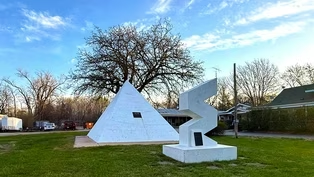
And I know that was in his head when he added the pyramid, that it again made bigger without a question.
(whimsical music) I think that dad wanted the largest time capsule in the world, because it would become a part of Seward's legacy.
Seward's lore.
And I think 50 years sounded so improbable that it would be there forever.
(whimsical music) It's a full time job that I really didn't mind until about two years ago, when I started thinking about how to open this and what it would involve.
I feel the weight of the world.
(gentle music) -[man] That's nice.
- You see my hands shaking?
(gentle music) I can feel 50 years of planning to go up in a minute, or it'd be a huge success.
And I consider this to be a huge success.
This is the culmination of his dream.
I'm hopeful those letters will be what people expected and give them the joy that they wanted.
And I am so excited to celebrate a Chevy Vega, and I never thought I'd say that in my life.
(gentle music) -[NarratorÑ Just like 50 years before, the time capsule now opened, was heralded by a grand ceremony featuring hundreds that waited to view the site and the contents sealed underground for half a century.
(gentle music) -[Jon] I think it's just an amazing testament to the builders and to Harrold Davisson on how well everything was preserved and how well it was built.
I believe it's kind of been a connection with the past for everybody.
For me, it's kind of been I knew my parents put a letter in there to us kids.
So it was, you know, at the time thinking, golly, I have to wait so long to see what it was.
But it got here before.
You know, it.
-[Amy] I guess our parents put their heads together and, decided they needed to put a packet in the time capsule.
Only my sister Anne remember that they talked about doing that.
And, she was convinced that there was something waiting for us when the time capsule was opened.
And so I went to speak with one of the women who was helping Trish sort through things.
I told her our name, and she typed on her computer and said, no, there's nothing here for you.
(gentle music) I still feel like it was a voice speaking to me.
(gentle music) That said, ask about Jones National Bank and there was.
And, I felt very much like it was (gentle music) some kind of a voice on the wind.
It was in bad shape.
But there was a crack.
In the envelope.
And the one line I could see said, oh, how we wish we could be there.
When you read this.
And again, it felt very much like (gentle music) they were speaking to us.
(gentle music) -[Anne] Paper is one of the scariest things you can work with because it is so fragile, but yet contained so many important moments in the history of human beings, as well as the history of your family.
-[Narrator] The task of repairing the letter fell to Amy's sister Anne an expert in art history and preservation.
Anne's work is methodical in restoring these treasures.
(gentle music) -[Anne] Going back and actually starting, having the opportunity to and starting to restore things that were actually created by my parents own hands, so to speak.
(gentle music) It meant a lot to be able to do that.
(gentle music) You know, our parents were spending their time putting together this envelope of material, knowing that as soon as it went into the time capsule, (gentle music) by the time we saw it, they were going to be here.
(gentle music) And that's pretty moving.
-[Amy] I can't read it without being moved to tears.
"How we wish you could be with you as you read this, years hence.
But the good Lord has decreed we must go when he calls.
(sniffling) We've worked hard.
But has been.
But it has been a good life with loved ones."
(gentle music) -[Trish] You've got to write those memories down, because they won't know what you were thinking when you saw them.
They won't know what you thought when they started kindergarten, or what you thought when they came out looking terrified and you thought, yeah, I didn't prepare you for this did I You need those memories down so that they can, at some point relate to what your life was like in, let's say, 2025, (gentle music) because it's pretty great.
And we want them to know that.
(gentle music) -[Anne] The impact of the time capsule in Seward.
(gentle music) Just this (gentle music) bit of material takes me back.
Decade after decade after decade after decade, and being able to piece together.
(gentle music) Our lives currently and how all of those experiences shaped who we are and what we're doing today.
I think that, everyone should be aware of how important time is.
All of this.
Is a very important way to reconnect with other people, other places, other times, and to think.
About where we all fall into this (gentle music) timeline.
-[Amy] When I think about Harrold Davisson coming up with this idea, I mean.
He didn't know anything about building a time capsule.
But you had this kind of crazy idea.
And, now I think how cool it was that?
In kind of a kind of a, you know, a crazy little visionary.
Preserving all these bits and pieces of Seward.
(gentle music) -[Trish] This is my father's legacy.
He left me something that is tangible that I can see.
I can touch.
I can imagine his emotions.
And you can't tell the story of the capsule without talking about Budd Davisson.
His story will be out there.
And this is his story.
And I am excited to share it with the world.
(somber western music) -[Narrator] Nestled in the high plains of Western Nebraska along the historic Lincoln Highway.
Sutherland is an unassuming town of 1200 that blends agricultural traditions with modern industry.
(somber western music) Main Street is a mix of practical needs and community charm.
(somber western music) -[Rascal] Nebraska nice, just a good spot.
(somber western music) Everybody's really friendly, good people.
(somber western music) A lot of hard workers around here too, so you get some real honest people.
(somber western music) -[Narrator] Musician, Rascal Martinez was born and raised in Sutherland with cattle, crops, an ethanol plant and a power station driving the local economy.
This might seem an unlikely place to forge a music career.
(guitar music) -[Rascal] For the last 10 years, I've been really busy performing all over.
Just been a full-time musician.
(guitar music) I play probably over 150 senior center shows like a year.
I've been doing that for like 10 years.
(somber music) Private events, a lot of corporate events, you know, backyard party type stuff.
I do a lot of weddings.
(somber music) I was down in Tennessee for a long time, just back and forth writing and doing shows.
(somber music) California, New York and Chicago.
(somber music) I almost moved to Tennessee but I was gone so much traveling all over.
I was like, why would I live here if I'm not gonna be here?
(somber music) So I moved back to Sutherland (somber music) -[Narrator] And that's when he found a new way to bring the music world to his tiny pocket of Nebraska.
-[Rascal] I was just looking kind of for an office space.
And then I saw this place was for sale.
So this is a, it was built in 1910.
It was an old bank farmer's bank back in the day.
I think it closed like somewhere in the seventies (crunching sounds) and it was vacant for a couple years.
-[Narrator] The character of the building is largely preserved from its original tin ceilings to the worn wooden floors that still bear the impressions of customers and tellers for more than a century ago.
-[Rascal] I came in here and right away I was just like, yikes.
I gotta have the place.
This is just like, just too good.
(somber music) (somber music) I've always wanted to make my own studio, have a place to rehearse or have bands come in.
I don't think people think they can do it in a small town, but with social media and all the things that we have now, just right at our fingertips, I mean, I think anything's possible with that.
(somber music) We record all the shows live and then I recording everything so that I can mix it all down and master it later.
(somber music) It's 1910, so you're, you know, this is not a brand new million dollar building that's, you know, you can't hear any noise.
You're gonna hear some stuff for sure, but I think that just gives it, it's just, it's so just is warm though.
(background chattering) -[Narrator] He calls it Stolen Vault records.
-[Rascal] We do a lot of bigger shows, but then there is something about a small audience of 20, 30 people where people are coming to listen to, you know what you have to say and it's just a different thing.
'cause you can kind of, you can be in the room.
♪ I don't Even know ya ♪ ♪ I don't even know your name.
♪ ♪ I don't even know ya anymore.
♪ (somber music) -[Rascal] We're bringing a lot of bands from all over.
A lot of, I mean, we got some Colorado bands, a lot of Nebraska bands coming in, a lot of solo artists.
(somber music) If you're coming from Denver and you gotta play a show in Omaha, I mean we're right smack in the middle.
You could do another show, just that small intimate show and you're just like, you're right there.
One-on-one, like with the artist.
♪ No one to turn to anymore ♪ (applause and cheering) -[Muriel] I don't care if it's an an A-list celebrity or a singer songwriter just starting out doing their own things.
This is an incredible way to experience their music.
- I love his passion and what he wants to do with this area and he wants to basically bring more musicians and more bigger musicians out here.
- He is putting us on the map for those big city musicians to come here and not only to perform but to record it is just amazing what this corner of Sutherland Nebraska is becoming.
(upbeat music) (upbeat music) (upbeat music) - Alright, everybody feeling alright?
Alright.
-[Narrator] In a world where success often means leaving small towns behind Martinez is proving that sometimes the best path forward is the road that leads back home.
(upbeat music) (upbeat music) -[Rascal] I've always loved Sutherland.
This is my home for sure.
Just to be on the spot where I grew up and bringing people to town they probably never even heard of is just.
Why wouldn't we do that?
You know, (upbeat music) (upbeat music) I like my life here and I like, you know, raising a family here and, and I can still travel and do everything I need to do, but I don't really need to be in the the big city to do that.
(upbeat music) (upbeat music) I've been an entrepreneur for a long, long time and you know, I just find my own way I'm doing things and then just I believe in what I'm doing.
I think that's a huge part.
(upbeat music) (upbeat music) (upbeat music) (upbeat music) (upbeat music) (crowd cheers and claps) -[Crowd] Woo.
-[Rascal] Thank you.
(applause) (gentle music) -[Narrator] It's a capital like no other.
(gentle music) -[Bob] Most state capitals are a variation of the federal capital in Washington.
And this building was the first to radically depart from copying that design prototype.
(gentle music) -[Narrator] It's a unique tower rising above the plains (gentle music) but far from plain.
Nebraska's capital is a masterpiece of art and architecture, (gentle music) and the spirit of everything Nebraska.
(gentle music) -[Gloria] Everything about this building tells a story.
The art on the walls, the floors, everything.
(gentle music) This is called the Spirit of Nebraska.
(gentle music) When you look at the artwork in the building, you're taken back into history.
And that history is of the Pioneers, the Indians.
(gentle music) You see, every race there is.
It's all in here.
And it's a mixture, just like the building itself.
The stone, Indiana limestone.
Marble coming from two different places around the world.
And you look at the wood is coming from different places around the world.
This is a building that is a mixture.
(gentle music) In the works and the art.
Everything.
It's a mixture.
-[Narrator]It was a new idea, built in a novel way.
(gentle music) A groundbreaking capital, timeless in design and function.
(gentle music) -[Bob] The iconography or the imagery.
Anything from carved inscription, (gentle music) lettering in the building or artwork appeared in the floor and ceiling mosaics, or the murals inside or out.
All of those items were carefully planned so that they tell a progression of the story of the development of Nebraska as a place, its natural and human history, and that's paralleled by the 3000 year evolution of democracy as a form of government.
(gentle music) -[Narrator] Nebraska's capital was planned by a gifted creative team led by visionary architect Bertram Goodhue, who drafted the towering Capitol design along with artist Lee Lawrie, who devised all sculptured features.
Muralist Hildreth Meiere, who crafted imaginative mosaics from floor to ceiling, and University of Nebraska philosopher Hartley Burr Alexander, who oversaw the inscriptions and themes for Goodhue designs.
(gentle music) Constructed from 1922 to 32.
The Capitol was crowned by an iconic figure of Plains life, witnessed by Lincoln Night, Barbara Day.
- The day that we came down to watch the Sower raised was pretty exciting.
There still was construction going on, and it was shipped out here and it opened freight car (gentle music) and he was big.
He's 17, 18ft high without the stand.
(gentle music) So we stood and watched while they fastened ropes and then slowly began to raise him up the side of the building.
(gentle music) So it was an exciting day to be there.
(gentle music) -[Narrator] Nebraska's capitol is a revolutionary design by a creative team that shared a single artistic vision.
(gentle music) If you plan a visit, take a tour and see how the capitals art and architecture reflect Nebraska as a place (gentle music) its people and the development of democracy.
(upbeat music) (upbeat music) - [Narrator] Watch more Nebraska stories on our website, Facebook and YouTube.
Nebraska Stories is funded in part by the Margaret and Martha Thomas Foundation, and the Bill Harris and Mary Sue Hormel Harris Fund for the presentation of cultural programming.
(upbeat music) (upbeat music) (upbeat music) (upbeat music)
Video has Audio Description
Clip: S17 Ep3 | 15m 21s | Unearthing the world’s largest time capsule.. (15m 21s)
Providing Support for PBS.org
Learn Moreabout PBS online sponsorship















Support for PBS provided by:
Nebraska Stories is a local public television program presented by Nebraska Public Media